Documenting my family's past for future generations. My family tree includes the Smith/Mansell families of Alabama and Oklahoma, the Castle/Day families of Kentucky and Oklahoma, the Wheat/Ming families of Texas and Oklahoma, and the Bell/Roberts families of Mississippi, Tennessee, and Oklahoma.

Monday, August 19, 2013

Where in the World Am I From?

I’ve been waiting a couple of months to upload my Family Finder results from Family Tree DNA to Gedmatch.  Gedmatch lets you compare DNA results from several companies, as well as offering you different tools to help you interpret your results.  Gedmatch exists on donations and has been down for a while upgrading its server to handle the ever-increasing numbers of DNA results uploaded by eager researchers, trying to understand what they mean.

It takes Gedmatch a few weeks to chart all your matches, but while you’re waiting, you can play with some of the tools.  You can match one-to-one with someone, as long as you know his/her kit number.  Since my brother’s Family Finder results have just come back, and I’ve uploaded them to Gedmatch, I could compare where we match on each chromosome.  That’s not so useful with my brother’s results since I already know how we’re related, but it does help me become familiar with how Gedmatch works so I can use the tools when my other matches come up.  I’ve got a couple of DNA gurus among my Huff cousins that I hope will teach me how to use all the tools, once they are all functional.

What’s really been fun is working with the Admixture (ethnic percentages) tools.  I’m not an anthropologist or a mathematician, but I’m guessing that the creators of the different admixture models are.  It’s really interesting to see how they differ with each other.  I’m guessing that the differences exist because the creators of the models compared against different populations or used different mathematical formulas to determine the percentages of ethnicity.  What’s fascinating is how closely they do match.

In every model, I’m at least 50% Northern/Northeastern/or Western European and from 26 to 30% Mediterranean.  The Mediterranean is sometimes further differentiated as Neolithic, which doesn’t surprise me, as my mitochondrial haplogroup, T2, came from northern Italy in the Neolithic period.  As most of my known ancestors can be traced back to England, Wales, Scotland, Ireland, or Germany, the North/Northeast/West Europe percentage does not surprise me either.  I was excited to see on most models that I am at least 1% Native American.  Combined with other Asian percentages, as Roberta Estes does in calculating Native American heritage, it is even more.  On one model it is broken down as .49% American, .53% Beringian, and .23% Siberian.


Ancestry.com also does its own "Genetic Ethnicity Summary."  Mine shows 44% Central European, 33% British Isles, 21% Scandinavian, and 2% Uncertain.  Again, not too surprising, except for the large percentage of Scandinavian.  This appears to be a flaw in the Ancestry.com formula for calculating ethnicity, as has been discussed online by Roberta Estes and other genetic genealogists.

In my next post I’ll talk about comparing my brother’s Family Finder results with mine and using FTDNA’s Chromosome Finder to pinpoint the chromosomes on which relatives with particular surnames may occur.  I hope when we are both fully up on Gedmatch, we will find even more to help us extend our family tree.  

Saturday, August 3, 2013

Will the Real Ancestor Please Stand Up?

Two years ago I gave my brother a DNA test for Christmas.  In my defense, 1) it wasn’t his only present, and 2) even though it seems like I bought a gift for myself, we really do have a mutual interest in finding out more about our Smith line.  I was born a Smith, and my brother is still a Smith, making him perfect for yDNA testing.  

I have always loved genetics.  I remember learning in school about Gregor Mendel, the monk who tracked the inherited traits of peas and became the father of the science of genetics.  I even liked doing Punnett squares, those little graphs that predict the traits of offspring of a particular set of parents.  When I became interested in genetic genealogy, I had to do homework again--about what tests are available and what they can tell you about your family tree.  The field of DNA testing has new developments all the time, and I’m still learning about testing and interpreting test results.

The first test I took myself was a mitochondrial (or mtDNA) test.   Mitochondrial DNA passes from mother to child, uncombined with the father’s DNA.  Only daughters can pass it on to their children, so what mtDNA does is trace your matrilineal line, your mother’s mother’s mother’s mother, back into the distant past.  Since a woman’s surname usually changes in each generation, it can be difficult to use mtDNA to find ancestors by name.  What you get instead are haplogroup matches—others who show the same mutations from the original mother of us all, who the geneticists call “mitochondrial Eve.”

My haplogroup is T, one of the 7 or 8 groups that are really common in Europe.  One of the first companies to test mitochondrial DNA for the general public was Oxford Ancestors.  You may have heard of its founder, Dr. Brian Sykes, because he wrote The Seven Daughters of Eve, in which he explains mtDNA testing and describes the seven clan mothers from ancient Europe who still have descendants today.  My clan mother is Tara, who lived about 17,000 years ago in northwest Italy.  (Geneticists look at how Tara’s ancestors dispersed and how many mutations have occurred in her line to help them estimate where her clan began and how long ago they lived.)  Really cool, but not especially useful in helping you fill out your family tree.

Back to my brother’s Christmas gift.  His paternal line consists of our father, Jack Francis Smith; his father, Weaver Harris Smith; his father, Stephen Albert Smith (for whom my brother is named); and his father, John A. Smith.  Yes, that’s right—John Smith.  That’s as far as we know, and all we know about John A. Smith is that he was born about 1805 in Virginia and died about 1850 in Pike County, Alabama.  We hoped that my brother’s yDNA test would help us differentiate our John Smith from the many others with the same name and lead us to his parents, grandparents, etc. 

While mtDNA traces the matrilineal line of both men and women through mitochondrial DNA, which both sexes have, yDNA traces a man’s patrilineal line, his father’s father’s father, etc. through the genetic information encoded in his Y-chromosome.  While a man can take an mtDNA test, a woman cannot take a yDNA test for the very important reason that she doesn’t have a Y-chromosome to test.   yDNA is a lot more useful for identifying ancestors because surnames remain the same from generation to generation. Hopefully, we would connect with another Smith (we joined a surname project called Smiths Worldwide) who matches my brother genetically, and maybe he knows who John A. Smith’s father was.  Mystery solved.

Except my brother’s closest yDNA matches—he matches one of them on every one of 37 markers—are three men named Banks.  What??  I assumed the worst—what genetic genealogists call a non-paternity event (NPE).  I figured that sometime, somewhere, a female married to a Smith was unfaithful with a Banks man, and the result of that union took the surname Smith.  I even looked for Banks families that lived near our Smith family in Pike County, Alabama, although I don’t know that that is where the alleged NPE took place.  (There actually was a Banks family in Pike County, but now what do I do with that information?  The family tree of that Banks family doesn’t match the family trees contributed by the Banks men who matched my brother on the yDNA test.)  So, there the results sit, on the Family Tree DNA site, just waiting for additional information that makes sense of them.

Until this week, when one of my Internet cousins suggested I read a blog by genetic genealogist, Roberta Estes, at www.dna-explained.com.  In fact, I have read the entire archive of her fascinating blog posts, but one post, “Surprise Y Matches—What Do They Mean?” has been especially helpful.  According to Roberta, there is more than one reason that one man might have matches with another man with a different surname, and this occurrence is not that uncommon.

The fact that my brother and Mr. Banks match at 37 markers means that they have a common ancestor at some point in the past.  However, it’s possible to test 67 and even 111 markers.  If my brother and Mr. Banks were to upgrade to more markers, some mutations might show up that suggest that their common ancestor is not recent but way further back in time.  Testing of other cousins might prove either line and show that what we are dealing with really is an NPE.  Roberta also suggested what I had already done—look for Banks families in proximity to our Smith families in locations where we know they lived.

Other reasons for the mismatch in surnames?  1) Someone just decided to change his last name.  (What better name to change to than Smith?)  2) A step-father raised a boy that took his name, rather than his biological father’s.  3) A boy took his mother’s maiden name, perhaps because he was illegitimate.  4) Someone was unfaithful.  And something I actually had not considered—that the NPE, for whatever reason, might have occurred on the Banks side, not the Smith side.  Before DNA, those circumstances might never have been suspected, and the answers would never be found.

The recent sale at Family Tree DNA ($99) has encouraged my brother to purchase the Family Finder test.  I’ve already had the FF test done but have yet to find any conclusive Smith or Banks cousins.  Family Finder finds matches through a third type of DNA—autosomal.  This is the DNA that most of us are familiar with from those Punnett squares, the kind that is contributed by both father and mother and combines in different ways to make each of us the unique person that we are.  

The test produces a lot of data that I am still learning to interpret, but Family Finder does a lot of the work for you by listing your DNA matches, typically cousins and their suggested relation to you—2nd-3rd Cousin, 4th Cousin, etc.  Our hope is that my brother’s test may give us some more options to trace our Smith line.  Because of the nature of autosomal DNA, my brother may have inherited more on our father’s side and will show up with more conclusive cousin matches that will give us some clues about the ancestry of John Smith (or, I suppose, prove that we aren’t related to him at all.)

Sunday, July 14, 2013

This and That

Just a few new things—None of them are big enough on their own to merit an entire post, but I’m pretty excited about all of them.

·         I found a new Roberts cousin on Family Tree DNA!  With all the confusion about the Huff and/or Pharris DNA and who may have been Elzina Huff’s parents, it was nice to have a definitive match with a Roberts relative.  In previous posts I wrote that I was pretty sure that Stephen Roberts had a brother Caleb, who in turn had a son James K. “Polk” Roberts.  Well, it has now been proved by DNA.

Polk Roberts moved to Hughes County, Oklahoma, near his Roberts cousins, Cornelia and James Nathan, and is buried in Holdenville.  His granddaughter, my DNA match on Family Tree DNA, lives in Texas and is my new Facebook friend.

·         I talked to the cousin that gave me much of the information that I have about the Huff and Roberts families.  We hadn’t talked in a few years, and she had lost track of me, so it was nice to reconnect.  She clarified a story that I had heard from my now-deceased Aunt Marie about one of the male relatives who had died in a wagon accident.  Aunt Marie thought it was Stephen Roberts, and I thought it might have been her paternal grandfather, Joe Wheat.  It turns out it was Mr. Spurlock, who was Cornelia Roberts’s first husband.  He died when his wagon ran over a rock and he was thrown out.  I’ve never been able to determine which Spurlock that my great-grandmother Cornelia married, but there were plenty to choose from in Jackson County.

·         I had an eerie experience when I thought one of my ancestors might have been calling from the grave.  My phone and TV are on the same system, so when I get a call, it shows up on my TV screen.  I heard the phone and looked up to see that I was getting a call from Elisha Mansell--who died in 1849.  The caller turned out to be the wife of a Mansell who is trying to trace his family tree, and her name is pronounced Alicia!

·         Ancestry.com has a new app for your phone called Shoebox.  It works just like the camera feature on your phone, only it scans photos and documents and sends them to the location of your choice on ancestry.com.  I have used the new app to scan both documents and old photos.  I was able to scan a photo that was in an album, then upload it and choose it as my grandfather’s primary photo with just a couple of clicks.

·         Have you watched Family Tree on HBO?  It’s filmed as a mock documentary, along the lines of Best in Show and Waiting for Guffman, with the same director (Christopher Guest) and actors (Michael McKean, Fred Willard, etc.)  Chris O’Dowd, the Irish actor that my family loved in The IT Crowd, is a young man named Tom Chadwick who is left a large trunk in his aunt’s will.  He attempts, with hilarious results, to research the photos and objects he finds in the trunk.  Somebody in this group of talented individuals must be a genealogist because the results of Tom’s search are just too much like the unexpected stories that real genealogists uncover.  (For example, it turns out that Tom’s great-grandfather, the famous actor, really played the back end of a horse in a Vaudeville-type show.)

·         Speaking of television, I shouted when I heard this news.  Although Who Do You Think You Are?, the genealogy series produced by Lisa Kudrow, was cancelled by NBC, Season 4 will now be seen on TLC!  The celebrities who will investigate their family histories in Season 4 are: Christina Applegate, Kelly Clarkson, Cindy Crawford, Zooey Deschanel, Chelsea Handler, Chris O’Donnell, Jim Parsons, and Trisha Yearwood. The series will be seen at 9/8C, beginning Tuesday, July 23.  You can see a preview at www.tlc.com.


While researching the new season of WDYTYA? on the Internet, I also found out that there will be a new PBS genealogy series beginning this fall.  Instead of focusing on just one celebrity,  Genealogy Roadshow focuses on the history and genealogy of four geographic areas by investigating the photos and heirlooms of several chosen participants.  (Sounds like a cross between Antiques Roadshow and History Detectives.)  The cities that will be highlighted this fall are Nashville, Austin, Detroit, and San Francisco.  The series will run on Mondays from September 23-October 14 at 9:00 Eastern time.  

Friday, July 12, 2013

Genealogy on the Road: Waterloo, Alabama

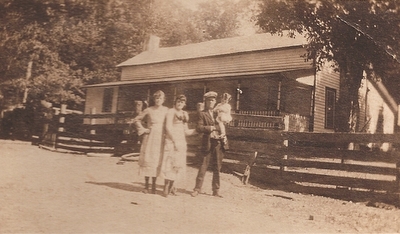
My grandparents, Weaver and Fannie (Castle) Smith spent their honeymoon in Waterloo, Alabama, visiting Grandpa’s relatives there.  Ninety-five years later my brother and I visited Waterloo on their wedding anniversary, June 29.  I know my grandmother enjoyed her trip there—the only real vacation she ever took—because I heard a lot about Waterloo when I was growing up.  On our trip my brother and I remarked again and again that we wished we had just put her in the car and driven her back to Kentucky and Alabama.  She would have complained but we should have just taken her anyway. 


Ella Smith Beckham?, Fannie & Weaver Smith
Waterloo, Alabama, 1919 

Waterloo is a quiet little town with a population of about 200.  It is located on the Tennessee River in the far northwestern corner of Alabama.  It was incorporated in 1832, one of the oldest incorporated towns in Alabama.  According to a historical marker, the town was an important port on the river during the steamboat era.Following a disastrous flood in 1847, the town was moved from its location on the riverbank, now under Pickwick Lake, to present higher ground.”  


Historical marker, Waterloo, Alabama 

In the 1930s the town was affected again when the Tennessee Valley Authority built the Pickwick Landing Dam just north in Hardin County, Tennessee.  I can’t help but think of my very favorite movie ever, O Brother, Where Art Thou? when Everett says,  “The fact is, they're flooding this valley so they can hydroelectric up the whole durn state. Yes, sir, the South is gonna change.”  I wonder how much Waterloo has really changed since my grandparents were there in 1919.

Waterloo is known, if it is known at all, as the “End of the Trail of Tears.”  Another historical marker on the edge of the river tells that at Waterloo the Cherokees were put on boats to make the final leg of the Trail of Tears.  The marker says: “Thousands of Cherokee Indians passed through Waterloo in the 1830s when they were forced by the U.S. government to move West on the Trail of Tears.  Most came by boat from Tuscumbia and camped here to await transfer to larger steamboats.  During the encampment several births, deaths, and escapes occurred.”


Trail of Tears marker, Waterloo, Alabama 

My great-grandfather Smith followed his Mansell in-laws to Waterloo from Troy in Pike County, Alabama, in the 1870s.  His mother-in-law, Elizabeth Simmons, and her children were supposedly Cherokee, and it was from Waterloo, in the 1890s, that Stephen and Fannie Smith moved to Indian Territory and applied for Cherokee citizenship.  

In one of the applications Elizabeth Simmons Mansell Cotton made a deposition stating that she and her children were Cherokee.  The deposition was dated 1894 and made in Cleveland County, Oklahoma, which used to make me wonder if Elizabeth died and is buried in Oklahoma.  However, on my last trip to Waterloo some Mansell cousins showed me the place in Mount Olive Cemetery where “Granny Cotton” is said to be buried.  After a long drive out into the hills outside Waterloo, I showed my brother her purported resting place.  According to our Mansell relatives, Elizabeth may have come to Indian Territory with the Smith family then returned to Waterloo with some Mansell/Webb family members who came back to Alabama.

Elizabeth Cotton's grave?, Mount Olive Cemetery,
Waterloo, Alabama 

And, again, the Smiths were traveling from Alabama to Oklahoma.  After a stop at the Shiloh Battleground we were on our way home.

Wednesday, July 10, 2013

Genealogy on the Road: Franklin,Tennessee

Franklin really puts a personal face on the Civil War.  The Battle of Franklin took place on November 30, 1864, and it’s not one of the most well-known of Civil War battles.  The opposing armies, both headed for Nashville, clashed at the little town of Franklin, home of about 750 terrified citizens.  At the home of the Carter family as many as 27 civilians, half of them children, cowered in the basement while 5,000 men fought hand-to-hand in the yard.  At Carnton Plantation, home of John and Carrie McGavock, Mrs. McGavock agreed to allow her home to be used as a field hospital.  On the morning after the battle four dead Confederate generals would be laid out on her back porch, and the wounded would cover every square inch of her home.

I’ve been to Chickamauga and Shiloh; I even cried a little at Shiloh’s Bloody Pond, imagining the poor wounded soldiers crawling there to drink and die.  At those preserved battlefields you can get a sense of the scope and strategy of the battles.  But there’s something really poignant about Franklin, even though less is preserved there.  The focus at the Carter House and at the Carnton Plantation is on people, both soldiers and civilians, and how the fighting there affected them for the rest of their lives.

There is the story of young Tod Carter, a captain for the Confederacy, who had been away from home for three years.  Wounded in his own front yard, he was found by his family the morning after the battle.  Finally home, he died in his own bed the day after.  


Carter House, Franklin, Tennessee
There is Carrie McGavock, immortalized in the novel The Widow of the South, who cared for the wounded in her home and spent the rest of her life caring for the dead buried on her land.  

Cemetery at Carnton Plantation
At Franklin you can just imagine the terror of the children hiding in the cellar at the Carter House.  One of them remarked later that, in the noise of the battle, she could not even hear herself scream.  You can still see the bloodstains on the floors of Carnton, where surgeons stood at makeshift operating tables, removing bullets and amputating limbs.  

Bullet holes in wall at Carter House

Carnton Plantation House--doctors performed surgeries near
the windows on the upper story
You can understand why the town of Franklin chose to build fast food restaurants over some of the battleground.  One tour guide explained that they didn’t want to remember the battle. Imagine a town of 750 coming out of hiding the morning after the battle and dealing with the bodies of thousands of dead and wounded.  Almost 150 years after the battle they are finally planning to rebuild the Carter family’s cotton gin, site of much of the fighting and the place where Confederate General Patrick Cleburne died.


The Battle of Franklin was personal for us, too.  On a previous trip to Franklin I had discovered that the 33rd Alabama Infantry, our great-grandfather’s unit, had been practically wiped out at Franklin.  I didn’t know much about the 33rd Alabama, except for Grandpa Smith’s Confederate pension application and the inscription on his headstone.  After that previous visit to Franklin, I looked more closely at the pension application and at the history of the unit.  Grandpa Smith joined the war late—in March, 1864, at Elba, Alabama—and was paroled as a prisoner of war from Macon, Georgia, at the end of April 1865.  Almost the only battles he could have participated in were at Atlanta and at Franklin.


Stephen Albert Smith headstone--Collinsville, OK

I have been able to find little information about Grandpa Smith’s war experience.  I’ve looked for him on the National Park Service’s Soldiers and Sailors Database but found only his enlistment and some quartermaster records.   On the other hand, I know that his brother, Alexander Jackson Smith, was wounded at Kennesaw Mountain in Georgia and was in the hospital at Macon. 

So I’ve had to rely on Grandpa Smith’s pension application for what little I know.  He listed the names and ranks of his officers as “Colonel Adams, Brigadier General Lowrey, Cleburne, Owesson,  Hardee Corps, Joe E. Johnston’s Army.”  The names listed would tend to support the fact that Grandpa Smith was out of the fighting by Franklin, as General John Bell Hood had taken General Joe E. Johnston’s place as the head of the Army of Tennessee in July 1864.  In September Major General William J. Hardee, the senior corps commander, who had requested to be transferred from Hood’s command, was sent east to command the Army of South Carolina, Georgia, and Florida.  Major General Patrick Cleburne, while disagreeing with Hood’s decision to engage the Union forces at Franklin, nevertheless did his duty, died in the battle, and was one of those laid out on Carrie McGavock’s back porch.


Cleburne Memorial
Franklin, Tennessee

On a lighter note: At the end of the trip my brother and I voted on the best place we stayed, the best place we ate, and the best place we visited.  Tim’s a big Kayak/Priceline fan, so he took care of our hotels.  We were never sure what we would get, but Embassy Suites in Franklin won hands down as the best place we stayed.  (Four words: Happy Hour / Breakfast Bar)  The best place we ate was Stoney River Steakhouse, recommended by the concierge at the hotel.  Yum.  Franklin was runner-up as the best place we visited, edged out by our great-great-grandparents’ graves in Kentucky.  

Saturday, July 6, 2013

Genealogy on the Road: Granville, Tennessee

The third stop on our genealogical journey was Granville in Jackson County, Tennessee.  While our stops in Kentucky and Virginia were dedicated to the Castles, this leg of our journey would hopefully tell us more about the Roberts and Huff families on our mother’s side.  We were going to miss the big genealogy weekend in Granville but maybe we could still learn something.

I had looked up Granville on Google Maps and my plan was to come into town by way of the Dry Fork of Martin’s Creek upon which our Huff family had lived in the mid-1800s.  Tim and I took the winding State Highway 290 and drove and drove and drove.  Little did we know, that was the shortcut.  We finally gave up, went back to the turnoff, drove to the town of Gainesboro and turned south, only to realize that if we had stayed on Highway 290 for another mile, we would have come out within a couple of miles of Granville.  I enjoyed the drive, though, and got a feeling for the area where our ancestors lived.

Granville was a delight.  We had been concerned that Tim wouldn’t have anything to do while I did research at the Granville Museum, but after we saw the town, we knew that wouldn’t be a problem.  He visited with the volunteer at the museum while I looked through notebooks for the Huff and Pharris families that had been prepared for the upcoming genealogy weekend.  While I didn’t find information that was far enough back to be helpful, I did recognize some researchers’ names that I had seen on ancestry.com.  Now I knew how they were connected with the various families of Jackson County.  Too bad we wouldn't be there this weekend to meet some of these researchers in person.

Granville Museum, Granville, Tennessee

It was lunchtime, so we decided to eat at the Sutton General Store.  My brother, surprisingly, had never had pimiento cheese, and I had never had it grilled, so I ordered that.  He ordered a chicken salad sandwich and a bottle of RC Cola, and we shared our sandwich halves.  Yummy and quintessentially Southern.  I bought a cookbook, Historical Recipes of Granville, which included the chicken salad recipe.  I have enjoyed looking at the recipes, especially ones contributed by the descendants of families that have lived in the area since the 1800s.

Sutton General Store, Granville, Tennessee

Lunch at Sutton General Store


After a trip to the gift shop, located in the old bank building, we were on the road again-- headed for Franklin, Tennessee, and the Civil War.

Gift shop at the old bank, Granville, TN

Thursday, July 4, 2013

Genealogy on the Road: Castlewood, Virginia

While my brother and I were this far east, we decided we would visit the town named for our ancestor, Jacob Castle.  Castlewood, Virginia, is located in Russell County in southwestern Virginia.  From West Liberty, Kentucky, where many of Jacob’s descendants migrated, it was about a 3-hour drive.

According to legend, Jacob traded the local Indians a butcher knife and rusty musket (or “a hound dog, a shotgun, and a drink of whiskey”) for forested land that became known as “Castle’s Woods,” while still maintaining his permanent residence in Montgomery County.  While Castle’s life in Montgomery County can be proven by tax and court records, his life in Castle’s Woods has little to document it, except for the name of the area.  In any case, the area was known by this name long before Daniel Boone set forth from the settlement for Kentucky in 1774.

Since no statue of Jacob Castle exists to visit (although there really should be), my brother and I did our best to find some locales associated with our ancestor Jacob.  A nice drive to the country outside of town took us to an area known as Castle Run.  The story is that the area got its name because Jacob was chased there by an Indian upon whose hunting lands he was trespassing. 


We had no directions specific enough to find either site that has been proposed as the grave of Jacob Castle.  My cousin Fred Castle had described on a genealogy message board a site on Copper Creek that he felt to be Jacob’s resting place, but no directions were given.  A very nice history of Jacob Castle by a descendant named Ron Hall includes Mr. Hall’s description of a gravesite in a field near the Scott County line, but again, we had no directions specific enough to get us there.  The best we could do was gaze into the woods on either side of the road as we drove, imagining Jacob in his longhunter garb, blazing a trail through the forest.

On the way out of Virginia to our next stop in Tennessee, we stopped near Nickelsville on Highway 71 to read a historical marker entitled “Early Settlers in Russell County.”  It said: “In 1787, Isaiah Salyer (1752-1818), son of Zachariah Salyer (1750-1789) of North Carolina, settled on Copper Creek, two miles southeast of here.  Isaiah’s brothers, John, Benjamin, and Zachariah, and sisters Sarah, wife of Solomon Saylor, and Rebecca, wife of Stephen Kilgore, settled on nearby land.  The Salyer land was officially surveyed in 1790.  The Salyers intermarried with other Virginia pioneer families – Castle, Isaacs, Nickels, Stapleton, Vicars, and Byerley.” 


The marker stood in front of a church and graveyard where we found several Castle graves, undoubtedly from the Virginia branch of the family descended from Jacob Castle.


For more information about Jacob Castle, see my post "Jacob Castle the Longhunter."