A friend of mine recently got her DNA results from Ancestry.com and was showing me her Ethnicity Estimate. I remembered that Ancestry had come out with a whole new version of ethnicity results last fall, and I had never really looked at mine since the new version appeared on their website. So I did.
On a previous post, "Where in the World Am I From?" I reported the results from my first ethnicity profile on Ancestry. I was 44% Central European, 33% British Isles, 21% Scandinavian, and 2% Uncertain. I knew that Ancestry got a lot of flak from experts in the field of DNA genealogy for the high proportion of Scandinavian ancestry in a large number of people who wouldn't be expected to have it. I wasn't especially skeptical of my Scandinavian numbers, because first of all, it's cool to be a Viking, and second, I figured my Irish and Scots forefathers probably did have some Scandinavian ancestry.
Well, now they don't. My new Ethnicity Estimate is 79% Great Britain, 15% Ireland, and 6% Trace Regions. These include 3% Europe East, 1% Europe West, 1% Italy/Greece, <1% Scandinavian, and <1% Iberian Peninsula. I've gone from 21% Scandinavian to less than 1%. However, I'm not really surprised at my overwhelmingly English/Scots/Irish roots, as I would be hard-pressed to find a surname in my tree that can't be traced to those regions.
I thought it might be fun to do a little survey of the surnames in my tree--where they come from and what they mean. Since none of my ancestors are recent immigrants and I haven't been able to trace very many of them conclusively to their mother country, surnames are the only evidence I have for country of origin. Let's see if my surname origins match up with the origins that Ancestry.com estimated from my DNA.
FYI: Surnames did not come about until the Middle Ages, when populations grew large enough that individuals with the same given names had to be differentiated from each other. There are four major ways in which surnames were given: based on the father's name (for example, Johnson, "son of John"); based on the occupation of the individual (John the Baker, John the Carpenter, etc.); based on a place (John Hill, John Meadows, John London); or based on a characteristic (John Little, John Brown.)
On my dad's dad's side, I have Smith, Williams, Simmons, and Soles. Just for fun, let's throw in Banks and Perkins, the surnames belonging to my brother's y-DNA matches. We know they are related to us--we just don't know how. I'm using Ancestry.com's surname information, which can be found at www.ancestry.com/learn/facts.
SMITH--English: occupational name for a worker in metal
WILLIAMS--English (also very common in Wales): son of William
SIMMONS--English (southern): son of Simon, or Anglo-Norman: son of Simund
SOLES--Old English; from sol, a muddy place, or possibly from Middle English (Latin solus), "single" or "unmarried", or if spelled
SOULE or SOULES--uncertain origin; perhaps derived from "soul" as a term of affection
BANKS--English or Scottish: name for someone who lived on the slope of a hill or by a riverbank
PERKINS--English (also mid and south Wales): son of Perkin
On my dad's mom's side, surnames include Castle, Sargent, Bays, Day, Lewis, Reed, Horton, Kendrick, Lea, Oney, McGrady, Cock, Patrick, and Henson.
CASTLE--English: someone who lived or worked at the castle (However, if the original spelling was Kassell or Cassell, as many Castle genealogists have speculated, my Jacob "the Longhunter" would have had a German, not English, origin.)
SARGENT--English and French: originally, an occupational name for a servant
BAYS--English: son of Bay
DAY--English: a pet form of David or other personal name; or, from a root word meaning "to knead" (related to dough), name for a dairy maid or servant of either sex
LEWIS--English (but most common in Wales): from the Norman personal name Ludovicus, or from the Welsh Llywelyn, or from the Irish/Scots Lughaidh
REED--English: nickname for a person with red hair or a ruddy complexion
HORTON--English: from one of many places in England with this name; from Old English horh "dirt" + tun "enclosure" or "settlement"
KENDRICK--Welsh, Scottish, or English: from the Welsh personal name Cynrig; shortened version of the Scots MacKendrick; or from the English Cyneric, meaning "royal power"
LEA--English: someone who lived near a meadow
ONEY--English: probably originally Olney, from two different places in England. One meant "Olla's island"; one was originally Onley, "single" + "clearing"
MCGRADY--Irish: son of Bradach, "proud"
COCK--English: "male bird or fowl," originally someone who struts like a rooster, then became generalized to "youth" and incorporated in names such as Alcock and Hancock
PATRICK--Scottish and Irish: son of Padraig, originally Latin Patricius, "son of a noble father"; popularized, of course, by St. Patrick, patron saint of Ireland
HENSON--English: son of Henne (short for Henry), Hayne, or Hendy
On my mom's dad's side, I have Wheat, Farris, Stephenson, Whitley, Ming, Beasley, Fullen, Bordley, and Logan.
WHEAT--English: grower or seller of wheat, from hwit, meaning "white" because of its use in making white flour
FARRIS--Scottish: son of Fergus; in southeast England, possibly variant of Farrar, "worker in iron," "shoer of horses"
STEPHENSON--English and Scottish: son of Stephen; sometimes shortened to Stinson. My Stephensons are supposed to be Scottish.
WHITLEY--English: place name, from hwit "white" + leah "wood"
MING--English: of uncertain origin; perhaps from shortened version of personal name, Dominick
BEASLEY--English: from a place in Lancashire; perhaps beos, meaning "bent grass" + leah, meaning "woodland clearing"
FULLEN--English: same origin as Fuller, an occupational name for a person who helped make cloth by wetting and walking on it
BORDLEY--English: place name, originally bord, "board" + leah, "woodland clearing"
LOGAN--Scottish or northern Irish: from a place name, originally lagan, "hollow"
And finally, from my mom's mom's side of the family: Bell, Roberts, Powell, Fowler, Crudup, Cooper, Battle, Dixon, and Huff. DNA evidence also points to Pharris, Broyles, and Wilhoit.
BELL--Scottish or northern English: bell maker, or someone who lived near the bell
ROBERTS--English: son of Robert. Very frequent in Wales and west central England.
POWELL--English (of Welsh origin): Anglicized form of Welsh ap Hywel, "son of Hywel," a personal name meaning "eminent"
FOWLER--English: occupational name for a bird-catcher (a common medieval occupation)
CRUDUP--Probably an Americanized version of North German Gratop, a nickname for an old man. From German gra (gray) + top (braid)
COOPER--English: occupational name for a maker and repairer of wooden barrels
BATTLE--English and Scottish (of Norman origin): habitational name from the place of a battle
DIXON--Northern English: son of Dick
HUFF--English: habitational name, meaning "spur of a hill." German: from the personal name Hufo. My Huffs were Dutch, so probably the German meaning.
PHARRIS--Irish variant of Farris. I'm still not completely certain that my Farris and Pharris ancestors weren't originally the same family.
BROYLES--American form of German Breuhl (one of my Germanna families)
WILHOIT and various spellings--German: from Willeit, wil "small settlement" + leite "slope" (another Germanna family)
Kindof fascinating, isn't it? Certainly bears out the ethnicity estimate of almost 95% Great Britain and Ireland. It's also fun to see what characteristics distinguished a person or place back then and to compare medieval occupations to those we have today. Can you imagine having a job that required you to walk on wet cloth or catch birds?
Try this little exercise with your own list of surnames. What does it tell you about the origins and occupations of your ancestors?
Showing posts with label Fowler. Show all posts
Showing posts with label Fowler. Show all posts
Saturday, April 19, 2014

Sunday, April 21, 2013
The Fowlers
The Fowlers
joined my family tree with the marriage of Eliza Helen Fowler to Benjamin
Powell on 22 December 1828 in Henry County, Tennessee, at the home of the
bride’s father. Eliza Helen’s parents
were William and Mourning (Crudup) Fowler.
William was born 8 February 1779, and Mourning was born 4 February 1781;
they married on 22 April 1800. Her
parents were Josiah and Elizabeth (Battle) Crudup of North Carolina. You will see the names Mourning, Crudup, and
Battle again and again in the names of their children and their children’s
children.

Eliza Helen
was one of twelve children, five sons and seven daughters of William and
Mourning Fowler. Their names were: Joseph,
Piety Hester, Crudup Battle, Martha Henderson, Mason T. (a girl), Eliza Helen,
Harriet E.C., Roina Broadus, William John, James Elisha (for whose wife and
sister-in-law Lydia was named; see post "Aunt Lydia Powell"), Mary Jane, and Calvin Crocker. All the children were born in North Carolina
before William Fowler came to Henry County, Tennessee, near Paris, in
1826. The only child who stayed in North
Carolina to raise his own family was the eldest, Joseph.
 |
| Family of William and Mourning (Crudup) Fowler from Annals of the Fowler Family |
According to *Annals of the Fowler Family, John Fowler came to Virginia from England
and patented land in Virginia in 1673 north of the Appomattox River near
Petersburg. By court records we know
that John Fowler was dead by 1683. By 1691 his son Godfrey was of age, and his
two brothers being dead, he inherited the estate of his father. By 1695 he had married Susannah Archer. Godfrey the First (to differentiate him from
his grandson) imported colonists and bought land, greatly adding to that owned
by his father John, and died by May 1747.
According to his will, his son Joseph had already received his
apportionment of land and had probably already moved to North Carolina.
 |
| Map of Fowler lands in Virginia from Annals of the Fowler Family |
We know that
Joseph Fowler was in North Carolina by 1772 and may have been there as early as
1743, when his father’s will was written.
Joseph’s wife was Nancy, and they had twelve children: Bullard, William Anderson, Susannah, Mary,
Godfrey Sr. (my ancestor), Wilmoth, Joseph, Elizabeth, Nancy, Martha, Sally,
and Burwell. Godfrey Sr. married Rahab
Cooper, and they had six sons and two daughters: Nancy, David, Joseph, John, Godfrey Jr.,
Bullard, William, and Elizabeth. William,
my ancestor, married Mourning Crudup, and his brother Bullard married her
sister, Bathsheba.
I’ve always
wondered what possessed the Crudups to give their daughters names so widely
differing in propriety: Mourning being such a nice Puritan name and
Bathsheba—really?—after the temptress of King David. As it turns out, Mourning is a family
name. Mourning Crudup was the daughter
of Josiah Crudup and his wife Elizabeth Battle.
Josiah’s parents were John and Mourning (Dixon) Crudup. The name Mourning travels through my family
from Mourning Dixon to her granddaughter, Mourning Crudup, to her
granddaughter, Mary Mourning Powell, to her granddaughter, who was Cornelia
Morning Bell, my grandmother’s sister.
I’ve always wondered if T.J. Bell knew how far back in his family this
custom went, or if he was merely naming his daughter Cornelia after his mother.
Besides
Crudup, Battle, Archer, Dixon, and Cooper, other surnames associated with the
Fowler branch of the family are: Tucker, Wilder, Jackson, Howell, Hunter,
Sumner, and Blanchard. All of these
families lived almost exclusively in Virginia and North Carolina, stretching
back into the 1600s.
*Annals of the Fowler Family can be read online in its entirety at archive.org.
Thursday, April 18, 2013
Aunt Lydia Powell
Great-great
Aunt Lydia, who passed down her “Genealogy of the Powells” to future
generations, is a kind of role model for me.
When you’re spending all your spare time surfing ancestry.com and
tracking down cemeteries and blogging not knowing if anyone is reading, you
sometimes wonder if what you leave behind will mean anything to anybody. Aunt Lydia, who wrote something that helped
me in my search 135 years later, gives me hope that what I’m doing will mean
something to future generations.
Lydia
Caroline was born 16 January 1849 in Tennessee, the next-to-youngest child of
Benjamin and Eliza Helen (Fowler) Powell.
In Lydia’s own words, “I was named for the wife of my uncle James E.
Fowler of near Paris, Tenn.; she was Caroline Harris, a sister of the late
Senator Isham G. Harris of Tennessee.
Lydia is for his sister-in-law, Mrs. Lydia Harris.”
 |
| 1860 Shelby County, TN census Lydia is listed as Martha L.C. Powell |
Lydia didn’t
marry until she was 33—to a 57-year-old man, Elisha Ray, who had been widowed
twice. She apparently used her spinsterhood
to good advantage, traveling and writing stories about her adventures for the
hometown newspaper. She carried her
writing implements, silver inkwell, and paper in a shagreen (sharkskin) box
with gilt trim. She visited a spa in Hot
Springs, Arkansas, where she took an oxypathor treatment that she claimed made
her look 10 years younger. (Google it;
it’s really interesting.) She visited a
home in Florida that she described as “decorated like a Turkish bashaw’s.” She visited Wales, where she bought a
washstand, highboy, wardrobe, and bed made of mahogany with carved roses and
angels, that she left to Aunt Clara in her will. (Uncle Angus refused to take possession of
them, as it would have required that he hire a wagon to fetch them.) My cousin owns two pictures that Lydia
painted—one of a swamp in Florida and one of sheep in Wales.
Lydia
married Elisha Boykin Ray on 10 May 1882.
He had been married previously to Mary Susan Lake, who died in 1864, and
Ann Rebecca Wright, who died in 1872. Years
ago, my cousin showed me a photograph of Elisha Ray with Lydia (she thought)
and his two young children. She seemed
to remember that Elisha had a boy and a girl from his previous marriage, and
that the boy had died young. I posted
the photo on ancestry.com and then received a message from a Wright researcher
who found the photo through a search for Elijah Ray, who had married her great-grandfather’s
sister, Ann Rebecca Wright. According to
her, Elisha had at least five children with his first wife; he and Rebecca never
had children, but she helped him raise the children from his first
marriage. His children, the youngest of
whom was born in 1862, would have been grown when he and Lydia married in 1882. The woman I corresponded with feels that the
following photograph depicts Elijah with her ancestor, Rebecca Wright, and two
of his young children. I hold out the
hope that it is somehow Lydia, since I have no other picture of her.

After I had
begun to research the Powells and the Fowlers, I found a book in the
library of the Oklahoma Historical Society called Annals of the Fowler
Family (more about it in the next post.)
It was published in 1901, and the author, Glenn Dora Arthur, had corresponded
with many of her Fowler cousins, trying to document as many Fowler descendants
as she could. Two of her correspondents
were Lydia and Eliza Helen, Lydia’s mother.
Lydia really comes to life in the long and chatty letter that she sent
to Mrs. Arthur.

She
addresses Mrs. Arthur as “My Dear Relative,” and then goes on to relate
interesting stories of Fowler relatives during the Revolutionary War and the
Civil War, such as this one about Rahab Cooper, wife of Godfrey Fowler, my 5th
great-grandmother:
“She and her children were in the
kitchen and she was spinning, when, just as she was drawing out a thread, she
glanced up the road and saw the British coming; she hastily raised the trapdoor and
bade all the children enter the cellar and keep wonderfully quiet; she then
took her babe—my grandfather—and went up in the attic. The English soldiers entered the home and she
could hear them laughing about chasing all the women and children away. They remained only long enough to eat up a
lot of roasted potatoes and drink all the brandy in the house. They then left
without discovering either hiding place,”
and this
poignant anecdote, maybe not as historically significant, but just as revealing
of the times:
“There is a sad romance about the
eldest daughter of great-uncle Bullard Fowler; her name was Tillitha. She never married, although she was engaged
three times, but all three terminated disastrously. In the first instance her intended was thrown
by his horse and killed while he was on his way to wed her; the next one
sickened and died near the wedding-day; the third went to Holly Springs on
business just prior to his marriage, and he died there among strangers. She had
suitors afterwards , but she never promised to marry anyone again.”
Mrs. Arthur
makes this very Victorian response to Lydia’s letter:
“Some women
have a decided fondness for family reminiscences, and I judge that Mrs. Ray has
inherited this interesting trait from her very interesting mother, whose letter
set me on my quest for ‘our ancestors.’ Women, as a rule, have more time for
remembering traits and incidents of different members of the related families.
They talk them over as they mingle in the home work; and on rainy days and
winter nights something of the dear past is suggested by the snatch of a song,
the odor of a flower, or the similarity of the weather, when one begins,--‘It
was just such a night as then when’—and immediately everyone listens.”
I would
greatly admire Mrs. Arthur as well for her helpful contribution to Fowler
history were it not for her occasional cattiness. I can’t quite forgive her for the unnecessary
comment she made about Lydia’s explanation of the origin of her name:
“If there
are any discrepancies in these facts I am unable to correct them, as I give
them just as they have been given to me.
As a rule women are more prone than men to draw on their imagination
when their stock of facts is exhausted, but I have requested facts only in
every instance.”
As a
genealogist, I can certainly appreciate Mrs. Arthur’s devotion to the facts,
but unless our ancestors come to life for us, what is the point of names and
dates? Lydia may have had imagination,
but I’m so glad she did, or I would never have heard such interesting stories
about my Powell and Fowler ancestors.
Sunday, April 14, 2013
The Powells
A lot of
what I know about the Bells and related families comes from one of my Bell
cousins. Her grandmother, Clara Bell
Guest, was the older sister of my grandmother, Cora Bell Wheat. As keeper of the Bell family treasures, my
cousin gave me a genealogical jump start by sharing family photographs, Primitive
Baptist church minutes, and a dog-eared handwritten history of the Bell and
Powell families written in the 1880s by our great-great-aunt Lydia Powell Ray.
 |
| Page 1 of the "Genealogy of the Powells" by Benjamin Powell, as told to his daughter, Lydia |
The tears
and mends make it very hard to read, and I only have a photocopy of Aunt
Lydia’s “Genealogy of the Powells.”
However, I was able to decipher enough to set me on the way to
identifying my Powell ancestors. The
usual way to do genealogical research, from the present back through each
generation to the earliest ancestor, worked the other way around in this situation. I ended up working down from the earliest
ancestor listed in Lydia’s genealogy until I got to Benjamin Powell, who was
the father of the most recent Powell in my family tree—Mary Mourning “Polly”
Powell who married James W. Bell.
Although
written by Lydia, she was recording the words of her father, Benjamin Powell,
who said, “The ancestors came from Wales and settled in Virginia and moved
[from] to Halifax Co., N.C. Had two sons
one of them (my great grandfather) Dempsy Powell married a Miss Benton
[indecipherable] moved from there to Wake Co., N.C. before the Revolution
War. Raised up a family of five
daughters and four sons.” They go on to
record the names of Dempsey’s sons and daughters, daughters’ married names,
their children, and where they lived. For
example, one readable part of the document says, “The other three daughters of
my great grandfather Dempsy Powell married Sims Streeter and Temple and moved to
Middle Tenn and settled on Duck River near Shelbyville. They were all very wealthy and their children
married so far as we know, men of affluence.” (I love the Victorians!) While much information is there, it’s
sometimes hard to untangle and frustrating because so much is missing due to
the age of the document itself.
 |
| Map of Tennessee showing location of Duck River |
It’s been
almost 20 years since I received this document from my cousin and did the
initial research. So much is now
available on ancestry.com and from other sources that corroborates these facts
or calls them into question. For
example, Lydia does not mention Dempsey’s purported first wife, Nancy Dempsey,
at all. According to comments I have
read online, the name Nancy Dempsey first shows up in early DAR applications
and Powell researchers have not been able to find a source for it. Lydia’s genealogy seems to support the fact
that Dempsey only had one wife, a “Miss Benton,” given name Pleasant, according
to a court record that lists her as the mother of Caswell and Jesse Powell.
I remember
how exciting it was as I did find sources that mostly supported the facts that
Lydia and her father had recorded. For
example, Dempsey Powell’s home was in Wake County, North Carolina, near the
present town of Wake Forest. I recently
found a transcript online of minutes from the 1792 meeting of Commissioners in
Wake County who were viewing lands in the county for a site for the State
Capital, “establishing a place for holding the future meetings of the General
Assembly and the place of Residence of the Chief Officers of the State.” They viewed the “Land of Dempsey Powell on the
south side of Neuse at Powell Bridge Seven miles from Isaac Hunters” and
others.
 |
| Wake County map showing Neuse River |
Another
piece of information from Lydia’s document has proved to be correct. Dempsey received a grant of 1,977 acres
located on the Duck River in Tennessee for his service in the North Carolina
state militia. (When he was one his way
to have the land surveyed, he was shot through the heel by an Indian at
Nashville, whereupon he turned around, went back home, and hired someone else
to survey the land for him.) Upon his
death three of his daughters, Charlotte who married John Sims, Mildred who
married John Streeter, and Elizabeth who married Robert Temple, settled on
their father’s grant lands on the Duck River in Tennessee.
Lydia’s 3-page
document ends with these words: “This was written by myself Lydia C. Powell as
given to me by my father Benj. Powell son of Caswell Powell who was son of
Dempsy Powell (senior.) She adds: “My
father died near Potts Camp, Miss. in 1889 age 78 years 0 months. My mother’s maiden name was Eliza Fowler
daughter of Wm. Fowler of Paris, Tenn.”
Benjamin
Powell married Eliza Helen Fowler on 22 December 1828 in Henry County,
Tennessee. They had ten children: William Dempsey, Joseph Devereaux, Thomas A.,
Benja Ann Helen (Bennie), Georgiana Isabella, John Calvin, Mary Mourning, Lydia
Caroline, and Eliza Jane (Jimmie.) Of
the siblings, only two remained in Tennessee.
The others went to Arkansas, Mississippi, Oklahoma, and Texas. Eliza Helen was visiting her daughters in
Johnson County, Texas, when she died on 22 December 1882 on the 54th
anniversary of her marriage. She is
buried at Bethesda Cemetery, Burleson, Texas.
 |
| Eliza H. Powell headstone Bethesda Cemetery, Burleson, Texas from findagrave.com |
James W.
Bell died in 1883, and in 1894 or 1895 Mary M. Bell married George Akers and
moved to Woodford, Indian Territory.
George Akers died in 1896. On the
1900 census Mary was living in Choctaw Nation, Indian Territory, with her adult
children, William, 32; Russell, 30; Kitty, 22; and Joseph, 20. William, Russell, and Joseph were working as
miners. Mary apparently died before 1910
as she does not appear on the 1910 census.
She is supposedly buried in McAlester, Pittsburg Co., OK, but I have not
been able to find her grave. Her granddaughter
Cora, my grandmother, named her only son William Powell, and he went by the
name Powell all his life.
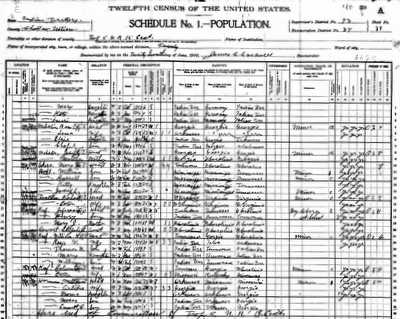 |
| 1900 Choctaw Nation, Indian Territory census |
Subscribe to:
Posts (Atom)