Documenting my family's past for future generations. My family tree includes the Smith/Mansell families of Alabama and Oklahoma, the Castle/Day families of Kentucky and Oklahoma, the Wheat/Ming families of Texas and Oklahoma, and the Bell/Roberts families of Mississippi, Tennessee, and Oklahoma.

Showing posts with label Morgan County KY. Show all posts

Monday, October 21, 2019

Goldman Davidson Castle: 52 Ancestors #2 (Castle side)

From last week's biography of my 2nd great-grandmother on my Smith side, Elizabeth Simmons, I'm turning this week to my 2nd great-grandfather on my Castle side, Goldman Davidson Castle. Goldman being a rather unusual name, I have found his records under the names Golman, Solomon, his initials G.D., and his nicknames "Goolen" and "Gool." 

G. D. Castle was born 23 February 1824 in Scott County, Virginia. It's hard not to compare Elizabeth Simmons and Grandpa Castle since they were fairly close in age and in the same relationship to me--2nd great grandparents. I never met anyone who had met Elizabeth Simmons, although my dad once told me that he had heard a description of her from someone who saw her when she came to Oklahoma. (Another reason why I believe she did actually come to Oklahoma.) On the other hand I know quite a bit about G. D. Castle because my grandmother remembered him and told me about him. Can you imagine? An eyewitness description of someone born in 1824!!

Goldman Davidson was the son of William and Margaret (Cox) Castle. He married Rachel Sergeant/Sargent on 1 September 1844. Sometime between 1840 and 1850 they all moved to Pulaski County, Kentucky, from Scott County, Virginia. The first time that Goldman appears by name is on the 1850 census in Pulaski County, on the page previous to the page on which his parents appear. Family #707 includes "Solomon" Castle, age 26; his wife Rachel, age 24; and son (William) Henderson, age 2. #708 is Rachel's brother, William Sargent, age 23. Family #713 includes William Castle, age 50; Margaret, age 51; William H., age 21; Margaret, age 17; Henry G., age 14; and Patton, age 8. Also in Pulaski County in 1850 is William's son and Goldman's older brother, James, age 35, enumerated with his wife and three children.
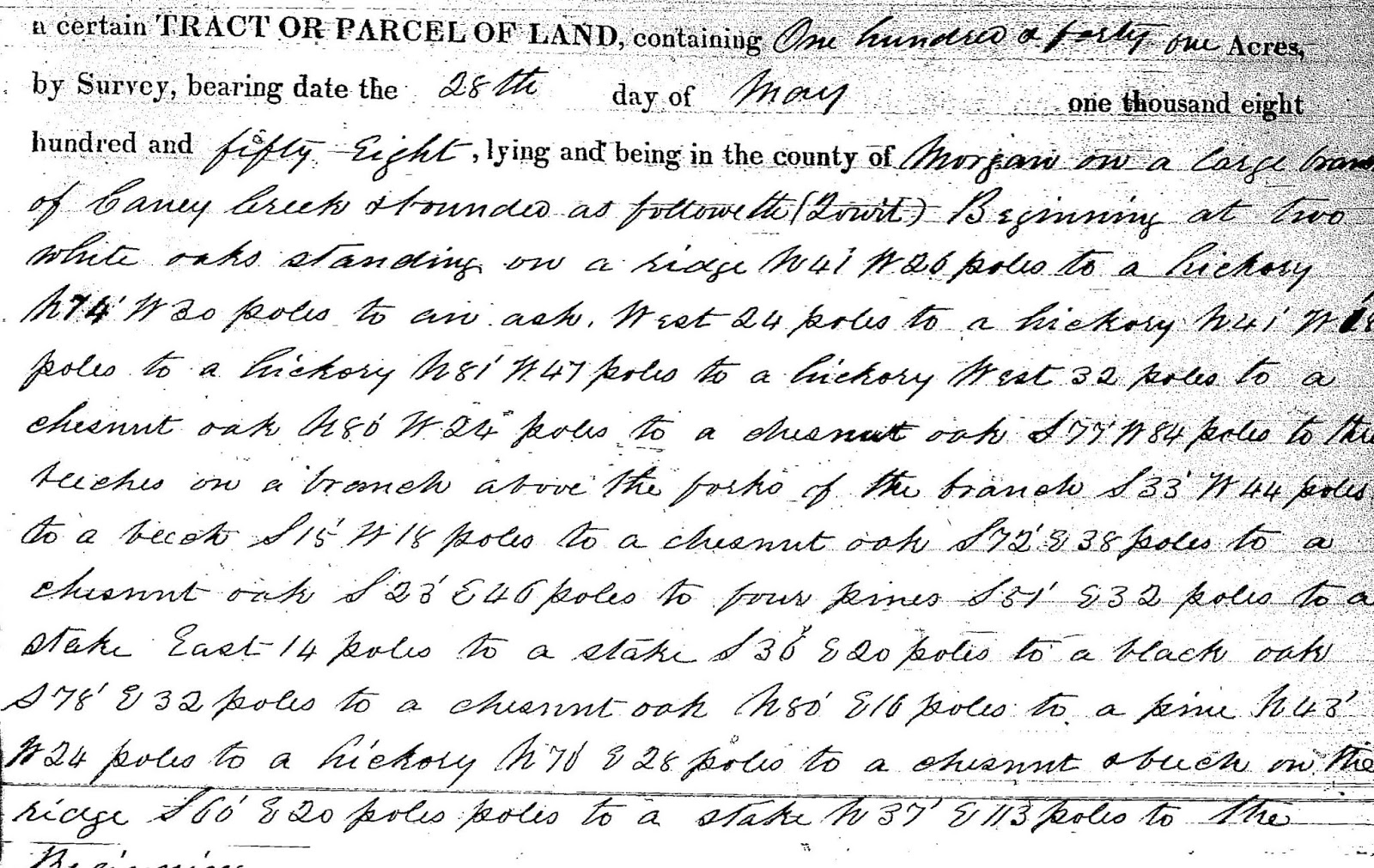
Kentucky Land Grant dated 28 May 1858

My branch of the Castle family was actually a little late to the migration from Virginia to Kentucky. In 1858 when "Goolen" Castle purchased 141 acres on Large Branch, Caney Creek, Morgan County had already been in existence for over 25 years. Enumerated in Morgan County, West Liberty Post Office, on the 1860 census were: G. D. Castle, age 36; Rachel, age 35; William, age 14; James, age 8; John, age 4; and Lilburn, age 1. Little John and Lilburn would not live very long; they both died of scarlet fever in 1861 within days of each other. 


Death Records for John and Lilburn Castle, 1861


By 1870 Goldman and Rachel's family was complete with the birth of daughter Sarah Frances "Sis," born in 1861; my great-grandfather, George Turner, born in 1863; and Nancy Anna, born in 1868. In 1867 the first of Goldman and Rachel's children married; William Henderson Castle married Nancy Jane Wells on 5 November 1867. Their first grandchild, John Seymour Castle, was born 3 July 1869.

My great-grandfather, George Turner Castle, married for the first time on 17 October 1884 to Mary Frances Nickell. Their daughter, Cora Lee, was born 10 March 1890. Mary Frances died 10 April 1893. Unable to care for his daughter, George turned to his parents who brought Cora into their home to raise. In fact, on the 1900 census Cora is enumerated with both her father and his new family and with her grandparents. George's new family consisted of wife Florida (Day); daughter Fannie (my grandmother), age 3, and son Forrest, age 1.

1900 Morgan County KY census, enumerating
Cora Castle with both her father and grandfather


G. D. Castle was first appointed Postmaster of Castle, Kentucky, on 21 March 1896 and kept the position for several years. He received compensation of $8.01 in 1897 and $23.68 in 1901. The post office was at one end of his house.

Record of Goldman D. Castle's Postmaster Appointment

What I know about my 2nd great-grandfather, Goldman Davidson Castle, I learned from my grandmother, who dearly loved him. He was 73 when my grandmother was born in 1897. I grew up hearing stories about how she stood on a chair and brushed his silver hair; how she tried on his "specs" (spectacles=glasses); how he saved the metal stars on top of his Star Chewing Tobacco and gave them to her; and how he so adored his wife Rachel that he would bring her "sweet crackers" after his visits to town--which she kept in her bureau drawer and did not share with the grandkids. You could definitely tell who her favorite grandparent was!

Here is my grandmother's description of her grandfather in her own words:
Sturdy type man--My first remembrance of Grandpa was about 1900-01. He let me try on his steel-rim specks (spectacles) and walk up and down their long porch to their log house of 4 or 5 rooms. The porch was boxed in on one end and contained the Castle, Kentucky Post Office. 
Large orchard back of house, cribs of corn, barn for horses, cows, sheep, hogs, chickens, and turkeys--Meadow for mowing in front of house. They lived there many years. I think all the children lived there as they grew up. After Frances Nickell died (childbirth), Dad brought 2-year-old Cora back to live at Grandpa's. About 1903 the Post Office was robbed and crib of corn burned. They were afraid to live alone and were getting up in years, so they moved in with us. I have some pleasant memories of the whole family sitting before a wood fire in Grandpa and Grandma's room after dinner listening to Grandpa talk.
He had beautiful, silvery, wavy gray hair and blue eyes--These words describe him: pleasant, independent, honest. He and my mother organized the first Sunday School at Stacy Fork, Kentucky. I think most of the Castles were (hard shell) Baptists. They held their association meetings once a year.
He chewed Star tobacco that he bought in 2-inch by 2-inch squares (sweet) with metal stars on it. He gave me the stars.
The Castles had the reputation of having well-filled larders (pantries)--canned and dried fruits and vegetables, a smoke house, the ceiling bristling with hickory-cured hams--Grandpa was an artist at preserving meat and sausage--a barrel of kraut, a barrel of pickles, a barrel of sorghum, pounds of homemade butter with the imprint of a little jersey cow on the mold, jars of honey from the beehives in one corner of the big yard.
In autumn large holes were excavated in one corner of the garden plot, these were lined with straw and filled with potatoes, onions, turnips, and apples, then covered with straw and dirt to a depth of no freezing. The whole family joined in this project of producing and preparing our daily bread.
Wood, coal and kerosene gave us heat and light. We bought flour by the barrel, sugar by the 50# bag, had corn ground for meal at nearby mill. These are a few happy memories of my old Kentucky home.
In February of 1907 Goldman Davidson Castle died and was buried in the little Castle cemetery on his own land where some of his grandchildren were already buried. I always wondered if my great-grandfather George held out until his father died before making the decision to move to Oklahoma in the summer of 1907. Rachel moved in with her son, James Harvey, who stayed on the Castle land, and George sometimes came back to visit, but my grandmother never saw her Kentucky home again.


G. D. Castle's gravestone in Castle family plot

All three of G. D. Castle's surviving sons named sons after him. William Henderson's son, who was named as Davidson on the 1900 census, was born in June of 1882. He died just three years after the census in 1903. James Harvey's son Goldman was born in 1884 and died in 1888. He is buried in the Castle family plot. George Turner named his next-to-youngest son Goldman Henry, but to me he was Uncle Harry. He used both the names Goldman and Harry, but a lot of family members and friends called him "Plute." He was born in 1905 and died in 1978 and is buried at Rose Hill Cemetery in Tulsa.

Monday, July 9, 2018

The Oneys (and a Couple of Great Stories)

A few months ago I wrote a post on the Days--the ancestors of my great-grandmother, Sarah Florida Day, who was born on 5 November 1878 in White Oak, Magoffin County, Kentucky. Her father was James Thomas Day, and his parents were Andrew Jackson Day and Sarah Jane Oney. At the time I realized that I had listed the wrong parents for Sarah, but until last weekend I had never actually added all the corrected family info to my tree on Ancestry. 

Sarah's father was James Oney, born in 1818 in Virginia. Her mother was Rhoda Day, born in 1820 in Virginia. (Sarah and her husband, Andrew Jackson Day, were 1st cousins.) James and Rhoda married on 17 December 1837 in Tazewell County, Virginia, which had been formed from Russell County in 1799. In 1850 James and Rhoda were living in Tazewell County with their children--William, age 12; Sally (Sarah), age 10; Richard, age 8; Joseph, age 6; and Rufus, age 2. Daughters Rebecca and Lou Emma were born in Tazewell County in the early 1850's, but by the time son Creed Fulton was born in 1855, the family was living in Magoffin County, Kentucky. John Wesley was born in Magoffin County in 1858 and Mary in 1861.

I decided to take the Oney children--Sarah's brothers and sisters--one by one and document their birth, marriage, and death information.


The Children of James and Rhoda (Day) Oney


According to his headstone, William P. (Patton) Oney was born 17 December 1838. It is interesting to note that this date is exactly one year after the marriage of his parents--either an amazing coincidence or a made-up birth (or marriage) date. I'm also not sure of his place of birth, as I can't find James Oney on the 1840 census in Tazewell County. There are some Oneys there in 1840, but no James. On 8 August 1861 William married Perlina Allen in Magoffin County, Kentucky. 

Documenting William's service during the Civil War was somewhat confusing at first, but I think I have a better understanding after finding his records on Fold3 and doing a little research. I'm not a big Civil War scholar, although I did know that Kentucky held a special place as a border state during the Civil War. What I didn't know is that Kentucky actually declared its neutrality at the beginning of the war. However, by September of 1861 Kentucky's General Assembly passed a resolution, over the Governor's veto, ordering the withdrawal of Confederate forces, and by early 1862 the Union pretty much controlled Kentucky.

I thought this explained why, even though William was living in Kentucky in 1861, he enlisted in Caldwell's Battalion of Cavalry back in Tazewell County, Virginia, his childhood home. Interestingly, I also found a register of "...Persons subject to do military duty in the Ninth Congressional District, consisting of the Counties of ...Magoffin...Morgan..., State of Kentucky, enumerated during the month of October 1863," that listed William Oney. So, though he had served in the Confederate Army, he was considered "subject to military duty" for the Union. No wonder I was confused! 

We'll come back to the Civil War in a little bit, but now back to the children of James and Rhoda Oney.

Sources vary as to her age, but most family trees on Ancestry list the next child of James and Rhoda in order of birth as my ancestor, Sarah Jane Oney. Some trees list her birth date as 17 October 1840 which corresponds fairly well with her marriage age of 15 on her marriage date of 25 September 1855. On the 1860 census where she appears with her husband A.J., age 23, she is listed as age 18 (born 1842). Also on that census is son James T., my 2nd great-grandfather, age 4; and daughter Nancy, age 1. Sarah lists her birthplace as Virginia. Her marriage took place in Morgan County, Kentucky, and the 1860 census places the family in Magoffin County. Oney researchers give Sarah a death date of 16 March 1862; if her birth date is correct, she was 21 at the time of her death.

According to his headstone, Richard K. Oney was born 1 January 1843. He enlisted as a Private in Company A, 5th Kentucky Mounted Infantry, Confederate States of America, in West Liberty, Kentucky, on 21 October 1861 and was mustered out on 20 October 1862. And I'm back to confused again, because apparently there were Confederate units in Kentucky during this period, because Richard joined one. 

I assumed that Richard just enlisted for a year, as was typical, since his discharge date was one year from the date of his enlistment. However, after doing a little research I found out that the 5th Kentucky Infantry was actually organized in Prestonburg, Kentucky, on the same date as Richard's enlistment--21 October 1861--and was disbanded in Hazel Green, Kentucky, on the date of his discharge on 20 October 1862. Richard could have joined another regiment at this point, but I have found no evidence of further service.

Not long after his discharge, Richard married in Magoffin County on 18 December 1862 to Mary Margaret Collinsworth. They had one child, Mary Virginia, before Richard died on 16 January 1866.

The next of the children of James and Rhoda (Day) Oney was Joseph Day Oney, born 19 May 1845 in Tazewell County, Virginia. After the death of his brother, Richard, Joseph married Richard's widow, Mary Margaret, on 5 September 1866 in Magoffin County. They had four children together. Joseph died 2 December 1936, age 91.

Rufus Hickman Oney, "Hickey" on the 1860 census and "Hick" later in life, was born 3 February 1848 in Tazewell County, VA. He married Delpha Hammond on Christmas Day, 1866. They had three children. Rufus Hickman died in Morgan County KY on 14 April 1876.

Rebecca Oney has been given a birth date of 7 January 1850 and later censuses seem to uphold a date around 1849/50, although she is not listed on the 1850 census and on the 1860, her age is given as 7. Rebecca married John M. Collinsworth, brother of Mary Margaret, in about 1867. (The 1900 census says they had been married 33 years.) Rebecca and John had 10 children, and Rebecca died in 1931 in Magoffin County.

Okay, so here's one of the great stories, and it's a doozy. The next of James and Rhoda's children was Lou Emma Oney, born 1852 in Tazewell County. In 1871 she married William Preston Taulbee, a Morgan County teacher. Later, he became ordained as a Methodist minister. Together, they had five sons from 1872-1885. When I added Lou Emma and then her husband to my tree on Ancestry, I got over 20 hints--mostly to newspaper articles from all over the country. What in the world? 


William Preston Taulbee


William Preston Taulbee was an ambitious man. In 1878 and 1882 he was elected to the office of Magoffin County Clerk. In 1884 he made a run for a much more prestigious job; he beat his Republican opponent to become a member of the U.S. House of Representatives and was re-elected to the office in 1886. It's remarkable enough that we have a member of Congress in our family tree, but what happened next put him in the history books--and newspapers.

In December 1887 the Washington Post reported a story about a Representative being found in a "compromising position" with a clerk from the Patent Office. No names were named, but later, an article by Charles E. Kincaid appeared in the Louisville Times with the titillating title, "Kentucky's Silver-Tongued Taulbee Caught in Flagrante, or Thereabouts, with Brown-Haired Miss Dodge, Also of Kentucky." (Both Taulbee and Dodge denied the affair.) Thus began a feud of several years between Taulbee and Kincaid, that would lead to a shocking event the evidence of which still remains in the Capitol today.

Taulbee had already decided not to run for re-election in 1888 but to buy a house in Washington, D.C. and remain there to work as a lobbyist. For some reason, of all the journalists who reported on the scandal, Taulbee focused on Kincaid, the Washington reporter for the Louisville Times, whom he saw often in the Capitol, and upon every occasion of their meeting found some way to humiliate Kincaid. Things came to a head on 28 February 1890 with a scuffle outside the entrance to the House of Representatives. The House doorkeepers had to separate Taulbee and Kincaid. This time Taulbee warned Kincaid that he had better arm himself for their next meeting.

Kincaid went home and got a revolver, and the next meeting was not long in coming. That very afternoon Taulbee and Kincaid met again on a set of marble stairs that led to the basement restaurant in the Capitol. Apparently without waiting for a remark from Taulbee this time, Kincaid raised his revolver and shot Taulbee in the face. The blood drips from the wound stained the marble staircase, even though Capitol janitors were quick to clean it up, and the bloodstains remain there to this day.


Photo from Kentucky Explorer Magazine


Taulbee actually was expected to live, but an abscess surrounding the bullet, which still remained in his skull, caused his death on March 11. Kincaid was released on bail and went home to Kentucky until his trial a year later in March 1891. Several witnesses, including Kincaid, described Taulbee's harassment of the journalist, and amazingly, Kincaid was acquitted by reason of self-defense. 

Lou Emma raised her five sons, with the older boys helping financially. All of the boys had distinguished careers, several of them in the military and two of them as physicians. They always considered that Kincaid had gotten away with murder and described him as a frustrated office-seeker. Lou Emma apparently believed--or forgave--her husband, because she is buried beside him in the Taulbee Cemetery in Morgan County. Kincaid died at the age of 51, still working as a journalist. Miss Dodge, who had lost her job at the Patent Office after the scandal, found another job in the Pension Office, married well--twice--and died at the age of 89. (For more details see "William Taulbee: A Stain on the Capitol" in the blog, The Downfall Dictionary by Dirk Langeveld. It was very helpful to me in writing this post.)

Creed Fulton Oney was born on the 4th of July, 1855. He was the first of James and Rhoda's children to be born in Kentucky. He married Nancy Emma Ball on 13 May 1880. I have written about C. F. Oney before in the blog post, "The News from Oklahoma." With a group of other Methodist ministers, he bought townsites in Davenport, Oklahoma, and encouraged Kentuckians like my 2nd great-grandparents, J.T. and Nancy E. Day, to settle there, so I guess he is the reason I am sitting here in Oklahoma tonight writing this post.

John Wesley Oney was born 9 April 1858 in Magoffin County. His first wife was Annie Sprague, who died. He then married Loduska "Lowie" Whitt. He had children with both wives, but a discrepancy in dates makes me hesitant to list the number of children that belonged to each wife. John W. died in 1935 and is buried in the Gullett Cemetery in White Oak, next to his second wife. 

The baby of the family was Mary F. Oney, who was born 7 January 1861 in Magoffin County. She married David C. Williams on 8 July 1879. I was able to find her marriage license on Family Search. It is a little hard to read, but the witnesses to the marriage were two of her brothers-in-law, John Collinsworth and William Taulbee. It looks like she might have been married at the home of her uncle, Joseph Oney. 


James Oney and the Civil War


The other interesting story concerns James Oney and his changing allegiances during the Civil War. Going strictly by the existing documents in chronological order, this is what happened.

James appears on a Company Muster Roll for the 5th Kentucky Mounted Infantry, C.S.A., the same unit that his son Richard joined, dated November 23, 1861. Two other dates on the muster roll document are a little confusing. Under "Enlisted" the date is 25 October 1861 in Prestonburg, and under "Remarks" it says that he was "Sworn into service at West Liberty October 21." Remember that at this point Kentucky had taken sides in the conflict, and not the side that James took. At least until he got caught.

The next document is dated 17 February 1862. This is my best attempt at transcribing the document. 


Know all men by these presents that I James Oney of Magoffin County in the state of Kentucky owe the United States of America the sum of one thousand dollars to be levied of my goods and chattels lands and tenements.

The __________ of this obligation is such that whereas the said obliger having formerly enlisted in the rebel army of the so called Confederate States of America and now desirous to renounce all allegiance to said so called government and having taken an oath to support the constitution government and laws of the United States of America and to support maintain __________ the same against all enemies and opposers whomsoever.

Now if the said obliger shall faithfully keep said oath and shall hereafter and ever refrain from aiding the said rebel government in any action or influence? -- and if the said obliger shall remain a true and loyal citizen of the United States of America and shall ever aid her against any and all enemies by word act and influence then this obligation shall be void and of no effect otherwise? to be and remain in full force and __________ in law.

Given under my hand and seal at Camp Buel this 17th day of February A.D. 1862
                                                                                              James Oney (signature)               SEAL

I hereby become surety for the above named obliger for the performance of the conditions of the foregoing bond as witness my hand and seal at Camp Buel this 17th day of February A.D. 1862.
Albert L.A. Sheldon? (signature)                                  Name unreadable (signature)     SEAL

And here's the oath.

I James Oney of Magoffin County Ky do solemnly swear that I will bear true faith and allegiance to the government of the United States of America that I will faithfully and to the best of my ability support the constitution and laws thereof that I will aid and defend her in all my acts words and deeds influence against all her enemies and opposers whomsoever more especially against the so called Confederate States of America so help me God!

Camp Buell Paintsville Ky
Feb 17 1862
James Oney (signature)

But that wasn't the end of it. The next document in chronological order was dated 24 May 1863. 

James Oney
Pvt Co A. 5 Regt. Ky. Inf
Appears on a Muster Roll
of prisoners of war confined by the Provost Marshal at Louisa, Ky. 
Roll dated Louisa, Ky., May 31, 1863.

Where captured or arrested  Morgan Co Ky
When captured or arrested  May 24 1863
By whom captured or arrested  Capt Patrick 14 Ky.
When confined  May 24 1863
Charges  Being a Rebel officer
Remarks: Released May 28, 1863, by military commission on giving bonds and security of $1000, and taking oath of allegiance

The exact same document exists for James's son, Richard. Apparently, James cannot learn his lesson, and it makes me wonder if he was on the 1860's equivalent of a "watch list." In fact, the 14th Kentucky, the unit that arrested him, was charged with protecting eastern Kentucky and the border with Virginia from Confederate forces, so they would be on the lookout for those who continued to encourage pro-Confederate views. I also wonder at that strikeout of the word "deeds" in his oath, replaced with the word "influence." Maybe James Oney was arrested not because of a deed he had committed but because of the influence he had wielded with his family and neighbors.

Some interesting facts about Kentucky in the Civil War:

Kentucky provided about 35,000 soldiers to the Confederate Army.
Over 75,000 Kentuckians joined the Union Army.
Both Abraham Lincoln and Jefferson Davis were born in Kentucky.
Magoffin County was formed in 1860 from portions of Floyd, Johnson, and Morgan counties. It was named for Beriah Magoffin, who was Governor of Kentucky from 1859 to 1862. Even as he sympathized with the South, he maintained the neutrality of the state of Kentucky through the first couple of years of the war. He was the Governor that vetoed the removal of Confederate troops from the state.

The Oney Cemetery Near White Oak, Kentucky


I've mentioned serendipity before in this blog. It's amazing how often I'm working on something genealogical and something else pops up that relates to the thing I'm researching. About the time that I was adding the Oney ancestors to my family tree and starting to work on this post, I was cleaning out a tote bag and found a printout of a message board post that I had found in 2012. It was a list of people buried in the Oney Cemetery near White Oak, Kentucky. At the time I printed it off I'm sure I knew very few people on the list, but after working on this blog post, I know who most of them are.

Oney Cemetery (photo contributed to Findagrave by Roger Sprague)


The message was in reply to a question about the Oney Cemetery and had been written by an Oney descendant named Scott Chafin in the year 2000. Scott's list includes some graves that are not on the Findagrave listing for the Oney Cemetery and omits others. A visit to the Oney Cemetery is definitely in order for my vacation next summer. Here are the graves that Scott documented. (His words are in italics; my notes follow in parentheses in regular font.)

I believe "Annie Oney" is nee Annie Sprague, daughter of Ambrose D. Sprague and Sarah Bloomer. She married John Wesley Oney, son of James Oney and Rhoda Day Oney (my ggg-grandparents).

The "Elisha Oney" is probably son of William Oney and Sarah Brown, married Elizabeth Whitt. (Elisha is James Oney's brother.)

"Elizabeth Oney" probably his wife.

"Rebecca Amyx" is nee Rebecca Oney. She was married to Preston Amyx at the Elisha Oney residence. (This Rebecca is the daughter of Elisha Oney, not the Rebecca listed above as the daughter of James and Rhoda Oney.)

"Rhoda Harper" is nee Rhoda Ellen Oney; married Lafayette Harper. (Rhoda was the daughter of William Patton Oney.)

"Richard K. Oney" ... was a son of James and Rhoda Day Oney and married to Mary Margaret Collinsworth. After his death, she married his next-youngest brother, Joseph Day Oney.

"Rhoda Day" is probably Rhoda Day Oney, wife of James Oney, but without dates I'm not 100% certain. It was unusual for a married woman to be buried under her maiden name, but as I know she's buried there, it's probably her. (I have seen a photograph of a headstone at the Oney Cemetery that shows the names of both James Oney and his wife, Rhoda Day Oney. I wonder if that headstone did not exist in 2000 when Scott Chafin wrote this message board post.)

"Boney Oney" is probably Napoleon "Bonapart" Oney. (Son of Elisha Oney.) Married to Mary Oney, only child of Richard K. Oney and Mary Margaret Collinsworth.

"Sarah Day" is nee Sarah J. Oney, daughter of James Oney and Sarah Day Oney, married Andrew Jackson Day. (My 3rd great-grandmother)

Scott omitted the grave of James Oney. He has the aforementioned headstone shared with his wife Rhoda and a military headstone engraved with his unit, "Co A, 5 KY Inf, CSA."


Contributed to Findagrave by Roger Sprague


Sunday, February 11, 2018

Monrovia Testerman Update

Back in July I wrote a post about Salina Monrovia Testerman, the half-sister of my grandmother's half-sister, Cora. (Secret Sister) Of course, Monrovia was not a secret. It was just that none of us knew about her. An Ancestry hint, found by my cousin Linda, led us to discover records that gave us the outline of Monrovia's life. However, it's the conversations I've recently had with three of Monrovia's granddaughters that have filled in the details and answered the questions we had.

It all started with an email that said, "My name is Julia. I am a Testerman and I have lots of info. Please call me." So I did, and we had a delightful 3-hour conversation over two nights. Julia did have lots of info, and she was able to flesh out the bare outline of her ancestors' lives that I had found in historical records. A subsequent phone conversation with Julia's cousin Helen and emails from another cousin, Kathryn, added more details to the story.


  • Yes, Mary Frances Nickell, Julia's great-grandmother, was married before she married George Turner Castle, my great-grandfather. Her first husband's name was Silas Monroe Testerman, and he did die tragically before the birth of his daughter and namesake, Salina Monrovia Testerman.

Mary Frances Nickell Testerman,
widow of Silas Monroe Testerman
(before marriage to George T. Castle)
  • Silas Monroe was pretty amazing. He was only 27 when he died, but he had accomplished a lot in his short life. He was a schoolteacher. He was a Mason and helped organize the Grange (in Morgan County, I presume); he kept a journal of his travels (which I hope to read); he played the violin and the dulcimer; he held a long-standing record as a high jumper; and he saved the life of a drowning boy but lost his own life in the attempt.

Silas Monroe Testerman

  • On the subject of names: Helen told me that in the years following the drowning a lot of new parents named their sons Monroe. All three cousins told me that their grandmother was emphatic in her preference to be called Monrovia. 
  • Kathryn's mother told her that Monrovia was in the wagon with her mother and her new husband, George Castle, when Monrovia jumped down and ran back to her Testerman grandparents, "crying that she did not want to leave them." She was 8. She apparently stayed with them until she married Alonzo Jones in 1898. Those are the kinds of details I love and the kind of thing we wouldn't know from the historical record. It seems that both of our families were lucky that our grandmothers passed down their childhood memories.
  • I mentioned to Julia that my grandmother told me that when Grandpa Castle died, her cousin John Smith Castle went to Hazel Green to get Cora, who was going to school at Hazel Green Academy. She said, "Oh, my goodness! Both Monrovia and Alonzo graduated from Hazel Green Academy!" Here's another scrap of memory that has more significance now that I know that Cora was following in her older sister's footsteps. (I just realized while writing this that John Smith Castle, who was the son of James Harvey Castle and his wife Elizabeth Nickell, was Cora's first cousin on both her father's and her mother's side.)
  • Monrovia and Alonzo had 9 children: Carl; Bernice; Clarice; Estella (who preferred to be called Estelle); Mary Catherine (named for her great-grandmother, Mary Catherine "Kitty" Brooks Nickell); Vernon; Wendell; Virginia; and Alfred. Helen is the daughter of Bernice, the second of Monrovia's children; Julia's father was Vernon, child number 6; and Kathryn's mother was the next to youngest, Virginia.

Alonzo and Monrovia Jones family
Left to right: Bernice, Estelle, Alonzo, Clarice, Wendell, Monrovia, Vernon, Carl


  • Mary Catherine was the only child that did not reach adulthood. She died of diphtheria; Monrovia also caught it but survived. Alonzo went to town and got the diphtheria vaccine and vaccinated the rest of the children. 
  • Finally, the answer to this question: Did Monrovia and Cora visit each other as adults? Yes! Kathryn has photos of the two of them together when they were older. The two sisters were close. When I asked this question of Julia, she told me I needed to talk to her cousin Helen, because Helen was actually born in Herington, Kansas, where Cora and Fred Jones lived. Fred had gotten Helen's father a job with the railroad in Herington, and the family moved there. Helen lived there until she was 7. 
  • Monrovia lived to be 96. In her later years she moved to live with her daughter, Bernice, in Nampa, Idaho. She had a small mobile home in Bernice's back yard. Helen remembers her as a sweet-tempered person, although Julia remembers her as also being "straight-laced." 
  • In 1975 Carl, Bernice, Clarice, Vernon, Julia, and youngest brother Alfred went on a road trip to visit every place that the Testermans had lived, including Herington, Kansas, and Morgan County, Kentucky. Helen has a picture of her mother, Bernice, with our mutual cousin Ralph Jones from that trip. Alfred Jones was a writer for the Capital Journal of Salem, Oregon; upon his return from the trip he wrote a 5-part series for the paper about the family's trip.


I have thoroughly enjoyed getting to know Julia, Helen, and Kathryn. Their memories and their obvious love of their family have made me feel as if I have also met their parents; their grandmother, Monrovia; and their great-grandfather, Silas Monroe. 

One more goose-pimply coincidence: How did Julia find me? She is in the habit of doing genealogy research at the McClung Library in Knoxville, Tennessee, near where she lives. A fellow genealogy researcher there suggested she look at my blog because he knew that she was a Testerman. How did he find my blog? He researches the Reeds, another of my ancestral families. I'm so glad he shared his find with Julia!

Friday, July 21, 2017

Secret Sister

I think the Castle readers of this blog will be interested in this post, but I also think our experience with this new "relative" could be helpful to anyone doing family research.

My cousin Linda recently texted me this question: "Was Cora's mother's name Mary Lesterman?" and then followed it up seconds later with a second text: "Never mind -- I remember it was Frances Nickell -- brain lapse."

Cora was the half-sister of the eight Castle siblings who were children of George Turner Castle and Sarah Florida Day. Cora was the daughter of G.T. Castle with his first wife, Frances Nickell. Cora's parents married in Morgan County, Kentucky, on 17 October 1884, and Cora was born on 10 October 1890. Her mother passed away on 10 April 1893, and Cora was subsequently raised by her Castle grandparents. Her father remarried to Florida Day on 2 January 1896.

The Castle and Nickell families were connected by more than just this marriage. Frances's sister, Elizabeth, was married to G.T. Castle's brother, James. The graves of James, Elizabeth, and some of their children (including Caledonia and her foot) are located with those of James and George's parents, Goldman and Rachel (Sargent) Castle, in Panama, Morgan County, Kentucky. You can read about our discovery of the graves here. That's why we were so sure that George T. Castle's first wife's name was Frances Nickell. That's all my grandmother ever called her.

Family of James H. and Elizabeth (Nickell) Castle

Which brings us back to Mary Lesterman. Linda had gotten a hint on Ancestry.com (Kentucky, County Marriages, 1783-1965) that George Castle had married Mary F. Lesterman (or in another index--Mary Flesterman) on 17 October 1884. We had both disregarded the hint because it was the wrong name, but what Linda had noticed was that it was the same date. That made me take a look at the original record of the marriage.

Hint #1: I've seen this hint over and over in genealogy self-help books, and I try to look at the original record if it's available online, but I don't always if I'm in a hurry. Make a vow right now: Always look at the original record if you have access to it.

The handwritten record made it obvious that the bride's name was not Flesterman; it was Mary F. Lesterman or maybe even Testerman. But what the index didn't show, and the original marriage register did, was the place of marriage: the home of J.W. Nickell. James Wilson Nickell was the father of Frances and Elizabeth Nickell. It began to be more and more probable that Frances Nickell was the same person as Mary F. Lesterman/Testerman.

Marriage record of Mary F. Nickell and S.M. Testerman

Hint #2: Usually my hint would be "Don't assume two people with similar names are the same person," but in this case, If dates or other details match up, don't assume that two people with similar names are not the same person.

My next step was to search the Ancestry records for a Frances Nickell who married a Testerman in Morgan County, Kentucky. Sure enough, Mary F. Nickell, age 17, married S.M. Testerman, age 27, on 4 February 1876. Sadly, Silas M. Testerman died 19 May 1876. Again, checking the original record supplied information the index didn't show. Poor Silas drowned. And apparently--and here's the thing that has surprised Linda and me--at the time of Silas's death Mary Frances was pregnant.

Death record for Silas M. Testerman

Hint #3: Check all the census records you can find for the relative you are researching. If I hadn't, I might never have noticed that Mary Frances had a child.

The next census in which Mary Frances would have appeared was the 1880. On the 1880 Morgan County census I found Mary Testerman, age 22, widowed, with daughter Salina M., age 3. Kentucky birth records show that Salina was born 17 November 1876.

Unfortunately, as most genealogists learn to their chagrin, the 1890 census mostly does not exist, due to a fire in 1921 at the Commerce Department Building where the records were stored. By 1900 Mary Frances was dead, and George Castle was remarried. The 1900 census shows that his family consisted of himself, wife Florida, and children Cora, Fannie, and Forrest. (Goldman and Rachel Castle, the next family on the census, also claim Cora, calling her "step daughter." Of course, she was really their grandchild.)

So, what happened to Salina?

Hint #4: Pay attention to Ancestry resource tips.

When you look at a source for an individual on Ancestry, Suggested Resources appear to the right of the page. I think they must be sources that are attached to the same individual by other Ancestry users. They are often extremely valuable when other records for an individual (census, birth, marriage, death) are difficult to find for some reason. (Beware; sometimes they are wrong. That's what makes me think they are selected by Ancestry users--sometimes in error.) In the case of Salina M. Testerman, they were very helpful--because Salina did not always go by the same first name.

When I look at Salina M. Testerman's 1880 census record, records for the following names appear in Suggested Resources: Salina Testerman, Monrovia Jones, Selina M. Jones, Monrovia Testerman, and Salina M. Testerman. Of course, I had to click on all the resources to determine if they all referred to the same woman. Apparently, they do.

Having not seen Silas M. Testerman's middle name on any primary source, I wasn't sure what it was until I found an entry on Findagrave for Silas Monroe Testerman. It looks like Mary Frances gave her baby a name that honored her father: Salina Monrovia. Monrovia Jones is enumerated on the 1900 census in Morgan County, Kentucky, with husband Alonzo H. Jones, whom she had married in 1898, and son Carl M. Jones, age 1. In 1910 the Jones family, with several more children, are living in Missouri; in 1920, 1930, and 1940 they are living in Kansas.

According to Findagrave, Alonzo and Monrovia are buried in Memorial Park Cemetery in Chanute, Kansas. Alonzo died in 1952; apparently, Monrovia moved to Idaho to live with one of her children, because the Social Security Death Index shows that a Monrovia S. Jones (with the same birth date as Salina M. Testerman) died in Nampa, Idaho, in 1971. They must have returned her body to Kansas for burial beside her husband.

Which is the weird thing. Cora Castle also married a Jones and lived and died in Kansas. I think Cora met her husband, Fred L. Jones, after the Castle family moved to Davenport, because Fred was born in Arkansas. They are listed on the 1910 census in Chandler, Oklahoma, with their son Ralph, who was just a baby. I can't find them on the 1920 census, but on the 1930 census they are living in Herington, Kansas, where they are both buried.


Cora Castle, Herington KS, 1940's

Chanute and Herington are about two and a half hours away from each other. Did Cora and her half-sister, Monrovia, visit each other as adults? Considering that he lived in another state, we saw our Jones cousin, Ralph, often. My grandmother told me stories about Cora, who was 7 years older than she was. She never mentioned that Cora had a half-sister, as far as I can remember, but Salina Monrovia had already married in 1900 when my grandmother was just 3, and by the time the Castle family settled in Davenport, Oklahoma, Salina Monrovia was in Missouri.

I have recently had a DNA match with a Jones cousin, the son of Ralph's brother, Lavelle. I have messaged him to ask about Monrovia, but I haven't heard back from him. If he has anything to add to the story, I will let you know.

Saturday, January 7, 2017

Bazle Castle, Part 1: Floyd County, Kentucky

I recently got a comment on the blog post I wrote about Jacob Castle, son of Jacob "the Longhunter." (See "DNA Circle: Jacob Castle.") The commenter was justifiably skeptical about the undocumented stories concerning the original Jacob. I could tell by looking at her blog that she doesn't write it if she can't document it! She wondered what I knew about Bazle Castle, another son of Jacob Sr., according to many Castle family researchers. I had Bazle in my tree and had mentioned him in the blog post about Jacob Jr., but I haven't done a lot of research on him. It turns out that he is the reason we know that his father Jacob was at the Battle of Kings Mountain.

Jacob the Longhunter's life has been so mythologized, that I find it hard to determine what is the truth about his marriages and children. I discount any trees that list his children with named native wives, because I think this information comes from Shawnee Heritage by Don Greene and Noel Schutz. The authors give no documentation for any of the names they have come up with. I'm not sure there is documentation for any of Jacob's children. I think the best we can do is look for Castles in the right area of Virginia, born in the right time period to be Jacob's children. Many researchers include Basil/Bazle, Jacob Jr., maybe a Joseph, maybe a Benjamin.

Another complication arises because we don't know which documents refer to Jacob Sr. (the Longhunter) or Jacob Jr. (the one who lived to be 100.) Jacob Jr. died in Virginia, but it appears that many of his children made the move to Kentucky, including these probable sons: Benjamin, Inman, Nathan, William, Zachariah, and Zedekiah.

As far as I can tell, Bazle (AKA Basil, Baswell) was the first Castle to move permanently from southwestern Virginia to Kentucky. He appears on the 1810 census in Floyd County, Kentucky, as Basil Caswell. His family consists of one male 26-44, one female 16-25, and one male under 10. Also listed on this census is a J. Joseph Castile, a single man between 16 and 25, who may or may not be one of our Castles. The heads of households on this census are listed alphabetically, not geographically, so it's hard to know if these two families are related. Many Ancestry trees list Basil as "Basil Joseph" Castle. I don't know where this comes from. I have never seen any document that lists him as Basil Joseph. It makes me wonder if some past Castle researcher confused the two men, perhaps combining them, and other Ancestry users have followed suit.

The 1820 census records Bazil Castle on page 34 with a family that includes one male 45 and over, one female 26-44, and one female under 10. Also on page 34 is Nathan Castle, aged 16-25 with wife, aged 16-25, and son under 10. On page 21 of the same census are two other Castles, Zedekiah and John. Zedekiah has a large family that includes one male 26-44, one female 16-25, one male 16-25 (son or brother?), three males under 10, and three females under 10. John, who may be Bazle's son (more about him later), is aged 16-25. Other members of his household include two females, aged 16 to 25, one male under 10, and two females under 10.

1820 census, Floyd County KY


By the time of the 1830 census these Castles have been joined in Floyd County by Benjamin Castle, aged 30-39; Inman Castle, aged 20-29; and James Castle, aged 20-29. John is listed on the Floyd County census, while Bazle, Benjamin, Inman, James, and Nathan are enumerated within the limits of Paintsville, Floyd County. Records exist for 50 acres granted to Benjamin Castle, who is listed on the 1820 census in Scott County, Virginia. The land, on Sycamore Fork of Tom's Creek in Floyd County, was surveyed 22 September 1824, so it would appear that Benjamin moved to Kentucky between 1820 and 1830. Benjamin continued to buy land: 200 acres on Sycamore Fork in Floyd County in 1836; 100 acres on Sycamore Fork in Johnson County in 1848; and 100 acres on Sycamore Fork in Johnson County in 1855. In 1830 Zedekiah is enumerated in Lawrence County.

1830 census, Floyd County KY


I think an explanation of the history of Floyd County's boundaries might help here. It was very enlightening to me to realize that Floyd was the parent county for nearly all the counties in which my ancestors lived. According to Annals of Floyd County, Kentucky 1800-1828 by Charles C.Wells, Floyd County originally consisted of over 3,600 square miles. Here is his description of the original boundaries of the county:

The original boundary of Floyd County began in its northern point at the junction of the Levisa and Tug Forks of the Big Sandy River, or Sandy River which the original settlers referred to it. The line traveled westward for approximately 50 miles before turning south. Following mountain ridges and streams as a natural boundary for 60 miles, the line then turned eastward in a meandering course to the Virginia border.

From this large area, all or parts of 15 other counties were formed, among them Johnson, Lawrence, Magoffin, and Morgan counties. Lawrence County was formed in 1821, so it's possible that Zedekiah never moved, because his residence was in the part of Floyd that became Lawrence. The same thing happened when Johnson County was formed in 1843. Benjamin's land on Sycamore Fork was now located in Johnson instead of Floyd.

Boundaries of Floyd Co., 1800-1804


I guess I always assumed that once the Castles branched off to live in different counties in Kentucky that they didn't have much contact with each other. However, I just Mapquested the distance from Paintsville to West Liberty. Today it is 39 miles by highway and takes less than an hour to drive. In the 1800s it could be traveled in two days, whether by horsedrawn wagon or on horseback. Not to say they did it a lot, but it was do-able.

William Castle, my ancestor, doesn't show up in Kentucky until 1850, in Pulaski County, along with his grown sons, Goldman and James. That is considerably west of the original Floyd Co., almost 150 miles by highway today. William died in Pulaski Co., but by 1860 his son, Goldman Davidson Castle, was in Morgan County, closer to the other Castle families. (By the way, there is documentation that William is the son of Jacob Castle Jr. The death register for Pulaski Co. records his parents as Jacob and Martha Castle.)

Kentucky Death Records, Pulaski Co.


There is more to the Bazle Castle story. Stay tuned for "Bazle Castle, Part 2: Indian Spy."

Sunday, November 13, 2016

The News from Oklahoma

From the summer of 1907 until the beginning of her teaching career, my grandmother lived on a farm between Davenport and Chandler, Oklahoma. According to the Encyclopedia of Oklahoma History and Culture, settlement in Davenport began in 1891 with the opening of Sac and Fox lands to non-Indians. A couple named Davenport staked a claim in that opening and their daughter Nettie became postmistress when the post office was established at Davenport in 1892. In 1901 plans to construct a railroad line through the area led to a building boom in the little town of Davenport.

My understanding of the move to Oklahoma was that my grandmother's Day grandparents came to Oklahoma first, followed later by the Castle family. James Thomas (J.T.) Day and his wife Nancy Emily Reed had been married in Magoffin County, Kentucky, on 13 April 1876 and by 1894 had seven living children, all girls: Ida, Florida, Zedda, Emma, Margaret, Minta, and Retta Lee. Sometime before 1907 the Day parents and their seven daughters, including Florida Day Castle and her family, had moved to Oklahoma.

But why Davenport? For a long time I didn't know or even question why or exactly when the Days had moved to Oklahoma. Then a few years ago I met some Day cousins and learned that our ancestors came to Davenport in a group led by Methodist ministers from Kentucky. I actually had forgotten that I knew that when I started to do some research on the Days last week and Googled "J.T. Day Davenport Oklahoma."

What I found was more than I expected. The Google search led to a priceless Oklahoma resource, the Gateway to Oklahoma History, an online repository of the Oklahoma Historical Society, which now consists of "hundreds of thousands of newspaper pages dating from the 1840s to the 1920s." My search of J.T. Day helped to pinpoint a date by which my 2nd great-grandparents had moved to Davenport -- 1904.

The first issue of the Davenport Leader in which J.T. Day appeared was dated 15 December 1904. The entire front page of the paper was dedicated to the growth of the town--the construction of a bank building, the preparations for oil and gas drilling, and the purchase of townsites for homes. The townsites were owned and sold by the group of Methodist ministers, incorporated as the Kentucky, Oklahoma, Indian Territory and Adjacent States Land and Townsite Company. According to the Leader, the secretary of the townsite company, Rev. C.F. Oney, had recently come to town from Kentucky to close several pending deals.

,
Davenport Leader, 15 December 1904


The Oneys were ancestors of the Days, so I did a little research on C.F. Oney. Creed Fulton Oney was the son of James Oney and Rhoda Day. My 4th great-grandfather, Thomas P. Day, and Rhoda Day were brother and sister. J.T. Day's mother was an Oney. So Creed Oney and James T. Day were double cousins. It made a little more sense now how my Days had ended up in Oklahoma.

On the front page of the 15 December 1904 issue of the Davenport Leader was the name I was looking for. The paper reported, "G.A. Hugo and J.T. Day are having plans drawn and will soon commence building large and substantial residences on their lots recently purchased." The 2 March 1905 issue of the Leader reported, "Wm. Tipton and family arrived last Thursday from Lykins, Ky. and for the present are stopping with his wife's parents, Mr. and Mrs. J.T. Day and family. He will locate here." William Tipton's wife was Zedda Day. Here is a piece of evidence that might support the story that Grandpa and Grandma Day's daughters followed their parents to Oklahoma.

According to my grandmother, the Castles came to Oklahoma the summer before statehood was declared in November 1907. After seeing the headstone of Goldman Davidson Castle in Kentucky, I wondered if his death in February 1907 gave his son George permission to follow his wife's family to Oklahoma.

So I began to search for mentions of the Castles in Davenport newspapers. The next item I found was in a different paper, the New Era, dated 12 May 1910, and was especially precious to me. My grandmother was born in 1897 and died almost 25 years ago. But here she is in print, captured forever at age 13: "The Era is indebted to Miss Fannie Castle, little daughter of G.T. Castle, who recently bought the Berry farm, for a monster boquet which she brought to the office last Saturday." 


My grandmother, Fannie Castle (back, center) at
about the age she delivered the bouquet

I also found several news items and articles referring to a fact that I don't think any of the Castle descendants knew: George T. Castle, former deputy court clerk of Morgan County, Kentucky, ran for the office of Register of Deeds for his new home in Lincoln County, Oklahoma. The following article appeared on 18 April 1912:

  The Era is pleased to be able, this week, to announce the candidacy of G.T. Castle for the office of Register of Deeds. Mr. Castle is known to most of our readers as a man of ability and integrity, but to his friends as well as to those who are not acquainted with him the following facts will prove of interest.
  He was born in Morgan Co. Ky, 45 years ago and made his home there until about five years ago when he came with his family to Lincoln Co. He has a good education, is a good accountant and served for four years as deputy clerk of Morgan Co. where the office of clerk and recorder are one. He is an able man, known to be honest in all his dealings, a good fellow in the best sense of the term, has a fine family, owns a good farm and knows how to manage it and has a host of friends in Lincoln county who can vouch for his fitness for the office he wants.

Following a few weeks later was an endorsement from the county court clerk of Morgan Co., James H. Sebastian, with the headline "Says Castle Is O.K."


The New Era, 13 June 1912


What I find really interesting is that the Davenport newspapers of the early 1900s were every bit as informative and gossipy as Facebook. Here is a sample of some of the little items of news that mentioned the Castles, both young and old.

5 August 1909
  • J.T. Day is putting in a cain (cane) mill and evaporator on his place two miles north of Davenport.
Davenport, OK on August 31, 1910
(from davenportok.org)

10 August 1911
  • Mollie and Debbie Massey visited Fannie and Georgia Castle Sunday. [My grandmother was 14; Aunt Georgia had just turned 8.]
  • Mr. and Mrs. Jones [Cora, George's daughter by his first marriage] of near Chandler were the guests of Mrs. Jones' parents, Mr. and Mrs. Castle Sunday.
17 August 1911
  • Mrs. G.T. Castle and little daughter, Jessie, visited the school Friday afternoon.
2 November 1911
  • There was quite a crowd at prayer meeting last Wednesday night. The prayer meeting will be at J.T. Day's next Wednesday.
2 May 1912
  • G.T. Castle and little son Goldman visited J.T. Day's Tuesday.
30 May 1912
  • J.T. Day and G.T. Castle and family were visitors at W.T. Tipton's Sunday.
27 June 1912
  • J.T. Day and wife were in Chandler on business Tuesday. [Was nothing private?]
  • G.T. Castle and wife were visiting the latter's parents Sunday.
  • Maggie Day was shopping at Davenport Thursday.
  • Misses Minta and Retta Lee Day are expected home Saturday from Chandler where they have been attending normal [school] for the past month.
26 September 1912
  • There was a family reunion at the Day home Sun. Everyone of the family was present and able to partake of a goodly dinner of which mutton was the chief diet. After dinner which was served on the lawn, a photographer was called and a family picture taken.
  • Minta Day and her sister, Mrs. Day who is here on a visit from Kentucky, expect to attend the State Fair...
2 January 1913
  • G.T. Castle and family have moved in from the farm and are occupying the Hugo house for the present.
13 February 1913
  • G.T. Castle, who was appointed deputy assessor for South Fox township, has started in on his duties.
30 September 1915
  • Miss Fannie Castle was in Chandler last Saturday.  
School Dope (column)
  • Fannie Castle was absent from school Monday morning.
14 October 1915
Literary Program a Great Success (article)
  • Miss Fannie Castle, in giving the reading "Little Nell," so vividly described the scene that you could almost see the flames leaping from the little log house on the hillside and hear the blood curdling yell of the savage red men. 
28 October 1915
  • Mrs. G.T. Castle and son Forrest drove to Chandler last Thursday.
18 November 1915
  • Fannie Castle of Davenport and Ollie Landis of Luther called on Marie Bell Sunday afternoon. [Marie Bell Lay was my grandmother's best friend from Davenport.]
30 December 1915
  • Miss Fannie Castle, who is teaching school near Tulsa, is here spending the Holidays.
Miss Fannie Castle as a young teacher


6 January 1916
  • Miss Fannie Castle and brother Forrest went to Tulsa Saturday night on the 9:02.
2 March 1916
  • Miss Fannie Castle came up from Tulsa Saturday, and returned to her school Sunday.
  • Marie Bell entertained a number of young folks Saturday night at her home in honor of Miss Fannie Castle of Tulsa. The evening was spent in music and games. Those present were Messers. Eldon Hall, Steve Grigsby, Roy Rounsavell, Hobart Baugus, Oscar Allred, Ollie Landis, Oliver Lay and Misses Jurene Grigsby, Gertrude Rounsavell, Ezma Johnson, Willa Harvey, Fannie Castle and Eva and Marie Bell.
I'm so glad I found these newspaper articles, and I'm so thankful to the Oklahoma Historical Society for these glimpses into a century past and the lives of my grands and greats.


Davenport Leader (Davenport, Okla.), Vol. 1, No. 33, Ed. 1 Thursday, December 15, 1904, Newspaper, December 15, 1904; (http://gateway.okhistory.org/ark:/67531/metadc106289/ : accessed November 13, 2016), Oklahoma Historical Society, The Gateway to Oklahoma History, http://gateway.okhistory.org; crediting Oklahoma Historical Society, Oklahoma City, Oklahoma.

The New Era. (Davenport, Okla.), Vol. 4, No. 23, Ed. 1 Thursday, June 13, 1912, Newspaper, June 13, 1912; (http://gateway.okhistory.org/ark:/67531/metadc109847/ : accessed November 13, 2016), Oklahoma Historical Society, The Gateway to Oklahoma History, http://gateway.okhistory.org; crediting Oklahoma Historical Society, Oklahoma City, Oklahoma.