Documenting my family's past for future generations. My family tree includes the Smith/Mansell families of Alabama and Oklahoma, the Castle/Day families of Kentucky and Oklahoma, the Wheat/Ming families of Texas and Oklahoma, and the Bell/Roberts families of Mississippi, Tennessee, and Oklahoma.

Tuesday, May 19, 2020

A Century of Smiths in Alabama

Traditional genealogy provided all the information to make this post possible, but the motivation for it came from a DNA match. I had contacted him many months ago because our DNA match of 158 cM was one of my largest 3rd-4th cousin matches, according to Ancestry.com. I could see his tree there, but I still had no idea how we were connected. He had responded to me, and we determined that we had a place in common: Coffee County, Alabama, but I still didn't recognize any of the Coffee-related names in his tree. We let it go, until he emailed me last week to ask if I had made any progress in discovering our connection. I went back to the trees and the Coffee Co. censuses to see if I could. I still haven't made a definite connection between the two of us, but the research inspired me to take a close look at several generations of my Alabama Smiths on the U.S. Census. I actually found one census that I have been searching for for years!

The 1850 census of Coffee County, Alabama, has always been the starting point for my Smith family research. It lists Mary E. Smith, age 37, as the head of household, with her children Synthia A., age 18; John, age 16; Jackson A., age 9; Minor J., age 7; and Stephen A., age 4. Stephen A. (Albert) is my great-grandfather. Family tradition said that John Smith was his father (later confirmed by a son's death certificate), but unfortunately, John was apparently dead before the 1850 census. Smith researchers could never identify which John Smith, even among those in Alabama, was the father of this family. 

This time, using a combination of Ancestry.com and HistoryGeo, I think I might have found the right John Smith. First, I did a little research into the origins of Coffee County. I discovered that Coffee County was created in 1841 from Dale County. Thinking that possibly the Smiths lived in the part of 1840 Dale County that became Coffee County in 1841, I compared the four John Smiths that I found on the census in 1840 Dale County. 

One John Smith was 30-39, had a wife 20-29, a son under 5, and another 5-9. No daughter who would have been Cynthia's age in 1840.

Another John Smith was a male 80-89 with a wife 70-79.

Another John Smith was 50-59, had a wife 40-49, and one male 15-19. No children who would have been Cynthia or John, Jr. in 1850.

The fourth John Smith seemed more likely than the others. He was, surprisingly, age 60-69 (more about that later), and in his household were a female 20-29 (his wife?), who was in the age range that Mary would be; a male under 5 and a male 5-9--either could have been John, depending on birth dates, census dates, or faulty memories--and a female 5-9, who could have been Cynthia. If this is our family, one of the sons is missing in our trees; he could have died before the 1850 census or if he was the boy 5-9 in 1840, he could have been old enough to be out on his own by 1850. (We only have six children listed in our trees for this family--Moses C. comes along after 1850--but on the 1900 census Mary says that she had 7 children, so an extra son is a possibility.) 

I decided to utilize HistoryGeo to see if I could try to prove that this is our John and his family. I couldn't find a John Smith as first landowner in Dale or Coffee counties. Using names that were listed on the same page with the probable John Smith on the 1840 census, I looked for them as landowners in Coffee County in the same area where Mary E. Smith lived in 1850. I found Desire Tilman, Allen Lightfoot, Sampson Carpenter, and James Harrell living in Township 7N, Range 20E. I found Mary's neighbors on the 1850 census--Prescoats, Donaldsons, Richburgs, and Lindseys-- living in adjoining Township 6N, Range 19E.


Landowners in area where John Smith lived on 1840 census


John Smith's neighbors on 1840 census (7N 20E) adjacent to
Mary Smith's neighbors on 1850 census (6N 19E)

So, I think it's definitely possible this John Smith on the 1840 census in Dale, soon to be Coffee, County is my John Smith. However, it's also possible the Smiths were not living in Alabama at all in 1840 or that the match-up of adult female and children's ages is a coincidence. And what do I get out of finding John Smith on the 1840 census, since there is so little information there? Well, for one thing, I get his age and a revised birth date, and along with those, some things to ponder. 

Did Mary really marry a man 35-40 years her senior? John's death date is iffy; the only date I have found was from an application that Cynthia made for her husband's Civil War pension in which she stated her father died in 1845. (Cynthia would have been 13, so old enough to remember.) All we really know for sure is that he does not appear as head of household on the 1850 census. Mary was born about 1812; if John was born even as early as 1800, he would have been only 45-50 at his death. Not impossible, but I wasn't really surprised by the fact that he could have been much older. While I doubt I'll be able to follow my John Smith back to his state of origin even with a new birth date, if I find a likely candidate, I won't necessarily eliminate one that could have been born as early as 1775. It's also possible that a man of this age had a first family, with whom I would have a half-relationship, possibly shown by DNA. I also toyed with the idea that this John Smith is Mary's father-in-law. Another option to ponder. 

In 1860 Mary still appears to be living in Coffee Co., Township 6N, Range 19E, with Prescoats and Donaldsons as neighbors. Another possible clue as to her family origin occurs with this census. Next door to Mary's family is Miner J. Williams, age 42, born South Carolina, with wife Martha, age 40, and six children. On this census Mary's second oldest son is Jefferson, age 17; on the 1850 census he was listed as Miner J. For years I wondered if Miner could be Mary's brother and her son Miner's namesake. At that time I didn't even know what Mary's maiden name was; later I would find it listed on her son Andrew Jackson Smith's death certificate as Williams. I still have no proof that Miner was Mary's brother, just a message from another Ancestry user that stated that many Prescott, Donaldson, and Williams families migrated to Alabama from South Carolina at the same time.

1860 census of Coffee Co. AL
Mary Smith next door to Miner J. Williams

I can't find Mary on the 1870 census. One of my Alabama cousins who still lives in the area recently told me that he thinks a small area in the Dale/Coffee border area was missed in some census records, but he didn't say in what years. Another possibility is that she had married and is listed with her husband, but that seems unlikely. I don't find her again until the 1880 census in Pike County, living with Cynthia. (More about that later.)

The 1870 census of Pike County is the first one in which Cynthia uses the surname Linsy (spelled many different ways even in the same area--Linzy, Linsey, Lindsey, Lindsay), and later her children, Amanda and Willis, use it also. On the same pension document in which she gives her father's death date as 1845, she also claims to have been married to Jordan Lindsey. It seems unlikely that she was. 

Jordan Lindsey Sr. was born about 1806 in Georgia and appears on the censuses of 1830 and 1840 in Dale Co. and on the 1850 and 1860 in Coffee Co. with his wife Elizabeth. (Amanda was born in 1850 and Willis in 1853.) Elizabeth didn't die until 1860. Jordan died sometime during or immediately after the Civil War. One of his sons, also Jordan Lindsey, was born about 1840, too young to have been Cynthia's husband or the father of Amanda and Willis. Jordan Sr. claimed the late Jordan Jr.'s "arrears of pay" as a Private in the 18th Alabama, C.S.A., stating that he died "without leaving widow or child" that would be entitled to his pay. It seems likely that Cynthia, whether having had a relationship with Jordan Lindsey or not, claimed his name for her children after his death and after her move to Pike County.

On the 1870 Pike Co. census Cynthia, age 35, is head of household #263. She gives her name as Smithy Linsy, and her children's names as Amanda, age 15, and Willis, age 13. They all appear younger here than they should be, as the ages given on the 1860 census were 28, 7, and 6. I know no reason for the move from Coffee to Pike County, but this is where they will remain. Next door to Cynthia at household #264 is John T. Harrel/Harvill, age 63, with his wife Nancy (Duck), age 51, and children, including a widowed daughter and her children. Their daughter Jane, age 14, will eventually marry Willis Lindsey. At household #265 is Alford Harrel, probably son of John and Nancy. Remember my DNA match at the beginning of this post? These are probably his ancestors, but that doesn't explain our DNA match, since as far as we know, the families are only connected by the marriage of Willis and Jane, neither of whom are our direct line ancestors.

Cynthia Lindsey on 1870 Pike Co. census


I have concentrated on Cynthia's family up until this point because Mary always lived with them, as she will on the 1880, 1900, and 1910 censuses. However, of course, John and Mary Smith had other children, including my great-grandfather, Stephen Albert. In 1870 he was also living in Pike Co. with his wife, Frances, and a daughter, age 1, Sarah. I couldn't find him for the longest time because he is enumerated as Samuel A. Smith. I might not have found him at all, but he is living next door to his mother-in-law, Elizabeth, her husband, William W. Cotton, and the head of household, her son, William A. Mansel. 

The 1880 census Pike Co. census finds Mary back with Cynthia's family. Cinthia Lindsay, age 49, is listed as the head of household #513. And what a household it was--four generations worth. It included her son, Willis Lindsay, age 24; his wife Jane (Sarah Jane Harvill); and their children Lizzie, Thomas, and Malissia; her daughter, Mandy King, age 30; and her children, Cinthia, Jordan, and Willis; and her mother, Mary, age 70. Willis and Jane had married 22 December 1874. Mandy (Amanda) had married Melvin King in 1872. I'm not sure where he had disappeared to by 1880, but in 1891 Amanda will marry William J. Register, her next-door neighbor on the 1880 census at household #512. In 1882 Cynthia will marry James King, probable father of Melvin. Stephen Albert and his family have moved to Lauderdale County. Three of their children, Marry, Willice/Willis, and Martha, never appear on another census, and Sarah, who was age 1 on the 1870 census does not appear either.

Twenty years later and this family dynamic really hasn't changed that much. Cynthia's daughter Amanda has died and Cynthia is raising two of her children, and Willis and his wife have had a few more children. As a matter of fact, by this census Willis and Sarah Jane (enumerated as Sally J.) have been married 25 years. Sally reports that she has had 11 children and 11 are still alive. Almost all are listed with Willis and Sally at household #120: John Thomas, 22; Susy Malissia, 20; Francis, 18; Willis C., 14; William H., 12; Lilla G., 10; Hilary, 8; Archy, 5; Nancy A., 3; and David, 1. Their oldest, Elizabeth, had married George Grantham in 1891. 

Next door at household #121 Sinthy A. King (Cynthia), widow, age 68, is living with her mother Mary, age 90, and two granddaughters, Addie King, age 26; and Mandy L. Register, age 7. Mary reports, as I mentioned above, that she has given birth to 7 children and 2 are still alive. This is interesting as she has 3 living children at this point: Cynthia, Stephen Albert, and Alexander Jackson, who is living in Jefferson County, AL, with his wife, Mary C. (Breggs), and children, Willis, Albert F., Noah W., Mary, and George C. I wonder which one of her children Mary has lost track of. AND WHAT IS THE DEAL WITH THE NAME WILLIS? At this point I have counted 5 of them in the families of three of the original Smith siblings: Cynthia, Alexander, and Stephen. *Stay tuned for a future post about Willis Smith, above, son of Alexander and Mary. 

The 1900 census shows that Willis P. Lindsey owns his own farm. HistoryGeo shows him as first landowner in Section 22, Township 11N, Range 20E which he purchased in 1888. In 1901 HistoryGeo lists Cynthia A. King as the purchaser of a parcel in Section 15, Township 11N, Range 20E, and patentees as Amanda Register, Willis P. King, Cynthia A. King, and William J. King. (Remember Willis and William J. (Jordan) King from way back in the 1880 census? They are sons of Cynthia's daughter, Amanda, who married Melvin King.) Cynthia and Willis's neighbors are George Grantham, Jackson W. Register, father of Amanda Lindsey's second husband, William; and William R. Catrett, father of William M. Cartrette, Amanda Register's first husband. People really did marry their neighbors back in those days. 

Land ownership of Lindseys, Kings, and Register
11N Township, 20E Range, Pike Co. AL


Household #87 on the 1910 Pike Co. census, District #0169, Orion P.O., is still multi-generational. Will P. Lindsay is head of household at age 56, with his wife Sarah J., age 54, and children Susie (Susan Malissia), age 30; William H. (Haynes), age 22; Lenna (Lilla), age 19; Hillory, age 17; Arch, age 15; Nancy A. (Addie), age 13; and David, age 10. Puss (Emily Pearl), age 9, and Mary J., age 1, are apparently Susie's children, as becomes evident on the 1920 census. Also included in Will's household are his mother, Smth King, age 81, and his mother-in-law, Nancy (Duck) Harwill, age 92. At household #89 are his daughter, Lizzie (Elizabeth) Grantham, her husband George, their seven children, and hired man, Grady Register. And at household #90--I almost missed them--is Amanda (Register), age 17; her husband, William Cartrette, whom she had married in 1908; Amanda's half-sister, Cynthia King; and Cynthia's daughter, Bertha King, age 5.

In 1910 Stephen Albert, whose wife had died in 1905, is heading his own multi-generational family--children and grandchildren--while running a boarding house in Collinsville, Oklahoma. Alexander Jackson, his wife, a daughter and a niece, are living in Jefferson County, Alabama.

By the 1920 census Willis Lindsay has passed away. A couple of census records in Pike Co. in 1920 show where some of his family members have gone. His son, David Lindsay, just 20, is head of household #66 in Little Oak. Living with him are his mother, Sarah J., age 63; his sister, Susie M., age 38; and Susie's three children, Pearl, Mary J., and J.P. I have not found any marriage records to indicate who the father of Susie's children are, and they go by the surname Lindsay. Next door to them at household #67 is David's sister, Addie, her husband, Charlie Watts, their three children, and Charlie's brother. Also in Pike Co. in 1920 is Cynthia (King), who married Andrew Shaderick Walker in 1914. In their household are their three children, Emie (Emily), Shade, and Willis/Willie, and grandmother Cynthia King, age 92.

I promised you a century of Smiths in Alabama, so we have a couple of censuses yet to go. By 1930 the only one of the original children of John and Mary Smith that is still living is my great-grandfather, Stephen Albert Smith. His sister Cynthia had died in 1922, and his brother Alexander Jackson in 1924. Stephen will live until 1938 and die at age 92 in Oklahoma. 

But there are definitely still Smiths in Alabama, just farther down the line. In the 30's and 40's I found many of Willis Lindsey's children still living in Pike County. Susie, at age 60, is living with her daughter Pearl (Kelly) in 1940. Lenna, who married the hired man, Henry Grady Register, is on the 1940 census. Hillary and wife Katie (Mitchell) are living in Pike in 1930. David, who married Faxie Lee McLeod in 1926, is in Pike on the 1940 census with daughter Mary, son Willis, and twins Herman and Fermon. Addie, her husband, and three children are living in Montgomery. Cynthia King Walker, age 68, is living with her daughter Emmie and husband W.T. Watkins in Pike Co. in 1940. Amanda Register Catrett remarried to I.C. Killingsworth in 1944. I can't find her on the 1930 or 1940 censuses under any of her names, but she lives until 1973. She is buried under the name Amanda Killingsworth in Phenix City, Russell County, Alabama. Alexander Jackson Smith's sons, Thomas Jefferson, Albert Franklin, and Noah Washington, are living in Jefferson County, Alabama, in 1930 and 1940. 

Mary E. Smith, the mother of this expanding brood, died in 1901 and is buried in Mount Moriah Cemetery 12 miles north and west of Troy, Alabama. I've been there. What I wish I had known at the time was that I was only a couple of section lines away from Willis Lindsay's land. I also didn't realize that so many people related to the Smiths are buried in that cemetery. 


Willis Lindsey's land in relation to Mount Moriah Cemetery


Mary E. Smith's headstone, Mount M


Mary E. Smith  1 Mar 1810 -- 17 Sep 1901
Cynthia A. King  Nov 1830 -- Sep 1922
W. P. Lindsey (Willis)  Oct. 8 1953 -- Aug. 2 1911
Sarah Jane Harvill Wife of W.P. Lindsey  Feb. 1855 -- Mar. 5 1930
Cynthia King Walker  Dec. 31 1875 -- Dec. 15 1966 (and dau. Bertha, buried as Walker)
Andrew S. Walker  Mar. 16 1886 -- Aug. 28 1939
Mary W. "Emmie" Walker Watkins (and husband Wiley T.) 9 Apr 1911 -- 15 Jul 2005 
Susie M. Lindsey Grandmother of Daphne Kelly Randall (no dates) 
Pearl Kelly (w/husband Will)  29 July 1900 -- 24 May 1989
Lenna Lindsey Register (and husband Henry Grady Register)  1890-1977
Hilary Lindsey (and wife Katie)  14 Jun 1892 -- 16 Oct 1970
Addie Watts 1896 -- 1945
Dave Lindsey (and wife Faxie Lee)  24 May 1899 -- 18 Mar 1971

Plus Catretts (William M.'s mother and father), many Linzeys (any relation?) and Registers (including Jackson W. and William J.)


Probably everybody's tree is this complicated, but I have my doubts. 

Monday, January 20, 2020

Kindred Souls

The moral for today is one that I have heard over and over: Don't just research your direct-line ancestors but also their siblings (and sometimes even their friends and neighbors.) I've even followed this advice a few times and made some great discoveries. However, if I had followed it in this case, I would have made this interesting discovery a long time ago. 

I have to give the credit to Ancestry's Thru-Lines. I was looking at the descendant lines of the siblings of my 3rd great-grandmother, Priscilla Souls/Soles. Under her sister Elizabeth Soles Faulk, I found the name of a descendant that I have seen for years as a DNA match to me on Ancestry and Gedmatch. 


Here's why I overlooked the discovery I finally made this week. I am always looking for DNA matches that will help me find the parents of my 2nd great-grandfather, John Smith, and this particular match had the surname Smith. I know it's a long shot, but I always take a second look at my Smith matches. Years ago when I determined that the Smiths in Mr. Smith's tree were not my Smiths, I looked just far enough to realize that our match was not through the Smiths, but through the Soles line. I put a Note to myself that Mr. Smith was a Soles descendant and moved right on.

As I said above, this week I was looking at Thru-Lines, and this time I clicked on Mr. Smith's profile pic and looked a little closer at our match comparison. Thru-Lines had highlighted our shared surnames, which included Smith, Soles, and Harris. The Harris made me look a little closer, and that is the lucky part because the Harris surname is not even on the Smith side of my tree. However, it is my grandfather's middle name, and I have always wondered where it came from.

My 3rd great-grandmother's sister, Elizabeth Soles, married Phillip Lemuel Faulk in Columbus County, NC, in 1814. (Again, it's always good to research siblings, especially if you are into DNA matching. This explains why I have so many DNA matches with the surname Faulk in their family trees.) Their daughter, Mary Ann, born 1826, married Edward Harris on 10 January 1843 in Pike County, AL. (My Soles and Simmons ancestors also moved from Columbus County NC to Pike County AL in this time period.) 

Edward and Mary Ann's son, Joseph Warren Harris, born 1847, married Nancy Jane Hinson on 5 December 1867 in Troy, Pike County, AL. Nancy's parents were William Hinson and Martha Ann Pugh. And now you have all the names you need to know in order to understand the significance they had for me. 

On the 1860 census of the Eastern Division, Pike County AL, my 2nd great-grandmother, Elizabeth Simmons Mansell, is enumerated as head of household; her husband, John Mansell, had died in 1845. Her name is spelled "Mansill" on the census, and mis-transcribed as "Mansild." Enumerated with her on this census are: her sons, William, Samuel, and Simeon; her daughter Frances (my great-grandmother), age 11; and twins, age 7, named Pugh and Nancy J. 


1860 census, Pike County AL, Mansill family

More than one mystery is attached to this census record. The most significant one for me is: Who is Frances's father? Since she was born in 1849, four years after John Mansell's death in 1845, he can't be her father--even though she used the Mansell surname on her marriage license. Even the identity of Simeon's father can be questioned; he was born the same year that John Mansell died. However, the big one is: Who were Pugh and Nancy and what happened to them? 

As far as I can tell, neither of the twins ever appear again on any census, including the 1870, in which they would have been 17 and young enough to still be living with Elizabeth. Some explanations come to mind, and I have tried to eliminate each of them through research over the years. Nancy could have married before the 1870 census. Either or both of them could have died. They could have been Elizabeth's grandchildren and enumerated on the 187o census with their parents. Or maybe their surname wasn't Mansell at all, and they appear later under other surnames. Of course, Nancy J. has such a common name that she could be anywhere, but Pugh Mansell, if that was his name, should show up somewhere. He doesn't.

Then--my discovery this week, which gives me even more options. Could Nancy J. and Pugh have some connection to the Harris/Hinson family of Pike County? 

Possible avenues for research:

  • The most obvious explanation is that the Nancy J. on the 1860 census with the Mansell family IS the Nancy J. Hinson who married Joseph Warren Harris. Who else would be likely to have a twin brother whose given name Pugh is Nancy's mother's maiden name? Maybe she and her brother were visiting their cousins and got enumerated as Mansills by mistake. However, a couple of facts make this unlikely. The dates are a little off--Nancy J. on the census was born in 1853; Nancy J. Hinson was born in 1849. Her marriage in 1867 makes it unlikely, although not impossible, that the 1853 date is the right one. Another fact makes this explanation even more unlikely. "Jane" Hinson, age 11, appears on the 1860 census with her parents, William and Martha (Pugh) Hinson--no twin brother and no brother named Pugh. Too bad this couldn't be the answer, because I thought I had finally solved the mystery of Nancy J. and Pugh!
1860 census, Pike Co. AL, Hinson family

  • Perhaps Nancy J. and Pugh were visiting cousins with a connection to the Hinsons--again, accidentally enumerated as members of the Mansell family. This will require researching other Pugh descendants who could have children of the right age to be the twins.
  • They could be Elizabeth Mansell's own children. She would have been 40 at their birth. We still have the problem of who their father was. And why would she give them names more significant for her cousins than for herself? Looking closely at that relationship, exactly how was she related to the Hinson/Harris family? Elizabeth's mother Priscilla and Elizabeth Soles were sisters. It doesn't take much of a stretch of the imagination to conclude that Elizabeth Simmons Mansell was named for her aunt, Elizabeth Soles. Priscilla's daughter Elizabeth and Elizabeth's daughter Mary Ann would have been 1st cousins. Mary Ann's son, Joseph Warren Harris, would have been Elizabeth's 1st cousin, once removed. His wife, Nancy J. Hinson, whose mother was Martha Pugh, would not have been related to Elizabeth Mansell at all. Why would Elizabeth name her daughter for unrelated Nancy Jane Hinson or her son for Nancy's mother, Martha Pugh? How do I even begin to research this?
  • Maybe there is an even closer connection between the families than I expected. Don't forget that the naming continues into the next generation with Elizabeth's daughter Frances naming her youngest child Weaver Harris Smith. In fact, in the Smith family's petition to the Dawes Commission for Cherokee citizenship my grandfather is listed as Harris W. Smith. Maybe the connection is with the unknown father of Frances, Nancy J., and Pugh, but who could he possibly be? 

No matter which of these explanations is the right one, or even if Elizabeth and Frances just liked the names Nancy Jane, Pugh, and Harris, there is possibly a much closer relationship between the descendants of Priscilla and Elizabeth Soles than I had previously realized. While Nancy J. and Pugh are still mysteries, at least I now have another direction in which to search. 


Thursday, January 2, 2020

Christmas Baskets

As usual, the holidays have put me in a nostalgic frame of mind. Pulling out the tree ornaments and decorations, some of which are a half-century old, (see my post "Ghosts of Christmas Past") and remembering past Christmases with family members who are no longer here always makes me sentimental at this time of year. After having a conversation with my sister-in-law about practical presents, I decided to make food baskets for my family, based on gift items my grandmother used to make and recipes I remember making with her. I called them Grandma Fannie's Christmas Baskets.

Ham Salad

I remember when my grandmother started making food baskets for her sisters for Christmas. I remember her saying that she couldn't think of anything they needed or wanted, but everybody could always use food. Now that I'm older, I know exactly what she meant. The conversation with my sister-in-law about practical presents put me in mind of this observation of my grandmother's.

She always started her sisters' baskets off with a ham. She would pick a fairly small one--they didn't need a lot--but fancy it up with cloves and a glaze. I decided to go the ham salad route with my family baskets. I hadn't made or had ham salad in a long time, but it was something my grandmother made a lot. I checked out a lot of recipes and finally came up with my own. It used to drive me crazy when I would ask my grandmother for a recipe, and she would say "a pinch of this" or "a dab of that," but that's exactly how this ham salad was made. She used to grind the ham in her meat grinder, but I used the food processor, then added finely chopped red onion and celery, mayonnaise, a little Dijon mustard, and a "dab" of dill pickle relish. It was a big hit.

Bread and Butter Pickles


My grandmother canned her pickles, but I made the easy refrigerator kind. Bread and butter pickles are sweet and sour. Honestly, I can't stand sweet pickles, so I had to ask my relatives if these turned out well, because I didn't even try them. The ones who like sweet pickles said they were good!

I have wondered for a long time about the name of these pickles. Google mentions several variations on the theme of the Depression--taking cucumber sandwiches for lunch, etc.--but the name actually became trademarked in 1923 by a couple of cucumber farmers from Illinois as "Fanning's Bread and Butter Pickles." Omar and Cora Fanning said they called them bread and butter pickles because before they were famous, they used to use them to barter with their neighbors for bread and butter.

Cinnamon Apples

I remember watching my grandmother make cinnamon applesauce. It was one of the items that almost always went in her baskets. I had a recipe from an old cookbook that my grandmother used, but I had recently watched the Pioneer Woman make cinnamon apple slices on TV, so I used her recipe. They were delicious! The hardest part of this recipe was finding the Red Hots. I thought maybe it was because they are old-school, but my friend reminded me that a lot of people use them for gingerbread houses. In any case, they weren't available at our local grocery stores, but I finally found them at Dollar General.

Cloverleaf Rolls

I am a good cook, and sometimes a good baker, but I cannot make bread. I was going to use my grandmother's roll recipe from her old cookbook (copyright 1953), but I decided maybe I needed a more modern version. It didn't matter. They still didn't rise. Don't tell my family, but I ended up making them out of Rhodes frozen bread dough. The whole point is that they are cloverleaf rolls, which is what my grandmother always made. 

Late in life--she was in her 70's or 80's--my grandmother decided to start baking bread from scratch. Now I imagine she had made bread before, but she decided she needed to perfect the process of making cloverleaf rolls. Now that I am retired myself, I think I know what she was trying to do. She wanted to stay busy and keep her mind and hands active, and that was what she did. She used a recipe from my mother's cookbook, which is the only one I ever saw her use. The only reason I know it was my mother's is because my grandmother wrote on the flyleaf, "Ida Belle's cookbook." It was called The Modern Family Cookbook by Meta Given, and you can see that my mother and grandmother made good use of it.


Hermit Cookies

My recipe for hermits also came from The Modern Family Cookbook. I remember making hermit cookies with my grandmother and by myself, when I was a teenager. Compared to the cookie varieties we have now, they weren't very special, made with ingredients that most cooks would have in their pantries. I guess the best way to describe them would be as spice cookies--they have both cinnamon and nutmeg in them--with raisins and nuts. I laughed out loud when I saw the directions--the cook was supposed to sift the flour five times--once for the flour itself and once each after the addition of salt, soda, the cinnamon, and the nutmeg. Can you imagine any busy woman now sifting the flour for cookies five times?

My grandmother had no problem with modern conveniences. By the time she started raising my brother and me at the age of 60, she had been cooking for a long time, and she didn't mind at all using store-bought foods or being taken out to eat. And my dad, after a long day at work, didn't mind at all taking us out to eat. I was luckier than most kids in that respect, I guess, and those dinners out at our favorite places are some of my best memories. To be honest, there were some things that my grandmother could cook really well--her roast and potatoes in the pressure cooker were something I have never been able to reproduce--but she was a better baker than a cook. She made cakes a lot, but I don't remember her ever using a recipe. Betty Crocker and Duncan Hines cake mixes with homemade frosting--buttercream or marshmallow--were often requested and enjoyed.

By the way, many have wondered how "hermit" cookies got their name, and there is no definite answer. One website suggested that the Moravians, sometimes called by the Dutch name "hernhutters," also baked a kind of spice cookie, and their name might have sounded like "hermits" to an English speaker. Hermit cookies have been known by that name in the U.S. since the 1870's. Apparently, they last forever (maybe hermits could keep them a long time in their caves) and were a popular choice for mothers sending packages to their sons overseas during WWII.


Divinity

I have no recollection of my grandmother making divinity, but I'm sure she did. Her sister Georgia was the divinity queen in our family. This was one of those "keeping your mind and hands active" things for me. I just wanted to see if I could do it. If I have ever made divinity before, it was so long ago that I have forgotten. Unlike the rolls, the divinity turned out wonderful! The first ones wanted to spread a little, so I googled that and found a suggestion to add a couple of tablespoons of powdered sugar. That did the trick. Scrumptious, if I do say so myself.

On a note in each family's basket, I wrote:

Grandma Fannie's Christmas Basket
Ham Salad
Bread and Butter Pickles
Cinnamon Apples
Cloverleaf Rolls
Hermit Cookies
Divinity

And on the other side:
Making food for us was how she showed her love
Making her food for you is how I show you mine


Grandma Fannie's Christmas Baskets

Friday, November 29, 2019

William L. Sublette: 52 Ancestors #3 (Wheat side)

The subject of this post, William Lewis Sublette, has come to my attention lately, and not through genealogy. In fact, I heard about him while I was being trained as a museum volunteer. His uncommon surname jogged my memory, and I went home and looked him up in my family tree.  

William L. "Bill" Sublette is not technically my ancestor--at least, not my direct line ancestor. He is my 1st cousin, 5 times removed. His mother and my 4th great grandmother were sisters. His name might be one that you know, even though I didn't recognize it at first. He is among the group of adventurers known as "mountain men"--men like Jedediah Smith, Jim Bridger, and Kit Carson. His name and those of his brothers, as well, are written in the history books, and he was involved in many historic events in his short life of 46 years.

His mother, Isabella Whitley, came from an adventurous family. She came to Kentucky from Virginia in 1775 at age 1, riding horseback on the lap of her mother, Esther Fullen Whitley. Her sister, my 4th great grandmother Elizabeth, age 3, rode tied to Esther's back. In the 1780s William and Esther Whitley built the first brick house in Kentucky, and that is where Isabella, who had married Philip Sublette in 1797, gave birth to her first son William in 1798. They went on to have several more children: Milton, Sophronia, Pinckney, Mary, Andrew, Sally, and Solomon. 


Whitley House, Crab Orchard, KY

The Sublette family moved to St. Charles, Missouri, in 1817. William was appointed deputy constable of the township in 1820, and then constable. In 1822 he saw this advertisement in the Missouri Gazette and Public Adviser. 


General William Henry Ashley and Major Andrew Henry co-founded the Rocky Mountain Fur Company in 1822. Their plan was to compete with John Jacob Astor's American Fur Company by teaching young men to do the trapping themselves instead of trading for furs with the Native Americans. 

This was also the beginning of the rendezvous. From 1825-1840 in various pre-announced locations, the rendezvous was an annual meeting of the trappers with supply wagons brought in by the fur companies. In addition to selling furs and replenishing supplies, the trappers also swapped stories, competed in races and target shooting, and did business. After the rendezvous of 1826 in Cache Valley, Utah, William Sublette and David Jackson bought out Ashley's interest in his fur company. In 1830 they sold out to William's brother, Milton, and his partners.


Map of rendezvous sites from furtrapper.com

The 1832 rendezvous at Pierre's Hole, Wyoming, was attended by up to two hundred trappers from the Rocky Mountain Fur Company, led by William Sublette; trappers from the American Fur Company; small groups of independent trappers; and large numbers of Nez Perces and Flatheads. As the rendezvous began to break up, Milton Sublette's group of about 100 trappers headed towards Salt Lake. Within a day they were involved in a incident with a group of Gros Ventre. A battle ensued with about 250 Gros Ventre warriors, and riders were dispatched to bring reinforcements from the rendezvous site.

William Sublette arrived to aid his brother and coordinated an attack against the Gros Ventres' position. In this first rush towards the Gros Ventre camp William Sublette was wounded. Tricked by the Gros Ventre into thinking that the rendezvous site was being attacked, the trappers rushed back. Returning next morning they found the Gros Ventre position abandoned. The wounded Sublette returned to St. Louis to recover from his injury.

After recuperating for over a year, William returned to the West and built Fort William as a fortified trading post (later known as Fort John, then as Fort Laramie). Over the many years of exploring the area and organizing wagon trains to supply the rendezvous, Sublette was partially responsible for blazing the Oregon Trail. He found a shortcut through the Rocky Mountains which was named Sublett's Cut. Purchased by the U.S. Army in 1849 and renamed Fort Laramie, the fort founded by Sublette protected pioneers emigrating to the Northwest.

In 1844 William Sublette married Frances Hereford of Tuscambia, Alabama. In 1845 Sublette was desirous of obtaining the office of Superintendent of Indian Affairs at St. Louis. While on a trip back East to secure the position, he died in Pittsburgh in 1845. First buried in the family graveyard on his farm near St. Louis, his remains were later moved to Bellefontaine Cemetery in St. Louis. Sublette willed his property to his widow on the condition that she never change her name. Four years later she married his brother, Solomon Sublette, thus preserving William's legacy in more ways than one.


William Sublette's grave in St. Louis


Contributions and namesakes of William Lewis Sublette:

  • One of the first explorers of what is now Wyoming
  • Given credit by some for naming the valley of Jackson's Hole for his partner, David Jackson
  • While supplying the rendezvous, brought wagons across the South Pass of the Rockies, thus blazing this trail for future immigrants
  • Helped found Kansas City, Missouri
  • Built the first horse racing track in Missouri in the spirit of his grandfather and namesake, William Whitley
  • For a time Yellowstone Lake was known as "Sublette's Lake"
  • Sublette Street in Pocatello, Idaho, is named for him
  • Sublette County in Wyoming is named for him (See www.sublette.com)
  • Sublette, Kansas, is named for him (See sublettekansas.com)
  • The Sublett Range is southeast Idaho is named for him
  • Sublette Park and Avenue in St. Louis are named for him


Monday, October 21, 2019

Goldman Davidson Castle: 52 Ancestors #2 (Castle side)

From last week's biography of my 2nd great-grandmother on my Smith side, Elizabeth Simmons, I'm turning this week to my 2nd great-grandfather on my Castle side, Goldman Davidson Castle. Goldman being a rather unusual name, I have found his records under the names Golman, Solomon, his initials G.D., and his nicknames "Goolen" and "Gool." 

G. D. Castle was born 23 February 1824 in Scott County, Virginia. It's hard not to compare Elizabeth Simmons and Grandpa Castle since they were fairly close in age and in the same relationship to me--2nd great grandparents. I never met anyone who had met Elizabeth Simmons, although my dad once told me that he had heard a description of her from someone who saw her when she came to Oklahoma. (Another reason why I believe she did actually come to Oklahoma.) On the other hand I know quite a bit about G. D. Castle because my grandmother remembered him and told me about him. Can you imagine? An eyewitness description of someone born in 1824!!

Goldman Davidson was the son of William and Margaret (Cox) Castle. He married Rachel Sergeant/Sargent on 1 September 1844. Sometime between 1840 and 1850 they all moved to Pulaski County, Kentucky, from Scott County, Virginia. The first time that Goldman appears by name is on the 1850 census in Pulaski County, on the page previous to the page on which his parents appear. Family #707 includes "Solomon" Castle, age 26; his wife Rachel, age 24; and son (William) Henderson, age 2. #708 is Rachel's brother, William Sargent, age 23. Family #713 includes William Castle, age 50; Margaret, age 51; William H., age 21; Margaret, age 17; Henry G., age 14; and Patton, age 8. Also in Pulaski County in 1850 is William's son and Goldman's older brother, James, age 35, enumerated with his wife and three children.

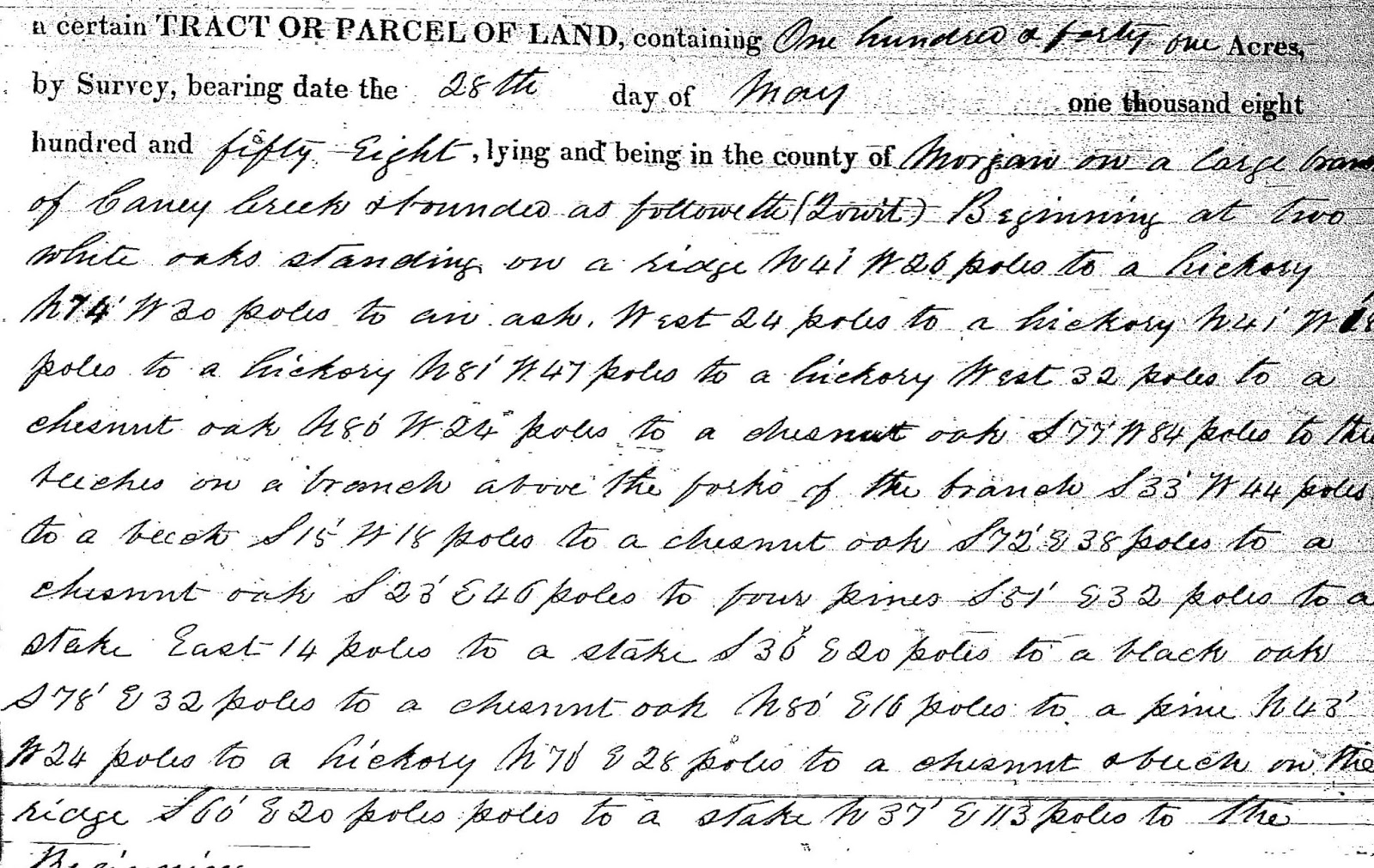
Kentucky Land Grant dated 28 May 1858

My branch of the Castle family was actually a little late to the migration from Virginia to Kentucky. In 1858 when "Goolen" Castle purchased 141 acres on Large Branch, Caney Creek, Morgan County had already been in existence for over 25 years. Enumerated in Morgan County, West Liberty Post Office, on the 1860 census were: G. D. Castle, age 36; Rachel, age 35; William, age 14; James, age 8; John, age 4; and Lilburn, age 1. Little John and Lilburn would not live very long; they both died of scarlet fever in 1861 within days of each other. 


Death Records for John and Lilburn Castle, 1861


By 1870 Goldman and Rachel's family was complete with the birth of daughter Sarah Frances "Sis," born in 1861; my great-grandfather, George Turner, born in 1863; and Nancy Anna, born in 1868. In 1867 the first of Goldman and Rachel's children married; William Henderson Castle married Nancy Jane Wells on 5 November 1867. Their first grandchild, John Seymour Castle, was born 3 July 1869.

My great-grandfather, George Turner Castle, married for the first time on 17 October 1884 to Mary Frances Nickell. Their daughter, Cora Lee, was born 10 March 1890. Mary Frances died 10 April 1893. Unable to care for his daughter, George turned to his parents who brought Cora into their home to raise. In fact, on the 1900 census Cora is enumerated with both her father and his new family and with her grandparents. George's new family consisted of wife Florida (Day); daughter Fannie (my grandmother), age 3, and son Forrest, age 1.

1900 Morgan County KY census, enumerating
Cora Castle with both her father and grandfather


G. D. Castle was first appointed Postmaster of Castle, Kentucky, on 21 March 1896 and kept the position for several years. He received compensation of $8.01 in 1897 and $23.68 in 1901. The post office was at one end of his house.

Record of Goldman D. Castle's Postmaster Appointment

What I know about my 2nd great-grandfather, Goldman Davidson Castle, I learned from my grandmother, who dearly loved him. He was 73 when my grandmother was born in 1897. I grew up hearing stories about how she stood on a chair and brushed his silver hair; how she tried on his "specs" (spectacles=glasses); how he saved the metal stars on top of his Star Chewing Tobacco and gave them to her; and how he so adored his wife Rachel that he would bring her "sweet crackers" after his visits to town--which she kept in her bureau drawer and did not share with the grandkids. You could definitely tell who her favorite grandparent was!

Here is my grandmother's description of her grandfather in her own words:
Sturdy type man--My first remembrance of Grandpa was about 1900-01. He let me try on his steel-rim specks (spectacles) and walk up and down their long porch to their log house of 4 or 5 rooms. The porch was boxed in on one end and contained the Castle, Kentucky Post Office. 
Large orchard back of house, cribs of corn, barn for horses, cows, sheep, hogs, chickens, and turkeys--Meadow for mowing in front of house. They lived there many years. I think all the children lived there as they grew up. After Frances Nickell died (childbirth), Dad brought 2-year-old Cora back to live at Grandpa's. About 1903 the Post Office was robbed and crib of corn burned. They were afraid to live alone and were getting up in years, so they moved in with us. I have some pleasant memories of the whole family sitting before a wood fire in Grandpa and Grandma's room after dinner listening to Grandpa talk.
He had beautiful, silvery, wavy gray hair and blue eyes--These words describe him: pleasant, independent, honest. He and my mother organized the first Sunday School at Stacy Fork, Kentucky. I think most of the Castles were (hard shell) Baptists. They held their association meetings once a year.
He chewed Star tobacco that he bought in 2-inch by 2-inch squares (sweet) with metal stars on it. He gave me the stars.
The Castles had the reputation of having well-filled larders (pantries)--canned and dried fruits and vegetables, a smoke house, the ceiling bristling with hickory-cured hams--Grandpa was an artist at preserving meat and sausage--a barrel of kraut, a barrel of pickles, a barrel of sorghum, pounds of homemade butter with the imprint of a little jersey cow on the mold, jars of honey from the beehives in one corner of the big yard.
In autumn large holes were excavated in one corner of the garden plot, these were lined with straw and filled with potatoes, onions, turnips, and apples, then covered with straw and dirt to a depth of no freezing. The whole family joined in this project of producing and preparing our daily bread.
Wood, coal and kerosene gave us heat and light. We bought flour by the barrel, sugar by the 50# bag, had corn ground for meal at nearby mill. These are a few happy memories of my old Kentucky home.
In February of 1907 Goldman Davidson Castle died and was buried in the little Castle cemetery on his own land where some of his grandchildren were already buried. I always wondered if my great-grandfather George held out until his father died before making the decision to move to Oklahoma in the summer of 1907. Rachel moved in with her son, James Harvey, who stayed on the Castle land, and George sometimes came back to visit, but my grandmother never saw her Kentucky home again.


G. D. Castle's gravestone in Castle family plot

All three of G. D. Castle's surviving sons named sons after him. William Henderson's son, who was named as Davidson on the 1900 census, was born in June of 1882. He died just three years after the census in 1903. James Harvey's son Goldman was born in 1884 and died in 1888. He is buried in the Castle family plot. George Turner named his next-to-youngest son Goldman Henry, but to me he was Uncle Harry. He used both the names Goldman and Harry, but a lot of family members and friends called him "Plute." He was born in 1905 and died in 1978 and is buried at Rose Hill Cemetery in Tulsa.

Wednesday, October 16, 2019

Elizabeth Simmons Mansell Cotton: 52 Ancestors #1 (Smith side)

In January 2014 a genealogist named Amy Johnson Crow issued a challenge to other genealogists that she called "52 Ancestors in 52 Weeks." The challenge was to profile an ancestor every week for an entire year, beginning in January. 

For a couple of reasons I didn't jump on the 52 Ancestors bandwagon right away. I had started this blog in 2013 and many of the blog posts that I had already written profiled an ancestor or a family. For example, I had already done short posts about my parents and each of my grandparents, along with posts like The Smiths in Oklahoma, The Castles in Kentucky, The Wheats in Texas, and The Ming Dynasty about the ancestors of my four grandparents. 

Another reason I didn't take the 52 Ancestors challenge is that I found it hard to start in January. January was all about finishing the old year--taking down Christmas decorations and doing taxes--and going back to school after Christmas vacation ready to fill teenagers' heads with knowledge. I didn't have much time left in my schedule to write weekly posts.

Now it's 2019 and I'm finding it hard to find new things to write about. When I find a new relative or take a trip, I share what I've learned or experienced, but I need something that keeps me writing every week. 52 Ancestors is the inspiration I need, but I'm going to start and end the 52 Weeks with my birthday instead of the traditional January through December. My schedule is still pretty full--even though I'm retired--but I hope to meet the challenge of "52 Ancestors in 52 Weeks."

I'm starting with my 3rd great-grandmother on my Smith side, Elizabeth Simmons. I have mentioned her in several blog posts, but I've never done an individual profile of her. I think she's a good example of how a hunt for primary documents can lead to surprising information about an ancestor.

When I started doing genealogy 30 years ago, I didn't know anything about Elizabeth Simmons, the mother of my great-grandmother, Fannie, who was the wife of Stephen Albert Smith and the mother of my grandpa, Weaver Harris Smith. I had always thought that Fannie's maiden name was Cotton. I had never heard the last name Mansell, the surname of Elizabeth's first husband. 

Then my brother and I were in Oklahoma City, looking for evidence that we had Cherokee ancestry. Yes, we had one of those families with a story about having a Native American ancestor. We had always been told that Fannie was Cherokee. What we found in Oklahoma City was Fannie's rejected application for Cherokee citizenship. That was the bad news. The good news was a lot of genealogical information that we didn't know. For this post I'd like to focus on what we found out about Elizabeth from this application.

Some of the information was in Elizabeth's own words. The application included a deposition that Elizabeth had given about her background and ancestry, and therefore her daughter's. Almost certainly, some of the statements in the deposition are not true, and consequently it throws the whole document into question; however, some of the statements have been verified by DNA results and other documents, and maybe someday proof will be found for other statements that Elizabeth made.


Here is a transcript of the deposition followed by further explanation of the numbered statements:

Exhibit "E"

Territory of Oklahoma
County of Cleveland  1

I, Elizabeth Cotton having first duly...and...[unclear, blot, and words marked out] and says. That I was born November 11 A.D. 1812 near Raleigh N.C. 2  That my maiden name was Elizabeth Simmons. That I was married to John Mansell in A.D. 1826 near Raleigh N.C. who died on or about the year A.D. 1850. 3  That I was again married to William Cotton on or about the day of _____ A.D. 1861 and that said William Cotton died in the year A.D. 1875. 4  The affiant further states that her mother's maiden name was Priscilla Soules and that she was born in North Carolina near Raleigh. 5

This affiant further states that her mother was a half breed Cherokee and so recognized by the authorities of the Cherokees, 6 and that the said John Mansell to whom I was first married was a Cherokee by Blood. 7 That I do not remember the names of any of the Principal [Minor?] Chiefs of the Cherokees.

The affiant further states that Frances [Sclania?] Smith is my daughter by my first husband John Mansell 8 and is the only child now alive 9 and further deponent saith not.

Witness to mark A. [Nicodemus?]                                          Elizabeth X Cotton
                           J. R. Shaver                                                         her mark

Subscribed and [unclear--same word as above] to before me this 12th day of January 1894. 10

                                                                                                J. R. Shaver Notary Public
                                                                                                Commission expires Oct 9th 1897

1. I have no idea why Elizabeth would have been in Cleveland County. The family story has Elizabeth coming to Indian Territory with the Smith family in 1894. Cleveland County is south of Oklahoma City, and as far as I know, the Smiths have always lived in northeastern Oklahoma. According to my grandfather's World War I and World War II draft registration cards, he was born in Catoosa, Indian Territory in 1895. His family later lived in Collinsville and Oologah. All of these locations are in northeastern Oklahoma. 
    
As Elizabeth would have been 81 at the time of the deposition, it is more than likely she was living with relatives. It has been suggested that Elizabeth came to Oklahoma with the Smith family and then traveled with her niece's family back to Alabama. Census records show that Elizabeth's niece, Joanna Mansell Webb, traveled back and forth between Alabama and Oklahoma before finally settling in Pontotoc County, Oklahoma, which is closer to Oklahoma City than to Tulsa. 
    
Perhaps the Webbs were living in Cleveland County in 1894, maybe Elizabeth traveled there to make the deposition for some reason, or maybe there is another explanation yet to be uncovered. 

2. When I discovered this document many years ago, I didn't question Elizabeth's birth date or place. Who would know better when and where they were born than the person herself? In the years since I found this deposition, other information would surface to call both date and place into question. The date is all tied up with the identity of Elizabeth's parents. It took me a while to connect Elizabeth with the right family, because as you may have noticed, she does not give the name of her father in this document.

When I first began to search for Elizabeth Simmons' mother, Priscilla Soules/Soles, I found a few trees on Ancestry that showed her as the wife of Luke R. Simmons. Many more trees, however, listed his wife as Priscilla Hargette. (I have never found the source for that identification.) I also found a lot of trees that didn't even list Elizabeth as one of the children of Luke and Priscilla. My only paper source for the identification of Priscilla Soles as Elizabeth's mother came from Elizabeth's deposition.     

When DNA came into the picture, however, I found plenty of matches to Simmons and Soles descendants. One of them has done a great deal of work on Simmons lines--his website is sjcjr.com--and corresponds with me frequently. A few years ago he shared the transcript of births listed in Luke Simmons' Bible that he found in the Troy, AL Public Library. It is obvious that all of the births except the last one were recorded years after the fact, as the Bible was published in 1827. Here is the list of births (and one marriage) from the transcript:


Page 1 -- This Bible the Property of Luke R. Simmons
Page 2 -- Luke R. Simmons and his wife Priscilla was married January 24, 1811
Page 3 -- Luke R. Simmons was born May 20, 1791
                        Priscilla Simmons was born April 5, 1792
                        Elizabeth Simmons was born December 10, 1812
                        Jemima Simmons was born October 13, 1815
                        Susannah Simmons was born August 14, 1817
                        Patience & Nancy Simmons was born January 2, 1821
Page 4 -- Leonard M. Simmons was born February 20, 1823
                        Rebekah Simmons was born June 8, 1825
                        Elizar Simmons was born August 7, 1827

So here is another paper document verifying that Luke and Priscilla (why, oh why, didn't he list her maiden name?) had a daughter named Elizabeth, their firstborn, but her birth date is exactly 30 days late, according to the birth date she gives for herself. 
     
Elizabeth's place of birth is confusing, too. On the 1820 census the Simmons family is living in Columbus County, NC, over 100 miles south of Raleigh. Some family researchers have found it implausible that Elizabeth was born in Raleigh, a location not known to be associated with the Simmons or Soles families. 

I recently found a Findagrave entry for Elizabeth's sister, Eliza, born 1826, that said that she too was born in Raleigh. After doing a little research, that one is easier to explain. Their father, Luke R. Simmons, was first elected a delegate from Columbus County to the House of Commons of the North Carolina General Assembly in 1820 and subsequently served until 1834, first in the House and then in the Senate. The General Assembly met in Raleigh, the state capital, so for at least some parts of those years, Luke R. Simmons (and apparently, his family) lived in Raleigh. That still doesn't explain Elizabeth, born in 1812. 

3. According to the U.S. and International Marriage Records database on Ancestry, Elizabeth Simmons married John Mansell in 1826 in North Carolina. The first time that John Mansell appears on the census is 1830 in Columbus County when he was already married to Elizabeth. The assumption is that he is from Columbus County. Did he and Elizabeth marry in Raleigh as she stated? Her father would have been serving in the General Assembly there in 1826, so it's possible.

Have you done the math? John Mansell, born in 1800, was 26 when he and Elizabeth married. Elizabeth, born in 1812, was 14. 

Elizabeth stretched the truth a little with John's death date. He died in 1844, not 1850. I'm pretty sure I know why she did so. Fannie, her youngest child and only daughter, was born in 1849, so John Mansell's death date of 1844 means he is not her father. Elizabeth was claiming that Fannie's father, John Mansell, was also Cherokee by blood, in case it was not enough to claim that citizenship for herself. So the question is, who was Fannie's father? I may never know, unless I can someday determine it from DNA results.

4. Elizabeth married William W. Cotton on 26 August 1863. Her deposition states that he died in 1875. I have not found any document to verify this. Elizabeth's daughter used the maiden name Mancil when she married Stephen Albert Smith in 1868. The only name I knew for her until I found the deposition was Fannie Cotton.

5. While I have not been able to find verification that it was indeed Priscilla Soles who married Luke R. Simmons and was the mother of Elizabeth Simmons, my DNA matches with Soles descendants do seem to back it up. 

6. Elizabeth claimed to be half Cherokee, but given everything I have found out about her ancestry, that doesn't appear to be true. My Simmons cousin who has done so much research has yet to determine if our Simmons family was English or Swiss, but they certainly weren't Cherokee. It looks like Priscilla Soles descends from a Mayflower passenger. (See my post "DNA Circle: Timothy Soles.") The applications for Cherokee citizenship made by Fannie Smith, and later by Stephen Albert Smith on behalf of his children, were rejected as they could not make a connection to anyone on the Cherokee tribal roll. 

7. The Mansells who applied for Cherokee citizenship were also rejected.

8. Not true, as explained above. Fannie was not the daughter of John Mansell. There is an interesting tidbit in this statement though. Elizabeth refers to Fannie as Frances [Sclania?] I'm not sure I'm even reading the handwriting correctly, although that's what it looks like. On anything where Fannie used an initial for her middle name, it was "A." Again, if anybody knows, it would be Elizabeth. Maybe it's a misspelling of Selina, a popular name in those days, or maybe Elizabeth was trying to make up an Indian name. Who knows?

9. Sadly, I think this one is probably true. Elizabeth had 7 sons (more about them later). At least 4 of them died in the Civil War. One lived until 1876, and another until 1880. I can't find one of them after the census of 1860, so it's possible he died young or in the war.

10. Obviously, Elizabeth lived until at least 1894. In my great-grandfather's deposition attached to the application for Cherokee citizenship, dated 28 August, 1896, he stated that "my mother-in-law is now dead."

So those are the biographical details of Elizabeth's life--birth, marriage, death--in a document based on her own words. What else can we found out about her from census records?

1820 census -- Columbus County, NC. Three females under 10 are enumerated with head of household, Luke R. Simmons, two females 26-44, and one male under 10. Elizabeth is presumably one of the females under 10, along with her sisters, Jemima and Susannah. Some trees show Luke R. Simmons, Jr. as a son in this family, and he might be the male under 10 on this census; however, he is not listed in the Bible record. I don't know who the second female 26-44 is.

1830 census -- Elizabeth would have been enumerated with her husband, John Mansell. I cannot find him on the 1830 census.

1840 census -- Pike County, Alabama. John Mansel, head of household, is listed with family as follows: 1 male, 15-19; 2 males, 10-14; 1 male, 5-9; 2 males under 5; 1 female, 15-19; and 1 female under 5. With varying birth dates for Elizabeth's sons in other documents, these figures might fit with her known male children. However, Elizabeth should be listed as a female, 20-30. The female under age 5 must not have survived until adulthood.

1850 census -- Pike County, Alabama. Elizabeth "Mansfield," age 37, is listed as head of household (John Mansell having died in 1844) with sons William, age 25; Samuel, age 22; Daniel, age 18; Simeon, age 14; Benjamin F., age 10; John, age 9; Amos, age 6; and daughter Frances, age 1.

1860 census -- Pike County, Alabama. Elizabeth Mansill, age 47, is listed as head of household with sons Wm. A, age 34; Samuel J., age 27; Simeon C., age 15; daughter Francis, age 11; Pugh and Nancy J., age 7. As far as I know, no one has ever been able to verify the identity of twins, Pugh and Nancy. Were they Elizabeth's grandchildren, possibly children of William or Samuel who were living with her at the time? Were they Elizabeth's own children? In any case, they seem to disappear after this census.

1870 census -- Pike County, Alabama. William A. Mansell, age 44, is listed first at residence 110 along with William W. Cotton, age 57, and Elizabeth, age 58.

1880 census -- Lauderdale County, Alabama. Elizabeth "Lizzie" Cotton, age 69, is head of household. Her son William A. Mansell, age 55, is living with her.

We know that by the time Elizabeth made her deposition in 1894 she only had one child living, her daughter Frances/Fannie. What happened to her seven sons? Let's take them one by one.

William, the oldest, was born when Elizabeth was 14 years old, and he was still living with her in 1880 when he was 55 years old. A strong bond must have existed between mother and son. The William A. Mansell who enlisted in the 60th Alabama Regiment in 1864 in Montgomery, Alabama, may or may not be our William. (Brother Daniel also enlisted in the 60th Alabama.) A marriage license between a William A. Mansell and Elizabeth Hancock in Pike County, Alabama, is dated 25 March 1866. If this is our William, the marriage dissolved or Elizabeth died before the 1870 census when William is living with his mother and stepfather.

Samuel J. married Eliza Ann M. Tharp on 30 June 1854. He enlisted in the 15th Alabama Infantry in September of 1861 and died of disease in Richmond, Virginia, in November of 1862. In the document by which his mother claimed his final pay she stated that he left "neither child or children or father or wife." My cousins, who wrote a history of the Mansel family called "Pages from the Past," have a hypothesis about Samuel and his wife, involving the mystery twins, Pugh and Nancy, who appear on the 1860 census. They wonder if perhaps Eliza died giving birth to the twins. Samuel left them with his mother when he enlisted, and they subsequently died before Elizabeth made the statement that Samuel left "no child or children..."

Daniel Monrow/Monroe Mansell married Margaret Brooks on 21 December 1854. Daniel enlisted in the 60th Alabama Regiment, Company C, in 1863, and survived engagements at Chickamauga, Bean's Station, and Drewry's Bluff. He and his wife raised a large family, and he died in 1876 in Waterloo, Alabama.

Simeon C. is a little bit of a mystery. He appears on the 1850 at age 14 and the 1860 census at age 15, then he disappears. No records of Civil War service have been found for Simeon, but it's possible he died in the war or during that decade.

Benjamin Franklin Mansell enlisted in Company G, 1st Regiment, Alabama Infantry, and died as a prisoner of war at Camp Randle in Wisconsin on 14 May 1862. He is buried in Forest Hill Cemetery, Madison, Wisconsin.

John E. joined the 15th Alabama on 15 August 1861 at age 19 and died of measles on 6 December at Hay Market, Virginia, before he turned 20.

Amos P. enlisted in the 15th Alabama at age 18 on 15 August 1861. He was wounded at Cold Harbor, Virginia, in 1862 but rejoined the fighting and was killed by a minie ball through the head on 2 July 1863 at Gettysburg, Pennsylvania.

Elizabeth died in 1896 with only one child still living, her youngest and only daughter, Frances "Fannie." Fannie died in 1905, leaving a 10-year-old, my grandfather, motherless. She is buried at Oakhill Cemetery in Oologah, Oklahoma, the only one of her family buried there.

So much loss. When I think of Elizabeth, it is with compassion at all she lost: two husbands and seven sons--four or maybe five, too young, in the violence and ruin of war.

There are two competing stories about Elizabeth's burial place. I had heard that she was buried in an unknown location in Oklahoma, until my cousins showed me the place where she is thought to be buried in Alabama. If she is in Alabama, she lies next to her eldest son, William, who was so close to her throughout his life. I hope that's where she is.