Documenting my family's past for future generations. My family tree includes the Smith/Mansell families of Alabama and Oklahoma, the Castle/Day families of Kentucky and Oklahoma, the Wheat/Ming families of Texas and Oklahoma, and the Bell/Roberts families of Mississippi, Tennessee, and Oklahoma.

Showing posts with label Castle. Show all posts

Saturday, January 7, 2023

Family Christmas

I can't believe it's been almost exactly a year since I last posted to this blog. It's interesting how I have less time to write now that I'm retired. I have gotten involved in several volunteer organizations and find myself getting ready to become President of one of them in May. My only grandchild was born in October of 2021 and lives close by, so he has become the most looked-forward-to part of every week. I joined a DNA study for my Wheat family side that has involved learning how to use WikiTree and keeping up with matches. It has also led to a new friendship with one of my distant Wheat cousins who lives in Kentucky; we communicate by email or text every few days and talk on the phone often. It seems I have something to do almost every day, and I have found I have less ability to multi-task the older I get.

I have to say that I haven't had any genealogical breakthroughs lately either, although I hope to write about one at the conclusion of the Wheat family study. So far, that looks unlikely, although we think we have decided who our common Wheat ancestors are not. What I want to write about today is the other side of my family, the Castle/Smith side. They always predominated at the holidays, because my dad's twin brother, Mack, and almost all my paternal grandmother's siblings lived close by when I was growing up and were always a part of our celebrations. This year was no exception, although so many who were an important part of past Christmases are now gone.

As my son and my brother's daughter have gotten older and started their own families, it has become harder and harder to schedule a time when we can all get together to celebrate birthdays or holidays. This year we finally decided to postpone our Christmas celebration until the afternoon of New Year's Eve. We would all meet at my house for lunch-y snacks, Dirty Santa for the adults, and presents to unwrap for the little ones--my grandson and my brother's granddaughter and grandson. In making our plans for the day, my brother Tim asked if there was anything special we did during our childhood Christmas celebrations. I think he was mainly asking about food, but I reminded him that our Christmas Eve get-togethers with our Uncle Mack's family in the 1950's and 60's usually involved a "program" of readings, songs, and poems, along with food and enthusiastic unwrapping of presents.

We're not talking anything classical here--somebody picked out "Jingle Bells" on the piano, somebody read the Christmas story, but my grandmother always recited a poem that she had learned for a Christmas program at school when she was in 3rd or 4th grade. We marveled that she could recite it word-for-word after 60 years; in fact, she knew 2 or 3 narrative poems by heart that she recited until she was 90, 80 years after she learned them in elementary school. We begged her to recite all of them whenever we got together for any kind of celebration, but I especially loved the one she recited at Christmas about Santa Claus on an immigrant train. Back to that later--

Since Tim was in a nostalgic frame of mind, I decided to create a slide show of photographs from family Christmases--from my 2nd Christmas in 1954 to his daughter's first Christmases in the 1990's. It was when I was looking for these photographs that I found one that was a lot older and would become a great addition to a get-together with our Castle cousins on Christmas Day. It was a professional photograph of the whole Castle family on Christmas Day 1942. That's the other part of this story.

Last year I got together with my cousin Ann's family at a restaurant dinner and then at her house for their family Christmas. Tim wasn't able to come last year, so this year he contacted our cousin Jayne, Ann's daughter, and asked if we could see them Christmas evening. We had both had Christmas with our respective nuclear families earlier in the day, which is why we couldn't do our joint Christmas celebration on Christmas Day, but we could both make it to Ann's for their family get-together that evening. I took the Castle photograph I had found. I don't know if you have done the math, but that photograph had been taken exactly 80 years ago to the day. Only two people in the photograph are still living, and one of them is my cousin Ann, seen at the far right on the front row.


Castle Family, Christmas Day 1942


Ann, Tim, and I were the only ones who could identify the people in the photograph, and none of us were sure about all the little boys. Using information from my family tree on Ancestry, I think I have been able to identify all the children of the 8 Castle siblings that were born by Christmas Day 1942.

So that was Christmas Day. Fast forward a week and my brother and his family were at my house for our Christmas celebration on New Year's Eve. We ate and visited and opened presents, then it was time for the program. It was pretty relaxed, but those that wanted to took turns with their parts of the program. My grandson Jack managed a few toots on a plastic flute; the little ones jingled bells while we all sang "Jingle Bells"; Tim's granddaughter sang her favorite Christmas song, "Last Christmas"; her father, who is from Liverpool, told us about English Christmas traditions; and I read the poem my grandmother used to recite, "Santa Claus on the Train." 

I can't believe I found it! I have looked for it for decades and had just about given up. This time I googled from my phone which gave different results than googling from my laptop. It took me to the blog of a woman whose mother had recited that same poem in a Christmas program when she was in school. The blog included a photograph of a faded and torn copy of the poem. It must have been a Christmas miracle, because I can't find it now using the same search I used a month ago. So--here it is--the poem my grandmother recited from memory 80 years after she learned it and I read to my family on New Year's Eve 2022.

Santa Claus on the Train

On a Christmas Eve an emigrant train

Sped on through the blackness of night

And cleft the pitchy dark in twain

With the gleam of its fierce headlight.


In a crowded car, a noisome place,

Sat a mother and her child;

The woman’s face bore want’s wan trace,

But the little one only smiled.


And tugged and pulled at her mother’s dress,

And her voice had a merry ring,

As she lisped, “Now, mamma, come and guess

What Santa Claus’ll bring.”


But sadly her mother shook her head,

As she thought of a happier past;

“He never can catch us here,” she said,

“The train is going too fast.”


“O, mamma, yes, he’ll come, I say,

So swift are his little deer,

They run all over the world today;

I’ll hang my stocking up here.”


She pinned her stocking to the seat,

And closed her tired eyes;

And soon she saw each longed-for sweet

In dreamland’s paradise.


On a seat behind the little maid

A rough man sat apart,

But a soft light o’er his features played,

And stole into his heart.


As the cars drew up at a busy town

The rough man left the train,

But scarce had from the steps jumped down

Ere he was back again.


And a great big bundle of Christmas joys

Bulged out from his pocket wide;

He filled the stocking with sweets and toys

He laid by the dreamer’s side.


At dawn the little one woke with a shout,

‘Twas sweet to hear her glee;

“I knowed that Santa Claus would find me out;

He caught the train you see.”


Though some from smiling may scarce refrain,

The child was surely right,

The good St. Nicholas caught the train,

And came aboard that night.


For the saint is fond of masquerade

And may fool the old and wise,

And so he came to a little maid

In an emigrant’s disguise.


Monday, October 21, 2019

Goldman Davidson Castle: 52 Ancestors #2 (Castle side)

From last week's biography of my 2nd great-grandmother on my Smith side, Elizabeth Simmons, I'm turning this week to my 2nd great-grandfather on my Castle side, Goldman Davidson Castle. Goldman being a rather unusual name, I have found his records under the names Golman, Solomon, his initials G.D., and his nicknames "Goolen" and "Gool." 

G. D. Castle was born 23 February 1824 in Scott County, Virginia. It's hard not to compare Elizabeth Simmons and Grandpa Castle since they were fairly close in age and in the same relationship to me--2nd great grandparents. I never met anyone who had met Elizabeth Simmons, although my dad once told me that he had heard a description of her from someone who saw her when she came to Oklahoma. (Another reason why I believe she did actually come to Oklahoma.) On the other hand I know quite a bit about G. D. Castle because my grandmother remembered him and told me about him. Can you imagine? An eyewitness description of someone born in 1824!!

Goldman Davidson was the son of William and Margaret (Cox) Castle. He married Rachel Sergeant/Sargent on 1 September 1844. Sometime between 1840 and 1850 they all moved to Pulaski County, Kentucky, from Scott County, Virginia. The first time that Goldman appears by name is on the 1850 census in Pulaski County, on the page previous to the page on which his parents appear. Family #707 includes "Solomon" Castle, age 26; his wife Rachel, age 24; and son (William) Henderson, age 2. #708 is Rachel's brother, William Sargent, age 23. Family #713 includes William Castle, age 50; Margaret, age 51; William H., age 21; Margaret, age 17; Henry G., age 14; and Patton, age 8. Also in Pulaski County in 1850 is William's son and Goldman's older brother, James, age 35, enumerated with his wife and three children.

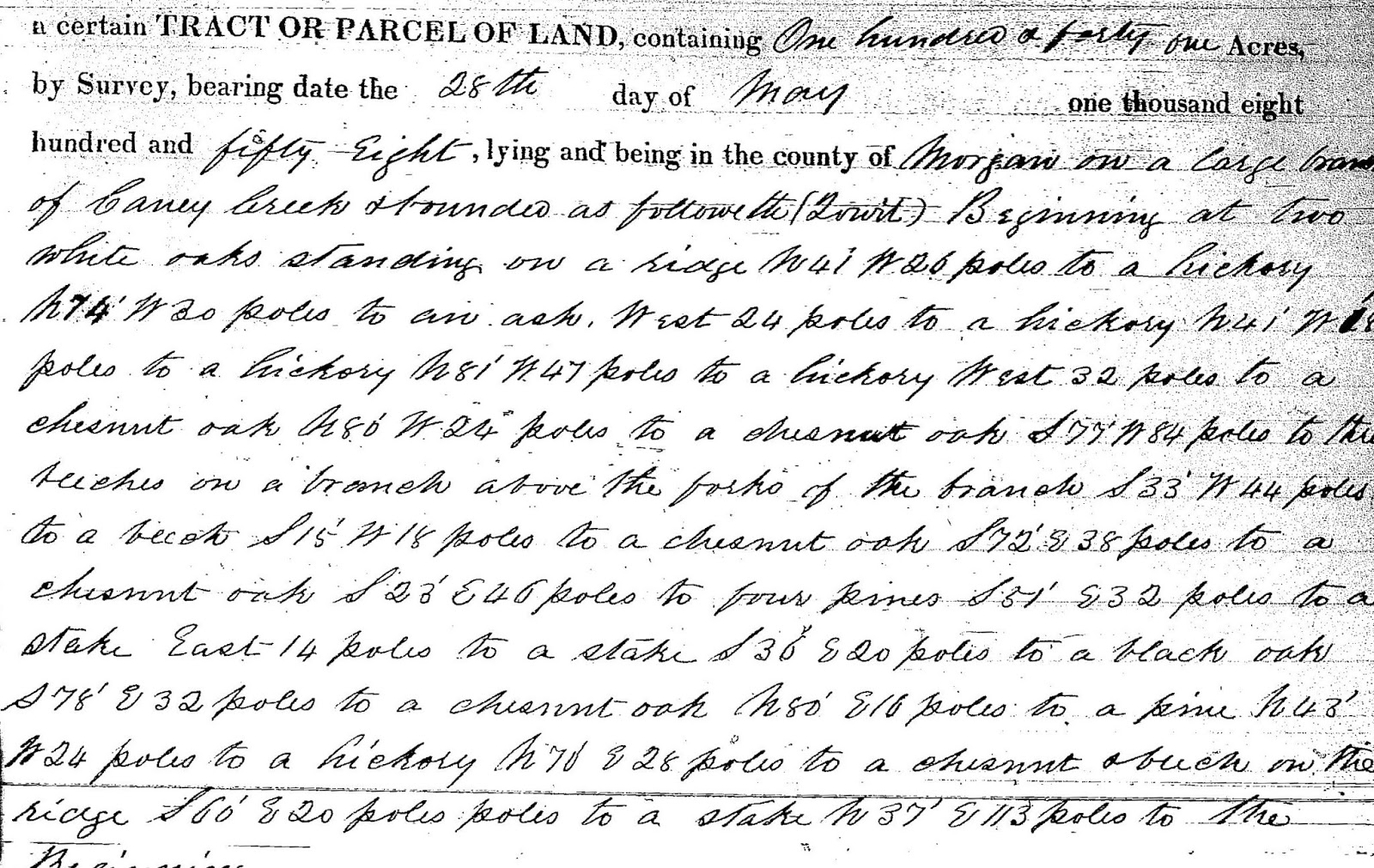
Kentucky Land Grant dated 28 May 1858

My branch of the Castle family was actually a little late to the migration from Virginia to Kentucky. In 1858 when "Goolen" Castle purchased 141 acres on Large Branch, Caney Creek, Morgan County had already been in existence for over 25 years. Enumerated in Morgan County, West Liberty Post Office, on the 1860 census were: G. D. Castle, age 36; Rachel, age 35; William, age 14; James, age 8; John, age 4; and Lilburn, age 1. Little John and Lilburn would not live very long; they both died of scarlet fever in 1861 within days of each other. 


Death Records for John and Lilburn Castle, 1861


By 1870 Goldman and Rachel's family was complete with the birth of daughter Sarah Frances "Sis," born in 1861; my great-grandfather, George Turner, born in 1863; and Nancy Anna, born in 1868. In 1867 the first of Goldman and Rachel's children married; William Henderson Castle married Nancy Jane Wells on 5 November 1867. Their first grandchild, John Seymour Castle, was born 3 July 1869.

My great-grandfather, George Turner Castle, married for the first time on 17 October 1884 to Mary Frances Nickell. Their daughter, Cora Lee, was born 10 March 1890. Mary Frances died 10 April 1893. Unable to care for his daughter, George turned to his parents who brought Cora into their home to raise. In fact, on the 1900 census Cora is enumerated with both her father and his new family and with her grandparents. George's new family consisted of wife Florida (Day); daughter Fannie (my grandmother), age 3, and son Forrest, age 1.

1900 Morgan County KY census, enumerating
Cora Castle with both her father and grandfather


G. D. Castle was first appointed Postmaster of Castle, Kentucky, on 21 March 1896 and kept the position for several years. He received compensation of $8.01 in 1897 and $23.68 in 1901. The post office was at one end of his house.

Record of Goldman D. Castle's Postmaster Appointment

What I know about my 2nd great-grandfather, Goldman Davidson Castle, I learned from my grandmother, who dearly loved him. He was 73 when my grandmother was born in 1897. I grew up hearing stories about how she stood on a chair and brushed his silver hair; how she tried on his "specs" (spectacles=glasses); how he saved the metal stars on top of his Star Chewing Tobacco and gave them to her; and how he so adored his wife Rachel that he would bring her "sweet crackers" after his visits to town--which she kept in her bureau drawer and did not share with the grandkids. You could definitely tell who her favorite grandparent was!

Here is my grandmother's description of her grandfather in her own words:
Sturdy type man--My first remembrance of Grandpa was about 1900-01. He let me try on his steel-rim specks (spectacles) and walk up and down their long porch to their log house of 4 or 5 rooms. The porch was boxed in on one end and contained the Castle, Kentucky Post Office. 
Large orchard back of house, cribs of corn, barn for horses, cows, sheep, hogs, chickens, and turkeys--Meadow for mowing in front of house. They lived there many years. I think all the children lived there as they grew up. After Frances Nickell died (childbirth), Dad brought 2-year-old Cora back to live at Grandpa's. About 1903 the Post Office was robbed and crib of corn burned. They were afraid to live alone and were getting up in years, so they moved in with us. I have some pleasant memories of the whole family sitting before a wood fire in Grandpa and Grandma's room after dinner listening to Grandpa talk.
He had beautiful, silvery, wavy gray hair and blue eyes--These words describe him: pleasant, independent, honest. He and my mother organized the first Sunday School at Stacy Fork, Kentucky. I think most of the Castles were (hard shell) Baptists. They held their association meetings once a year.
He chewed Star tobacco that he bought in 2-inch by 2-inch squares (sweet) with metal stars on it. He gave me the stars.
The Castles had the reputation of having well-filled larders (pantries)--canned and dried fruits and vegetables, a smoke house, the ceiling bristling with hickory-cured hams--Grandpa was an artist at preserving meat and sausage--a barrel of kraut, a barrel of pickles, a barrel of sorghum, pounds of homemade butter with the imprint of a little jersey cow on the mold, jars of honey from the beehives in one corner of the big yard.
In autumn large holes were excavated in one corner of the garden plot, these were lined with straw and filled with potatoes, onions, turnips, and apples, then covered with straw and dirt to a depth of no freezing. The whole family joined in this project of producing and preparing our daily bread.
Wood, coal and kerosene gave us heat and light. We bought flour by the barrel, sugar by the 50# bag, had corn ground for meal at nearby mill. These are a few happy memories of my old Kentucky home.
In February of 1907 Goldman Davidson Castle died and was buried in the little Castle cemetery on his own land where some of his grandchildren were already buried. I always wondered if my great-grandfather George held out until his father died before making the decision to move to Oklahoma in the summer of 1907. Rachel moved in with her son, James Harvey, who stayed on the Castle land, and George sometimes came back to visit, but my grandmother never saw her Kentucky home again.


G. D. Castle's gravestone in Castle family plot

All three of G. D. Castle's surviving sons named sons after him. William Henderson's son, who was named as Davidson on the 1900 census, was born in June of 1882. He died just three years after the census in 1903. James Harvey's son Goldman was born in 1884 and died in 1888. He is buried in the Castle family plot. George Turner named his next-to-youngest son Goldman Henry, but to me he was Uncle Harry. He used both the names Goldman and Harry, but a lot of family members and friends called him "Plute." He was born in 1905 and died in 1978 and is buried at Rose Hill Cemetery in Tulsa.

Friday, April 12, 2019

For Maryo

I met a new cousin this week. Well, that's not exactly true. I think we were introduced about 12 years ago at a funeral, but neither of us actually remembers being introduced. We met again when she replied to my message on Ancestry asking who she was. With our 308 cM's of shared DNA, Ancestry had estimated us to be 2nd cousins, but I didn't recognize her name, and she didn't have a tree yet. I told her I thought we must be related on my Smith side because of our Shared Matches.

Her reply affirmed that we are Smith cousins and 2nd cousins, sure enough. Her mother was Billie Virginia Smith Byars, and her grandparents were Owen and Fern (Walker) Smith. Her grandfather, Owen, and my grandfather, Weaver, were the oldest and youngest sons of Stephen Albert Smith and his wife Frances (Fannie). 

To me, our connection is more than just biological, more than just the fact that our grandfathers were brothers. In fact, if it weren't for her grandparents, I wouldn't be here today. In our correspondence with each other Maryo told me that she only knew "bits and pieces," that her sister--who passed away earlier this year--was the one that knew the family history. She wanted to know more about her grandfather Owen and her grandmother Fern. I had a great story to tell her, but I wanted to see if I could find out more before we talked.

Here is the story I already knew. Fannie Castle, my grandmother, got her first teaching job in a one-room school between Owasso and Collinsville, Oklahoma, during World War I. Since her family lived 30 miles away in Red Fork, she boarded with Mrs. Elizabeth Walker in Collinsville during the school week. Mrs. Walker's daughter, Fern, was married to Owen Smith, who ran a soda shop called the Candy Kitchen with his brother, Weaver. My grandmother, the teacher, was introduced to my grandfather, the soda jerk, and they were married in 1918. If my grandmother had gotten a job closer to home, if Fern hadn't married Owen, if my grandparents had never been introduced, I truly wouldn't be here. 


Fern Walker Smith

Fern passed away when her daughter Billie was still very young, and my grandmother and grandfather often spent time with her. Through the years my grandmother kept up with Billie and her son, Roy "Bud" Byars, and many years later I became friends with Bud's wife, Metzie, who was an avid genealogist until her death in 2012. It was at her brother Bud's funeral that I think Maryo and I were introduced.   

We had agreed to talk on Sunday. With a two-hour time difference I was going to call mid-day, which would be mid-morning for her. I stayed up late Saturday night, using marriage and census records on Ancestry to find out more about Owen and Fern and Mr. and Mrs. Walker. If you go all the way back to my very first post on Becky's Bridge to the Past, you will find that this family story was the inspiration for the blog, but that I didn't know much more than the facts I have already given here. I knew that Mrs. Walker's maiden name was Whitmore. I knew that Fern had a brother named Pearcy. I knew that there was someone named Amanda, but I couldn't remember if she was their sister or Pearcy's wife.

So last Saturday night I did a little researching. I found some new facts and was reminded of some I had forgotten. I documented the marriage of Fern and Owen on 16 January 1912 in Collinsville, and of Elizabeth Whitmore and James N. Walker on 31 December 1879 in Benton, Arkansas. By 1900 James and "Lizzie" were living in Valley Center, Sedgwick County, Kansas, with four children: Alonzo, Daisy, Fern, and Pearcy; next door was Oscar Walker, age 32, with wife and daughter. In 1910 J.N. and Lizzie were in Rogers County, Oklahoma. Only Fern and Pearcy were still living at home. Next door was O.U. Walker, about the same age as James; a brother named Oscar?

I got stuck following Elizabeth back to her parents, because I couldn't find her on the 1870 census. James was hard, too, with such a common name, so I tried following his brother Oscar. By using census and Findagrave entries for Oscar, I thought it likely that their parents were William and Virginia Walker of Elm Springs, Arkansas.

I couldn't find the right Alonzo Walker after 1900. I thought Mr. Walker died about 1910, because he never showed up in the census again with Mrs. Walker. However, he remained a rather hazy figure for me; if he died before 1915, my grandmother never knew him, and yet I thought I remembered her speaking of him in a not very complimentary way. I remembered that Metzie had found something out about Daisy, but I couldn't remember what it was. Pearcy died at age 22 in 1916, and I still wasn't sure if Amanda was his sister or his wife. Fern died the same year, leaving Billie who was not quite 4 years old. Billie appeared with Mrs. Walker on the 1920 census, and then Mrs. Walker died in 1926. I couldn't find Billie on the 1930 census.  

I was as ready as I was going to be for my conversation with Maryo. 

Maryo had some questions, and I had a few answers. Some of the answers led to more questions. She had a piece of information that proved to be crucial to further research. 

We talked about her grandparents, Owen and Fern. She was unaware that Owen had been married several times. She only knew about Fern and Rhoda, Owen's last wife, whom we both remembered. I know my grandmother told me he had been married 5 or 6 times (!), but it must have been between censuses, because I couldn't find any other wives' names. However, on the 1910 census (before he married Fern), he was living at the Smith boarding house in Collinsville and was designated as Divorced. As he was 29 at his marriage to Fern, he had had plenty of time to get married and divorced. I told her that the Walkers blamed Owen for Fern's death, and that he had very little contact with Billie as she grew up. Maryo wondered about the date of their marriage and Billie's birth--both in 1912. Was Owen bitter because he had been forced to marry Fern? I could answer that one. Apparently not, as they were married in January and Billie was born in November.

I told her about a photo that Metzie had, showing Owen participating in a wild west show, a popular entertainment of the early 1900's. I have a photocopy that Metzie made for me, and I promised to send it to her.

Owen in Wild West Show (unfortunately, I don't know
which one is Owen)

She wondered who Fannie was. That was a name she had heard and also seen--on the back of a locket that Billie wore. I told her that it could be my grandmother, but it could also be referring to Owen's mother. As his mother died in 1905, she felt sure the Fannie she had heard about was my grandmother. I told her that my grandparents spent a lot of time with Billie when she was young. She wondered how they got together after my grandparents moved to Red Fork. I couldn't answer that question, but my grandmother did. (See below) 


Billie Smith and Fannie Castle

She wondered what I knew about Tom and Ella Arnold, who raised Billie after the death of Mrs. Walker. I didn't know anything. I think that Metzie must have mentioned them to me, but it was one of those things that didn't stick. So, after our conversation it was back to Ancestry to follow up on some leads and tie up some loose ends.

The name Ella Arnold eventually led me to the 1930 census of Stroud, Oklahoma, where Ella was designated "sister" to the head of household, Andrew J. Whitmore. The other members of the household were Andrew's wife Edith and (guess who?) Billie, age 18, designated as "roomer." So apparently Andrew was Mrs. Walker's brother, Ella was Mrs. Walker's sister, and Tom, Ella's husband, had died. With the names Andrew, Elizabeth, and Ella Whitmore, I was able to find them on the 1870 census in Lincoln, Andrew County, Missouri, with parents William and Ann Eliza Whitmore, and a slew of other siblings. (No wonder I had so much trouble finding them as their last name was spelled "Whittemore.") I wasn't positive I had found the right family until I found Ann Eliza on the 1895 Kansas State Census in Wichita, Sedgwick County, living with T.E. (Tom) and Ella Arnold. This seemed to confirm Maryo's recollection of the Arnolds' home in Wichita, which relatives had described as a "mansion." 

I tried to find the final resting place of James N. Walker. There is a James N., born in the same year as our Mr. Walker, buried in Tontitown, Arkansas. Google Maps says that is 2 minutes away from Elm Springs, where he grew up. But this James N. died in 1922. If he is Mrs. Walker's husband, where was he on the 1910 and 1920 censuses? Did he abandon the family, which was the hazy recollection I had from decades-old conversations with my grandmother? 

If I haven't said this before, and I'm sure I have, my grandmother was amazing. I guess because she didn't make family trees and keep meticulous records, I didn't think of her as a genealogist, but she was, and I'm sure she's the reason that I have always been so interested in genealogy myself. In her 80's and 90's when she was home by herself most of the day, she made scrapbooks for her nieces and nephews and wrote about her life in Kentucky around 1900 and her life in Oklahoma in the 1910's and 20's. That is why I shouldn't have been surprised when I found a document answering many of Maryo's questions.

It was in my Smith file, along with a photocopy of Uncle Owen in his Wild West show. I'm the one who put it in the file, but at the time I guess I didn't need all the information it provided. How did my grandmother know that in 2019 I would need to know all about Mr. and Mrs. Walker and their families? Here is the transcription of the 5-page document that she wrote in her beautiful Spencerian script.


Mom's memories of the Walkers
in her handwriting


"In loving memory of a dear fine lady, Lizzie Whitmore Walker. She had 2 brothers, 1 sister: Andrew Whitmore, Frank Whitmore, Ella Whitmore Arnold.
She was married to Jimmie Walker in the 1890's [actually 1879]. They had 2 sons and 2 daughters: Daisy Walker ____?, 'Red' Walker, Fern Walker Smith, Pearcy Walker.
Fern married Owen Smith about 1914 or 15 [actually 1912]. They had 1 daughter, Billie Smith Byars. 
In the autumn of 1915 I went to Owasso Okla. to teach in a one room school. The Walkers lived about a mile east of the school. I boarded with the Pearcy Walker family (wife Mandy & small son 'Pete'). They were making preparation to move north of Collinsville. They told me their in-laws might keep me, so after an interview and looking me over they took me in and made me feel 'at home.' I spent 3 happy years with them. 
During that time I came to know Fern and her baby girl Billie. She told me of her wonderful brother-in-law Weaver Smith-- He proved to be a "super guy"; after a long courtship we were married June 29, 1918. We spent 52 years together before he died. He proved to be all and more than Fern recommended.
While I was living at the Walkers', Fern died of typhoid fever. Billie came to live with Grandma Walker. She was a dear little girl with brown curly hair. I grew to be very fond of her. She spent many Sunday afternoons riding in a buggy with her Uncle Weaver Smith and his girlfriend, 'Miss Castle.'
Weaver Smith and Fannie Castle were married and established a home in Red Fork, then a suburb of Tulsa. Billie spent many vacation trips with us. Mrs. Walker would come down on the Santa Fe R.R. to Tulsa and I would meet them and we would eat at Bishop's on South Main (It was then Tulsa's Best) and see all the movies at the Ritz, Majestic & Rialto. We had many happy times together. In 1916-1917 we saw all the 'old movies' that came to Collinsville. We had a horse & buggy at our disposal and Saturday saw us in Collinsville for lunch and ready for the 'Perils of Pauline' at the 1 o'clock show.
Mrs. Walker was an excellent cook. She taught me how to make Lemon Meringue Pie that is unexcelled. I shall never forget her flaky hot biscuits and homemade strawberry jam and homemade butter.
Lizzie Whitmore Walker and Granddaughter Billie hold a big place in my memory. 
The Jimmie Walker family lived around Cave Springs Ark. Jimmie Walker was Billie Smith Byars' grandfather. He had 2 brothers and 1 sister -- Oscar and Alex Walker were her uncles. The Walkers were the Drug Store owners at Cave Springs for many generations. Jimmie Walker is buried in this area. He died December 4, 1918." [She might have the date confused with Pearcy's death date, which was December 4, 1916.]
Facts my grandmother corroborated or got almost right:

  • Mrs. Walker had a brother named Andrew and a sister named Ella.
  • She was married to James (Jimmie) Walker and had four children: Daisy, "Red" (who must be Alonzo), Fern, and Pearcy.
  • She boarded with Pearcy and his wife, Mandy. (Years later, I was discouraged from naming my unborn child--who turned out to be a boy--Amanda. My grandmother said all she could think of was Amanda Walker, who was a big-boned, country girl, and she didn't want that for her granddaughter's name.) Pearcy and Mandy's marriage license shows her maiden name to be Birdsell, and I found the Birdsells living next door to the Walkers in Rogers County, OK, in 1910. I don't know what happened to Mandy and Pete after Pearcy's death.
  • She got marriage dates wrong. The Walkers married in 1879, not the 1890's. Owen and Fern married in 1912, not 1914 or 15.
  • The Walkers lived in Elm Springs, not Cave Springs. However, Mr. and Mrs. Walker did marry in Benton County, Arkansas, the same county where Cave Springs is located. There was a brother named Oscar. 
  • If I were a betting woman, I would say that the James N. Walker buried in Tontitown with a death date of 1922 is our guy. I think it's significant that he isn't buried with Mrs. Walker, Fern, and Pearcy, who are buried in Collinsville. My grandmother also mentioned the fact that he was buried somewhere else; she just got the place and date wrong.
My grandmother used to tease me about my need to follow the rules; in this case, making sure all the dates and places are correct and documented. She was more in the school of "close enough is good enough." You also have to remember that she was writing down these "facts" at least 60 years after they happened, and she didn't have Ancestry.com, where all the names, dates, and places are at your fingertips. But isn't it great to imagine all of them driving down the brick streets of Collinsville in a horse and buggy to go to the "picture show"?


To genealogists reading this post: While you're filling out your family tree and keeping meticulous records, remember to add some "fun facts" about yourself and the ancestors you remember. To family members--maybe yet to come--those stories will mean more than all the names and dates in the world.

Sunday, February 11, 2018

Monrovia Testerman Update

Back in July I wrote a post about Salina Monrovia Testerman, the half-sister of my grandmother's half-sister, Cora. (Secret Sister) Of course, Monrovia was not a secret. It was just that none of us knew about her. An Ancestry hint, found by my cousin Linda, led us to discover records that gave us the outline of Monrovia's life. However, it's the conversations I've recently had with three of Monrovia's granddaughters that have filled in the details and answered the questions we had.

It all started with an email that said, "My name is Julia. I am a Testerman and I have lots of info. Please call me." So I did, and we had a delightful 3-hour conversation over two nights. Julia did have lots of info, and she was able to flesh out the bare outline of her ancestors' lives that I had found in historical records. A subsequent phone conversation with Julia's cousin Helen and emails from another cousin, Kathryn, added more details to the story.


  • Yes, Mary Frances Nickell, Julia's great-grandmother, was married before she married George Turner Castle, my great-grandfather. Her first husband's name was Silas Monroe Testerman, and he did die tragically before the birth of his daughter and namesake, Salina Monrovia Testerman.

Mary Frances Nickell Testerman,
widow of Silas Monroe Testerman
(before marriage to George T. Castle)
  • Silas Monroe was pretty amazing. He was only 27 when he died, but he had accomplished a lot in his short life. He was a schoolteacher. He was a Mason and helped organize the Grange (in Morgan County, I presume); he kept a journal of his travels (which I hope to read); he played the violin and the dulcimer; he held a long-standing record as a high jumper; and he saved the life of a drowning boy but lost his own life in the attempt.

Silas Monroe Testerman

  • On the subject of names: Helen told me that in the years following the drowning a lot of new parents named their sons Monroe. All three cousins told me that their grandmother was emphatic in her preference to be called Monrovia. 
  • Kathryn's mother told her that Monrovia was in the wagon with her mother and her new husband, George Castle, when Monrovia jumped down and ran back to her Testerman grandparents, "crying that she did not want to leave them." She was 8. She apparently stayed with them until she married Alonzo Jones in 1898. Those are the kinds of details I love and the kind of thing we wouldn't know from the historical record. It seems that both of our families were lucky that our grandmothers passed down their childhood memories.
  • I mentioned to Julia that my grandmother told me that when Grandpa Castle died, her cousin John Smith Castle went to Hazel Green to get Cora, who was going to school at Hazel Green Academy. She said, "Oh, my goodness! Both Monrovia and Alonzo graduated from Hazel Green Academy!" Here's another scrap of memory that has more significance now that I know that Cora was following in her older sister's footsteps. (I just realized while writing this that John Smith Castle, who was the son of James Harvey Castle and his wife Elizabeth Nickell, was Cora's first cousin on both her father's and her mother's side.)
  • Monrovia and Alonzo had 9 children: Carl; Bernice; Clarice; Estella (who preferred to be called Estelle); Mary Catherine (named for her great-grandmother, Mary Catherine "Kitty" Brooks Nickell); Vernon; Wendell; Virginia; and Alfred. Helen is the daughter of Bernice, the second of Monrovia's children; Julia's father was Vernon, child number 6; and Kathryn's mother was the next to youngest, Virginia.

Alonzo and Monrovia Jones family
Left to right: Bernice, Estelle, Alonzo, Clarice, Wendell, Monrovia, Vernon, Carl


  • Mary Catherine was the only child that did not reach adulthood. She died of diphtheria; Monrovia also caught it but survived. Alonzo went to town and got the diphtheria vaccine and vaccinated the rest of the children. 
  • Finally, the answer to this question: Did Monrovia and Cora visit each other as adults? Yes! Kathryn has photos of the two of them together when they were older. The two sisters were close. When I asked this question of Julia, she told me I needed to talk to her cousin Helen, because Helen was actually born in Herington, Kansas, where Cora and Fred Jones lived. Fred had gotten Helen's father a job with the railroad in Herington, and the family moved there. Helen lived there until she was 7. 
  • Monrovia lived to be 96. In her later years she moved to live with her daughter, Bernice, in Nampa, Idaho. She had a small mobile home in Bernice's back yard. Helen remembers her as a sweet-tempered person, although Julia remembers her as also being "straight-laced." 
  • In 1975 Carl, Bernice, Clarice, Vernon, Julia, and youngest brother Alfred went on a road trip to visit every place that the Testermans had lived, including Herington, Kansas, and Morgan County, Kentucky. Helen has a picture of her mother, Bernice, with our mutual cousin Ralph Jones from that trip. Alfred Jones was a writer for the Capital Journal of Salem, Oregon; upon his return from the trip he wrote a 5-part series for the paper about the family's trip.


I have thoroughly enjoyed getting to know Julia, Helen, and Kathryn. Their memories and their obvious love of their family have made me feel as if I have also met their parents; their grandmother, Monrovia; and their great-grandfather, Silas Monroe. 

One more goose-pimply coincidence: How did Julia find me? She is in the habit of doing genealogy research at the McClung Library in Knoxville, Tennessee, near where she lives. A fellow genealogy researcher there suggested she look at my blog because he knew that she was a Testerman. How did he find my blog? He researches the Reeds, another of my ancestral families. I'm so glad he shared his find with Julia!

Friday, July 21, 2017

Secret Sister

I think the Castle readers of this blog will be interested in this post, but I also think our experience with this new "relative" could be helpful to anyone doing family research.

My cousin Linda recently texted me this question: "Was Cora's mother's name Mary Lesterman?" and then followed it up seconds later with a second text: "Never mind -- I remember it was Frances Nickell -- brain lapse."

Cora was the half-sister of the eight Castle siblings who were children of George Turner Castle and Sarah Florida Day. Cora was the daughter of G.T. Castle with his first wife, Frances Nickell. Cora's parents married in Morgan County, Kentucky, on 17 October 1884, and Cora was born on 10 October 1890. Her mother passed away on 10 April 1893, and Cora was subsequently raised by her Castle grandparents. Her father remarried to Florida Day on 2 January 1896.

The Castle and Nickell families were connected by more than just this marriage. Frances's sister, Elizabeth, was married to G.T. Castle's brother, James. The graves of James, Elizabeth, and some of their children (including Caledonia and her foot) are located with those of James and George's parents, Goldman and Rachel (Sargent) Castle, in Panama, Morgan County, Kentucky. You can read about our discovery of the graves here. That's why we were so sure that George T. Castle's first wife's name was Frances Nickell. That's all my grandmother ever called her.

Family of James H. and Elizabeth (Nickell) Castle

Which brings us back to Mary Lesterman. Linda had gotten a hint on Ancestry.com (Kentucky, County Marriages, 1783-1965) that George Castle had married Mary F. Lesterman (or in another index--Mary Flesterman) on 17 October 1884. We had both disregarded the hint because it was the wrong name, but what Linda had noticed was that it was the same date. That made me take a look at the original record of the marriage.

Hint #1: I've seen this hint over and over in genealogy self-help books, and I try to look at the original record if it's available online, but I don't always if I'm in a hurry. Make a vow right now: Always look at the original record if you have access to it.

The handwritten record made it obvious that the bride's name was not Flesterman; it was Mary F. Lesterman or maybe even Testerman. But what the index didn't show, and the original marriage register did, was the place of marriage: the home of J.W. Nickell. James Wilson Nickell was the father of Frances and Elizabeth Nickell. It began to be more and more probable that Frances Nickell was the same person as Mary F. Lesterman/Testerman.

Marriage record of Mary F. Nickell and S.M. Testerman

Hint #2: Usually my hint would be "Don't assume two people with similar names are the same person," but in this case, If dates or other details match up, don't assume that two people with similar names are not the same person.

My next step was to search the Ancestry records for a Frances Nickell who married a Testerman in Morgan County, Kentucky. Sure enough, Mary F. Nickell, age 17, married S.M. Testerman, age 27, on 4 February 1876. Sadly, Silas M. Testerman died 19 May 1876. Again, checking the original record supplied information the index didn't show. Poor Silas drowned. And apparently--and here's the thing that has surprised Linda and me--at the time of Silas's death Mary Frances was pregnant.

Death record for Silas M. Testerman

Hint #3: Check all the census records you can find for the relative you are researching. If I hadn't, I might never have noticed that Mary Frances had a child.

The next census in which Mary Frances would have appeared was the 1880. On the 1880 Morgan County census I found Mary Testerman, age 22, widowed, with daughter Salina M., age 3. Kentucky birth records show that Salina was born 17 November 1876.

Unfortunately, as most genealogists learn to their chagrin, the 1890 census mostly does not exist, due to a fire in 1921 at the Commerce Department Building where the records were stored. By 1900 Mary Frances was dead, and George Castle was remarried. The 1900 census shows that his family consisted of himself, wife Florida, and children Cora, Fannie, and Forrest. (Goldman and Rachel Castle, the next family on the census, also claim Cora, calling her "step daughter." Of course, she was really their grandchild.)

So, what happened to Salina?

Hint #4: Pay attention to Ancestry resource tips.

When you look at a source for an individual on Ancestry, Suggested Resources appear to the right of the page. I think they must be sources that are attached to the same individual by other Ancestry users. They are often extremely valuable when other records for an individual (census, birth, marriage, death) are difficult to find for some reason. (Beware; sometimes they are wrong. That's what makes me think they are selected by Ancestry users--sometimes in error.) In the case of Salina M. Testerman, they were very helpful--because Salina did not always go by the same first name.

When I look at Salina M. Testerman's 1880 census record, records for the following names appear in Suggested Resources: Salina Testerman, Monrovia Jones, Selina M. Jones, Monrovia Testerman, and Salina M. Testerman. Of course, I had to click on all the resources to determine if they all referred to the same woman. Apparently, they do.

Having not seen Silas M. Testerman's middle name on any primary source, I wasn't sure what it was until I found an entry on Findagrave for Silas Monroe Testerman. It looks like Mary Frances gave her baby a name that honored her father: Salina Monrovia. Monrovia Jones is enumerated on the 1900 census in Morgan County, Kentucky, with husband Alonzo H. Jones, whom she had married in 1898, and son Carl M. Jones, age 1. In 1910 the Jones family, with several more children, are living in Missouri; in 1920, 1930, and 1940 they are living in Kansas.

According to Findagrave, Alonzo and Monrovia are buried in Memorial Park Cemetery in Chanute, Kansas. Alonzo died in 1952; apparently, Monrovia moved to Idaho to live with one of her children, because the Social Security Death Index shows that a Monrovia S. Jones (with the same birth date as Salina M. Testerman) died in Nampa, Idaho, in 1971. They must have returned her body to Kansas for burial beside her husband.

Which is the weird thing. Cora Castle also married a Jones and lived and died in Kansas. I think Cora met her husband, Fred L. Jones, after the Castle family moved to Davenport, because Fred was born in Arkansas. They are listed on the 1910 census in Chandler, Oklahoma, with their son Ralph, who was just a baby. I can't find them on the 1920 census, but on the 1930 census they are living in Herington, Kansas, where they are both buried.


Cora Castle, Herington KS, 1940's

Chanute and Herington are about two and a half hours away from each other. Did Cora and her half-sister, Monrovia, visit each other as adults? Considering that he lived in another state, we saw our Jones cousin, Ralph, often. My grandmother told me stories about Cora, who was 7 years older than she was. She never mentioned that Cora had a half-sister, as far as I can remember, but Salina Monrovia had already married in 1900 when my grandmother was just 3, and by the time the Castle family settled in Davenport, Oklahoma, Salina Monrovia was in Missouri.

I have recently had a DNA match with a Jones cousin, the son of Ralph's brother, Lavelle. I have messaged him to ask about Monrovia, but I haven't heard back from him. If he has anything to add to the story, I will let you know.

Friday, July 7, 2017

Revolution Road Trip: Jacob Castle and Shenandoah

Finally--Shenandoah National Park! I had been anticipating this since I realized that Jacob Castle owned land not far from the park. Tim and I had visited Castlewood, Virginia, on a previous trip (see Genealogy on the Road: Castlewood Virginia), but Castle's Woods was not the first place Jacob lived in Virginia.

On Ancestry.com I had found an entry for Jacob Castle under "Virginia Land, Marriage, and Probate Records 1639-1850." Although the original land transaction was recorded in the Augusta County court records, the Ancestry entry comes from "Chronicles of the Scotch-Irish Settlement in Virginia, 1745-1800." Compiled by Lyman Chalkley and originally published in 1912, the Chronicles contain abstracts of Augusta County court records from 1745 to 1800 and is available online. (The University of Virginia urges caution when using these records; don't assume that just because a piece of information is not in the Chronicles that it doesn't exist.)

One of the entries that mentioned Jacob Castle was a land record dated 17th May 1752. In its entirety it says: " Edward Watts and Elizabeth, of Culpeper, to John Magret, 125 acres. Mouth of Hawksbill of Shanando; 200 acres sold by Jacob Stover to Jacob Castle; Castle sold 75 acres to Jacob Coger, 26th June, 1740, and 125 acres to Elizabeth Downs, present wife of Edward Whats. 33d [3rd?] September, 1742." In other words, Jacob Castle bought 200 acres from Jacob Stover (more about him later) before 26 June 1740; he sold 75 acres to Jacob Coger in 1740 and the remaining 125 acres to Elizabeth Downs (later Watts) in 1742. The land was located at the "mouth of Hawksbill of Shanando."


Jacob Stover is a well-known name in the history of this part of Virginia. He was born in Switzerland in 1688 and emigrated to Pennsylvania with a group of fellow Mennonites, possibly in 1702. He first bought land in Pennsylvania, not long before marrying Sarah Boone, the aunt of Daniel Boone, on 15 March 1714. In 1729 he first visited the Shenandoah Valley of Virginia, and in 1730 received two grants of land, 5000 acres each, from the Virginia Council.

According to the Family Search Wiki on Virginia Land and Property, "Land grants from this office were given in two ways--to those who brought persons to Virginia (headright grants) or to persons who paid money into the treasury (purchases). Headright grants were issued from about 1618 to 1732. A person was given a patent for a certain number of acres (usually 50 per person) for himself, his wife, servants, slaves, or any other passengers for whom he provided passage." Part of the colorful story surrounding Jacob Stover is that, in the absence of enough people to secure the 10,000 acres he requested, he submitted names for all of his livestock.

It appears that Jacob Stover and Jacob Castle were also friends. When Jacob Stover died in 1741, Jacob Castle was named guardian of Jacob's son, Abraham, who was under the age of 21. For a more complete picture of the peopling of the Shenandoah Valley by Jacob Stover and others, see The German Element of the Shenandoah Valley of Virginia, published in 1907, by John Walter Wayland, available online.

As usual, I learned a lot after I returned home from our trip. Before the trip I had googled "Hawksbill" and "Shenandoah," guessing that the word "Shanando" was a different, older spelling of that lovely word. I found that there was a Hawksbill Creek in the Shenandoah Valley, and not only that, but the highest point of the Blue Ridge Mountains in Shenandoah National Park was Hawksbill Mountain. There was a great map of Shenandoah National Park and surrounding areas on the Park website. Perhaps from the viewpoint of Hawksbill Mountain, we could see the mouth of the Hawksbill or the point at which it flows into the Shenandoah River, and we could pinpoint the approximate location of the land that Jacob Castle owned.


We entered the park at the northernmost entrance and stopped at the Dickey Ridge Visitor Center for our first photos of the valley. I was expecting beauty, but the view of valley and mountains exceeded my expectations.


Why, oh why, did Jacob Castle leave this beautiful place? The gorgeous views may not have impressed the pioneers; we love the mountains because we are on vacation, and we don't have to climb them or go around them to get where we are going. However, as the pioneers found out, the Shenandoah Valley was prime farmland. Some families have lived here and farmed here since the 1700's. We decided it was because our Jacob wasn't a farmer; he was an adventurer.

Shenandoah National Park runs the length of the Blue Ridge Mountains, and you can drive it from end to end in 6 to 8 hours. Between the length of the drive and my brother's fear of heights, we didn't make it to Hawksbill Mountain. As Tim pointed out, Couldn't we see Jacob Castle's land from the valley just as well as from the mountain? So we drove back out the north end of the park and headed through the Shenandoah Valley, which was just as beautiful with its views of the Blue Ridge Mountains on one side and the Shenandoah Mountains on the other.

We were nearing the end of the mountain ranges when we suddenly crossed a bridge with a sign that said Hawksbill Creek. I shrieked, and the intrepid Tim again tried to find a way we could get to our destination without losing our lives in a fiery collision with an 18-wheeler. We were really in luck this time. Tim realized that the creek went under the bridge and came out on the other side in the town of Luray. In fact, there was a whole park that ran alongside the creek.


I don't know how far we were from "the mouth of Hawksbill of Shanando," but it was good enough for us. We were standing on the same creek that ran through the land of our ancestor, Jacob Castle.

Thursday, June 8, 2017

Revolution Road Trip: Jacob Castle and the Battle of Kings Mountain

I have been immersed in the American Revolution for the last week. Even though I planned our vacation in North and South Carolina and Virginia, and even though I was taking this trip with my American-history-teaching brother, I guess I didn't realize that so many places we would visit were significant in the war for American freedom from British rule. A vacation with a theme: what could be better?

Our first stop, after a 14-hour drive from Tulsa to Knoxville on the first day, and a 3-hour drive to South Carolina on the second, was the Kings Mountain National Military Park. I have been promising to write about Kings Mountain for a long time but was hoping to actually visit the battle site first. 

For years I have read both facts and folklore about my ancestor, Jacob Castle. It was often mentioned that he took part in the Battle of Kings Mountain, but until recently I didn't know where that information came from. Then I found the application of his son Bazle for his own Revolutionary War pension, in which he stated that he remained at home in southwestern Virginia while his father Jacob "went with the Virginia Volunteers to South Carolina, and was under Campbell at the battle of Kings Mountain, in consequence of which he [Bazle] had to stay at home until his [Jacob's] return in the winter of 1780 in the month of February" [1781]. 


Bazle Castle's application for a Revolutionary War pension,
including statement that his father was at Kings Mountain


I didn't realize that Kings Mountain was such a big deal. We've all heard about Lexington and Concord, Bunker Hill and Yorktown, but who has ever heard of Kings Mountain? And yet, Thomas Jefferson, writing in 1822, called the battle "the joyful annunciation of that turn of the tide of success which terminated the Revolutionary War, with the seal of our independence." After years of battling the British to a draw (or losing) in the Northern states, the victory at Kings Mountain discouraged British plans for the Southern states and spelled the beginning of the end of the Revolutionary War.

And it all began with a boastful threat by a British major by the name of Patrick Ferguson.

Patrick Ferguson's title was British Inspector of Militia for the Southern Provinces. His job was to recruit and train Loyalists--those colonists that were still loyal to the British crown. Believing that the Southern states were predominantly Loyalist, British General Cornwallis sent Ferguson to organize the Loyalist militia in the South. He hoped to consolidate his position there in order to put pressure on the American forces elsewhere.

Ferguson was a soldier through and through, disciplined and for the most part, honorable. He was also considered the best marksman in the British Army. At the Battle of Brandywine in 1777 he had the opportunity to fire at an American officer and wouldn't take the shot because he would have shot the officer in the back. The officer was George Washington. Later in the same battle, his right elbow was shattered by a musket ball, and he never regained full use of it. His response to this disaster was to learn to shoot just as well with his left hand. 

There was much to admire about Patrick Ferguson, but his training and talent also made him arrogant. He despised the American militia forces for their unorganized way of fighting "Indian style." In skirmishes in North Carolina with the militia led by Colonel Charles McDowell, the Americans had ambushed Ferguson's troops, and then retreated to their homes over the Blue Ridge and Appalachian Mountains. Ferguson sent them a message via a captured Patriot militiaman: "If you do not desist your opposition to the British Arms, I shall march this army over the mountains, hang your leaders, and lay waste your country with fire and sword."

As soon as Isaac Shelby (future governor of Kentucky) got the message, he rode to the home of John Sevier (future governor of Tennessee), and together they made plans to take the battle to Ferguson. They sent messengers to North Carolina and to militia leaders, Arthur and William Campbell, in Virginia. They agreed to meet at Sycamore Shoals (near today's Elizabethton, TN) on September 25. Shelby brought over 200 men, as did Sevier. William Campbell brought 400 men who had mustered at Abingdon, VA (about 30 miles from Castle's Woods.) With the addition of McDowell's men who had retreated to this area following the skirmish with Ferguson, this force consisted of one thousand men--some on horseback, some on foot--who set off on September 26 to find Patrick Ferguson and engage him far from the homes he had threatened.

As Randell Jones, author of A Guide to the Overmountain Victory National Historic Trail, points out: "This was not an army in the strictest sense of the word. All the men were civilians; none was a Continental soldier, although most were experienced militiamen, having fought for years against Cherokees, Chickamaugas, Shawnees, and tories...The men were all skilled hunters and woodsmen. They were fighters, too, but they lacked the strict discipline of a military unit." This is why Patrick Ferguson looked down on them, but you also have to remember that Ferguson's men were militia, too. 

Okay, this is one of my favorite parts, because it's a connection to the other side of my family. On September 27 the thousand-man force began to climb Roan Mountain and found themselves in a meadow covered with snow that they described as "shoe-mouth deep." I laughed out loud when I read that for the first time. That was one of my grandpa Weaver Smith's favorite expressions. (See Grandparent #1: Weaver Harris Smith) I always thought it expressed perfectly a depth of two or three inches. The original home of my Smiths is such a mystery. It makes me wonder if that expression comes from the Overmountain region, or just the South in general. Up until I read that I had never heard anybody else use it, except my grandpa.

Also at Roan Mountain roll is called, and it is discovered that two men, obviously with Loyalist leanings, have deserted to warn Ferguson that the Overmountain men are looking for him. They expect to find Ferguson at Gilbert Town in southern North Carolina, but when they reach there, he is gone. They at first head west, away from Kings Mountain, thinking they are following Ferguson, but soon get news that he is headed east. 

Again quoting Randell Jones, "As the Patriots continued riding east, they learned from local residents that Ferguson was encamped atop Little Kings Mountain. It was a promontory rising about 60 feet above the surrounding terrain [more a hill than a mountain, my words]. The open area at the top was oblong, a few hundred yards in length and narrowing from 120 to 60 yards across...Ferguson had selected his campsite on top of the mountain believing that the high ground afforded him a military advantage should the Patriot militia catch up to him." At Cowpens, just west of Kings Mountain, on the evening of October 6, the Overmountain Men chose their best 900 armed and mounted men, and they pushed on to meet Ferguson's 1,000-man Loyalist army atop Kings Mountain. 


Today's Kings Mountain National Military Park is wooded and peaceful. We learned from our visit that the sides of the promontory would have looked different at the time of the battle. Where today there are many mature trees, saplings, and underbrush, in 1780 the existing trees would have been very old and very big, blocking the sunlight from reaching below their canopies. There would have been no saplings or underbrush. While the trees might have offered some cover, there was plenty of space between the trees for the militia on both sides to meet in battle. 

The predominant weapon on both sides of the Revolutionary War was the Brown Bess muzzle-loading musket, because it could be loaded and fired three to four times in a minute, although it was very inaccurate. Lines of soldiers in open-field combat had an advantage because they could fire together and quickly at an oncoming force and then use the attached bayonet to "finish the job." In the battle at Kings Mountain the Loyalist forces were carrying Brown Bess muskets. However, the Overmountain Men were carrying long rifles that they used at home for hunting and protection. According to the National Park brochure for the Kings Mountain park, Kings Mountain was the "only battle in the war in which the primary weapon of the patriot forces was the American long rifle." The long rifle took a minute to load, but was much more accurate than the musket. 


Overmountain Man at Kings Mountain NP


In the conditions at Kings Mountain, the long rifle was an advantage. The Loyalist forces coming down the mountain to meet the Patriot forces tended to shoot over the Patriots' heads, although when they got close enough, their bayonets were deadly. The Patriots were forced to retreat, and the Loyalists returned to the top of the hill. The Patriots again made an advance up the hill, "taking deadly aim with their hunting rifles and claiming victim after victim" [Randell Jones]. On their third advance, they took the top of the mountain.

At this point Patrick Ferguson rode toward the Patriot lines, probably in an attempt to escape capture, and was shot by one of the Patriot militiamen. As he fell from the saddle, his foot caught in the stirrup, and his horse dragged him around as more Patriots (at least 6 or 7) fired into his body. At the death of Ferguson, the Loyalists quickly surrendered. Along with Ferguson, 120 Loyalists died, and the rest were wounded or captured. The Patriot losses were 28 killed, 62 wounded.

Heading back toward Gilbert Town with their prisoners, the Patriots stop along the way at Biggerstaff's Plantation for a quick trial of the Loyalist prisoners. They condemn 30 to death and hang 9 of them before the proceedings are brought to a halt by Isaac Shelby. 

The victory of the Overmountain Men at Kings Mountain altered the plans of General Cornwallis. Instead of advancing into North Carolina, as was his original plan, he retreated to South Carolina for the winter. No longer could he depend on a large number of Loyalists in the South, as the events at Kings Mountain encouraged Patriot sentiment in the South and discouraged Loyalist support. British General Sir Henry Clinton, overall commander in North America, remarked that Kings Mountain was "the first link in a chain of evils...that ended in the total loss of America."

The battlefield was untouched until 1815 when Dr. William McLean initiated an effort to commemorate the battle. This included cleanup of the site, reburying of the bones of the dead, and dedication of a marker honoring four of Dr. McLean's neighbors from North Carolina and Patrick Ferguson. A monument was erected in 1880, and another in 1909. In 1930 on the 150th anniversary of the battle a marker was placed at Patrick Ferguson's cairn on the mountain, which reads "This memorial is from the citizens of the United States in token of their appreciation of the bonds of friendship and peace between them and the citizens of the British Empire."


1909 Monument
Patrick Ferguson marker erected 1930


My brother and I mentioned often on this trip that it's weird how often members of the two sides of our family, our dad's and our mom's, were living in the same areas and engaged in the same events. Isaac Shelby, one of the militia leaders at Kings Mountain and future governor of Kentucky, commanded our paternal ancestor Jacob Castle at Kings Mountain and our maternal ancestor William Whitley at the Battle of the Thames, which Shelby survived. He is buried at his home in Kentucky, Traveller's Rest, less than 30 miles from William Whitley's home at Sportsman's Hill.