Documenting my family's past for future generations. My family tree includes the Smith/Mansell families of Alabama and Oklahoma, the Castle/Day families of Kentucky and Oklahoma, the Wheat/Ming families of Texas and Oklahoma, and the Bell/Roberts families of Mississippi, Tennessee, and Oklahoma.

Showing posts with label Elba AL. Show all posts

Wednesday, July 10, 2013

Genealogy on the Road: Franklin,Tennessee

Franklin really puts a personal face on the Civil War.  The Battle of Franklin took place on November 30, 1864, and it’s not one of the most well-known of Civil War battles.  The opposing armies, both headed for Nashville, clashed at the little town of Franklin, home of about 750 terrified citizens.  At the home of the Carter family as many as 27 civilians, half of them children, cowered in the basement while 5,000 men fought hand-to-hand in the yard.  At Carnton Plantation, home of John and Carrie McGavock, Mrs. McGavock agreed to allow her home to be used as a field hospital.  On the morning after the battle four dead Confederate generals would be laid out on her back porch, and the wounded would cover every square inch of her home.

I’ve been to Chickamauga and Shiloh; I even cried a little at Shiloh’s Bloody Pond, imagining the poor wounded soldiers crawling there to drink and die.  At those preserved battlefields you can get a sense of the scope and strategy of the battles.  But there’s something really poignant about Franklin, even though less is preserved there.  The focus at the Carter House and at the Carnton Plantation is on people, both soldiers and civilians, and how the fighting there affected them for the rest of their lives.

There is the story of young Tod Carter, a captain for the Confederacy, who had been away from home for three years.  Wounded in his own front yard, he was found by his family the morning after the battle.  Finally home, he died in his own bed the day after.  


Carter House, Franklin, Tennessee
There is Carrie McGavock, immortalized in the novel The Widow of the South, who cared for the wounded in her home and spent the rest of her life caring for the dead buried on her land.  

Cemetery at Carnton Plantation
At Franklin you can just imagine the terror of the children hiding in the cellar at the Carter House.  One of them remarked later that, in the noise of the battle, she could not even hear herself scream.  You can still see the bloodstains on the floors of Carnton, where surgeons stood at makeshift operating tables, removing bullets and amputating limbs.  

Bullet holes in wall at Carter House

Carnton Plantation House--doctors performed surgeries near
the windows on the upper story
You can understand why the town of Franklin chose to build fast food restaurants over some of the battleground.  One tour guide explained that they didn’t want to remember the battle. Imagine a town of 750 coming out of hiding the morning after the battle and dealing with the bodies of thousands of dead and wounded.  Almost 150 years after the battle they are finally planning to rebuild the Carter family’s cotton gin, site of much of the fighting and the place where Confederate General Patrick Cleburne died.


The Battle of Franklin was personal for us, too.  On a previous trip to Franklin I had discovered that the 33rd Alabama Infantry, our great-grandfather’s unit, had been practically wiped out at Franklin.  I didn’t know much about the 33rd Alabama, except for Grandpa Smith’s Confederate pension application and the inscription on his headstone.  After that previous visit to Franklin, I looked more closely at the pension application and at the history of the unit.  Grandpa Smith joined the war late—in March, 1864, at Elba, Alabama—and was paroled as a prisoner of war from Macon, Georgia, at the end of April 1865.  Almost the only battles he could have participated in were at Atlanta and at Franklin.


Stephen Albert Smith headstone--Collinsville, OK

I have been able to find little information about Grandpa Smith’s war experience.  I’ve looked for him on the National Park Service’s Soldiers and Sailors Database but found only his enlistment and some quartermaster records.   On the other hand, I know that his brother, Alexander Jackson Smith, was wounded at Kennesaw Mountain in Georgia and was in the hospital at Macon. 

So I’ve had to rely on Grandpa Smith’s pension application for what little I know.  He listed the names and ranks of his officers as “Colonel Adams, Brigadier General Lowrey, Cleburne, Owesson,  Hardee Corps, Joe E. Johnston’s Army.”  The names listed would tend to support the fact that Grandpa Smith was out of the fighting by Franklin, as General John Bell Hood had taken General Joe E. Johnston’s place as the head of the Army of Tennessee in July 1864.  In September Major General William J. Hardee, the senior corps commander, who had requested to be transferred from Hood’s command, was sent east to command the Army of South Carolina, Georgia, and Florida.  Major General Patrick Cleburne, while disagreeing with Hood’s decision to engage the Union forces at Franklin, nevertheless did his duty, died in the battle, and was one of those laid out on Carrie McGavock’s back porch.


Cleburne Memorial
Franklin, Tennessee

On a lighter note: At the end of the trip my brother and I voted on the best place we stayed, the best place we ate, and the best place we visited.  Tim’s a big Kayak/Priceline fan, so he took care of our hotels.  We were never sure what we would get, but Embassy Suites in Franklin won hands down as the best place we stayed.  (Four words: Happy Hour / Breakfast Bar)  The best place we ate was Stoney River Steakhouse, recommended by the concierge at the hotel.  Yum.  Franklin was runner-up as the best place we visited, edged out by our great-great-grandparents’ graves in Kentucky.  

Wednesday, February 6, 2013

Sweet Home Alabama


In the summer of 2011 I convinced one of my best friends to travel to Alabama with me to look at cemeteries, libraries, and court houses.  I had to sweeten the pot by promising to see some non-genealogical attractions, so we 1) ate dinner to live music and shopped the courthouse square in Oxford, Mississippi, 2) made a pilgrimage to William Faulkner’s house, 3) visited Helen Keller’s home in Tuscumbia, 4) saw a restored Frank Lloyd Wright house in Florence, 5) had a couple of quintessential Southern lunches, and 6) shopped for shoes.

Rosenbaum Home in Florence
William Faulkner's house in Oxford, MS


Helen Keller's house in Tuscumbia
Schoolhouse at Old Alabama Town


We met two of my Mansell cousins in Florence, and they took us to the cemetery at Waterloo where Elizabeth Simmons might be buried in an unmarked grave.  We visited Pope’s Tavern, an inn where Andrew Jackson stayed on his way to the Battle of New Orleans, and the Rosenbaum Home, a beautiful restored home-turned-museum designed by Frank Lloyd Wright.  Jean and Laura were the epitome of Southern hospitality. On our way out of town the next morning we finally found—after thoroughly searching the wrong cemetery—the grave of Ella Smith Beckham, the only one of Stephen’s children to stay in Alabama.

Laura, me, and Jean at
Pope's Tavern
In Montgomery we spent the morning at Old Alabama Town, an authentic 19th century village, and ate the best Southern lunch at a nearby restaurant—baked chicken, fried green tomatoes, and yummy coconut cream pie.

On that trip I also had one of the most perfect days I’ve ever had, genealogical or otherwise. 

After eating breakfast at our hotel in Montgomery, we drove to Troy in Pike County and Elba in Coffee County, two of the towns in which my Smith relatives lived.  Outside of Troy I found the graves of my great-great-grandmother Mary E. Smith and my great-grandfather’s sister Cynthia. 
Mt. Moriah Baptist Church Cemetery outside
Troy, AL
At the wonderful Troy Public Library, the librarian in charge of the genealogy section was so helpful, and in two hours I found a purchase of land by John A. Smith in 1849; Mary E. Smith and Cynthia Smith on the 1855 Alabama state census; and three marriage licenses:  of Amanda Lindsey to Melvin King, of Cynthia Lindsey to James King (Melvin’s father), and of Amanda Lindsey King to W.J. Register.  (I had begun to think that the marriages of all the Smith girls were figments of their imaginations!) 

After a morning in the library we ate wonderful chicken salad at the Byrd Drug Store on the courthouse square.  From there we drove to Elba and then on the highway on our way back to Montgomery we found a shoe mall!  A steak dinner and a swim in the hotel pool put an end to my perfect day in Alabama.

Wednesday, January 30, 2013

The Rebels


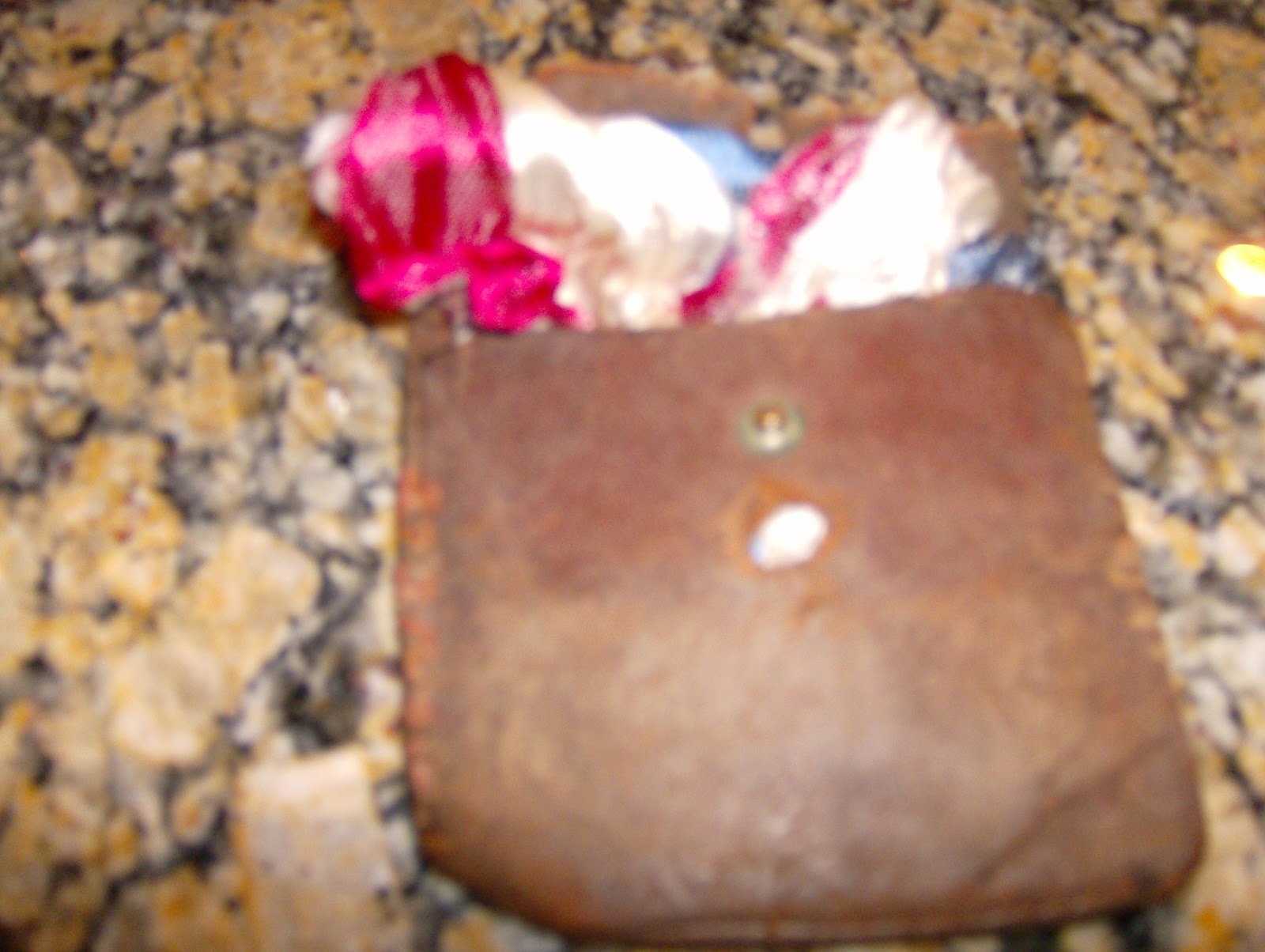
Our prized family heirloom is a small leather pouch, the “wallet” that my great-grandfather, Stephen Albert Smith, carried in the Civil War.  It now holds a piece of red, white, and blue-striped ribbon that came from the wreath placed by the Daughters of the Confederacy at his funeral.  In truth, it is a Climax chewing tobacco pouch, minus the snap that once held it closed, and reinforced by stitching around the edges.


Family lore had Stephen carrying his little coin purse, with only a few “coppers” in it, through the entire war, 1861-1865, taking part in several major battles.  The truth is, at age 17 he enlisted on 11 March 1864 in the last year of the war.  He can be found as S.A. Smith on muster rolls of Company A, 33rd Alabama Infantry.   (I don’t understand the 19th century’s fascination with initials; in the 21st century they have given me no end of trouble finding my relatives!)  On Footnote (now Fold3) I found the requisition for a coat ($14.00) for S.A. Smith, Private, Company A, 33rd Alabama Infantry, on March 16, 1864.


While Union veterans applied to the federal government for pension benefits deriving from service in the Civil War, Confederate veterans applied to the state in which they lived.  The information about my great-grandfather’s Civil War service mostly comes from his application for benefits from the state of Oklahoma.  He declared that he enlisted on 11 March 1864 in Elba, Alabama; that he joined Company A of the 33rd Alabama Infantry; that his officers were “Colonel Adams, Brigadier General Lowrey, Clayborne (Cleburne), Owesson, Hardee Corps, Joe E. Johnston’s Army”; that he was a prisoner of war, paroled about the last of April 1865 from Macon, Georgia; that he was not wounded in battle.

Stephen’s brothers, Alexander Jackson and Minor Jefferson, are both listed on a muster roll dated 11 March 1862.  Alexander was 21 and Minor J. was 19.  Alexander applied for a pension in Alabama at age 74, stating that he had been wounded at the Battle of Kennesaw Mountain (June 19-July 2, 1864).  A register of patients at Ocmulgee Hospital, Macon, Georgia, shows that Alex J. Smith was admitted on July 8, 1864, and transferred on July 22, 1864.  For “Disease,” the register shows “vul sclopet,” which means gunshot wound.  (What did we do without the Internet?)  Eliza S. Smith, widow of Jefferson Smith, Company A, 33rd Alabama, filed a claim on 14 October 1862 in Coffee County.  We think this is our Minor Jefferson.  In any case, he does not show up on censuses after 1860.


I have found no records that indicate when or where S.A. Smith was captured but as he was paroled from Macon, I suspect that he became a prisoner of war sometime during the Atlanta Campaign.  I found out when I visited Franklin, Tennessee, that the 33rd Alabama was practically wiped out there in November 1864.  I hope Alexander and Stephen were out of the fighting by then.


In 1938 when Stephen Albert Smith died in Collinsville, Oklahoma, he was one of three remaining Civil War veterans in Tulsa County.  His passing was noted in both the morning and evening newspapers in Tulsa and in The Collinsville News.


Monday, January 28, 2013

The Smiths in Alabama II

Eventually, I traced Stephen Albert Smith back to Coffee County, Alabama, and found the names of his mother and siblings.  On the 22nd day of August in 1860, the Smith family was enumerated in Coffee County in the town of Elba.


            Mary E. Smith                        age 48             born SC
            Sintha A. Smith                      age 28             born AL
            Jackson Smith                        age 19             born AL
            Jefferson Smith                      age 17             born AL
            Stephen A. Smith                   age 14             born AL
            Moses C. Smith                      age 9                born AL
            Amanda L. Smith                   age 7                born AL
            Wallis P. Smith                       age 6                born AL


Miner J. Williams, age 42, and his wife Martha lived next door.


At that time, I had no idea what Mary E.’s maiden name was, but I noticed that her next-door neighbor was also born in South Carolina and was about the right age to be her brother.  As became apparent on the 1850 census, her son Jefferson’s name was actually Minor Jefferson.  These clues made me consider that Mary’s maiden name might be Williams. 

Mary E. was also the head of the household in 1850.  The family was enumerated in Coffee Co. on the 19th of November and included:

            Mary E. Smith                        age 37             born S.C.
            Synthia A. Smith                    age 18             born AL
            John                                        age 16             born AL
            Jackson A.                               age 9               born AL         
            Minor J.                                   age 7               born AL
            Stephen A.                              age 4               born AL

Next door is James King and his family.


By 1880 Stephen Albert had left Mary E.’s home to start his own family, but I found his sister Cynthia as the head of household on the 1880 census in Pike County and some of the family relationships on the 1860 census became clearer.

            Cinthia Lindsay                      age 49             Head of household
            Willis Lindsay                        age 24             Son
            Mandy King                            age 30             Daughter
            Cinthia King                           age 6               Granddaughter
            Jordan King                            age 4               Grandson
            Willis King                              age 4               Grandson
            Jane Lindsay                          age 23             Daughter-in-law
            Lizzie Lindsay                        age 4               Granddaughter
            Thomas Lindsay                    age 2               Grandson
            Malissia                                  age 2 m           Granddaughter
            Mary                                       age 70             Mother

Apparently, Mandy (Amanda) and Willis (Wallis) from the 1860 census were not Mary’s children, but children of her daughter Cynthia.  The household also included Willis’s wife Jane and their 3 children, and Mandy and her 3 children. 

The 1880 census is the first time we see the Lindsay surname for Cynthia and at least one of her children, Willis.  (Amanda used it later—see below.)  Cynthia did not use the Lindsay name for herself or her children on the 1860 census but did on the 1880.  Some have put forth the name of Jordan Lindsay as father for Cynthia’s two children.  Jordan Lindsay is listed on the 1850 and 1860 census with wife Elizabeth Rials.  One of his daughters, born in 1849, was named Cynthia. Circumstantial, but if something was going on between Cynthia Smith and Jordan Lindsay, the timing for the birth of Cynthia’s children is right.  Elizabeth Lindsay died of bilious fever in 1860.  Jordan enlisted in Company A, 18th Alabama Infantry, in the Civil War.  A muster roll posted in the USGenweb Archives shows his death date as 8 May 1862.

Two years ago in the wonderful genealogy section of the Troy Public Library, I found marriage licenses for Amanda Lindsay to Melvin King and for Cynthia to James King at age 52.  I have never been able to find a marriage license for Cynthia and anyone named Lindsay. 

Mary was still alive, age 90, living with Cynthia on the 1900 census in Pike County.  On that census Cynthia is referred to as “Smithy” King.  On the 1910 census Cynthia was living with her son Willis.  At age 92, on the 1920 census, she was living with Cynthia King who is married to Andrew Walker.

Both Mary and Cynthia are buried at Mt. Moriah Cemetery outside Troy, Alabama.