Documenting my family's past for future generations. My family tree includes the Smith/Mansell families of Alabama and Oklahoma, the Castle/Day families of Kentucky and Oklahoma, the Wheat/Ming families of Texas and Oklahoma, and the Bell/Roberts families of Mississippi, Tennessee, and Oklahoma.

Showing posts with label Cemeteries. Show all posts

Thursday, June 18, 2015

Lost in Arkansas

My brother and I took a little cultural/genealogical excursion this past weekend. As usual, we talked history, politics, and books; ate good food; visited some interesting places; and had a couple of frustrating experiences that we turned into a really good story. So here's the story.

My brother wanted to check out the Crystal Bridges Museum of Art in Bentonville, Arkansas, thinking it would be a fun destination for his wife and him when they become empty-nesters next month. We both love long drives and small towns, and we planned to visit the museum and maybe walk around the historic parts of Bentonville and Fayetteville. From our hotel between Springdale and Fayetteville, we planned to venture out on the second day to find the grave of our 4th great-grandfather, Robert Patrick, in Patrick, Arkansas, south of Fayetteville.

Our first stop was the town square of Bentonville. Even though the Civil War ended 150 years ago, it's not far from the mind of any small town in the South. In the center of the square is a monument erected by the United Daughters of the Confederacy in 1908, honoring James H. Berry, a Confederate soldier and the only governor of Arkansas from Benton County. The west, north, and east sides of the monument read: "They fought for home and fatherland," "Their names are borne on honors shield," and"Their record is with God."

Square in Bentonville AR with Confederate monument

***Update: On September 2, 2020, the Confederate monument was removed from the Bentonville city square. The Daughters of the Confederacy, who own the monument, announced that it will be moved to a private park.

We made our first circuit around the square, looking at the historic buildings that were constructed in the 1880's. We noticed there was a sidewalk art sale going on down one of the side streets, so we took a leisurely walk through the booths and visited with the painters, jewelry makers, and potters. We were getting hungry, and had choices of an old time soda fountain, an upscale buffet, and sandwich/salad/coffee shop (the Pressroom?) We ended up at the sandwich shop. Boy, I wish I could remember the restaurant's name because they had a great bacon and tomato sandwich they called the BLAT. I thoroughly enjoyed it and the mixed greens side salad.

Our next stop was Crystal Bridges. On the way there from downtown we saw some beautiful homes. One even had a deer grazing in the front yard. I had been to Crystal Bridges before for the Norman Rockwell exhibit, but there was no special exhibit going on at present. We toured the regular galleries and walked out to the trails. It had been really cool in the morning because of rain, but it was getting really hot and humid by the time we went outside. We didn't last long on the trails.

Crystal Bridges Museum of Art, Bentonville AR

Tim on trail bridge at Crystal Bridges

In the evening we drove down to the University of Arkansas campus in Fayetteville and walked around. I was impressed with the sidewalks etched with the names of all the U of A graduates, starting in 1904. What a cool tradition!

The next morning we left our hotel between Springdale and Fayetteville and proceeded on the genealogical portion of our trip. We drove south of Fayetteville on Highway 16. I had already Mapquested the little community of Patrick, named for our ancestor, and determined that the closest town of any size was called Elkins. Pretty soon we were driving Highway 16 through Elkins, where a large grocery store and a McDonald's probably serve the communities for miles around.

On south of Elkins we were traveling on the edge of the Ozark National Forest, and the scenery was just beautiful. With all the recent rain we were surrounded by green trees and vegetation on either side of the road, then occasionally we would pass through an open area where we could see the mountains wreathed in early morning mist. We passed through a small community in Washington Co. named Durham, then we saw just a small green highway sign for the community of Crosses. Pretty soon we saw a sign saying we were passing from Washington into Madison Co. and finally another small highway sign for Patrick.

The Ozarks 

There was only one way to go. On the right side of the highway were a couple of buildings that looked abandoned. On the left was a road. Turning left off the highway, we soon came to a low bridge over a busy creek filled with all the recent rain. After just a moment of hesitation, Tim drove us over the bridge and up the road on the other side.

Scary bridge

Looks like a creek from this side

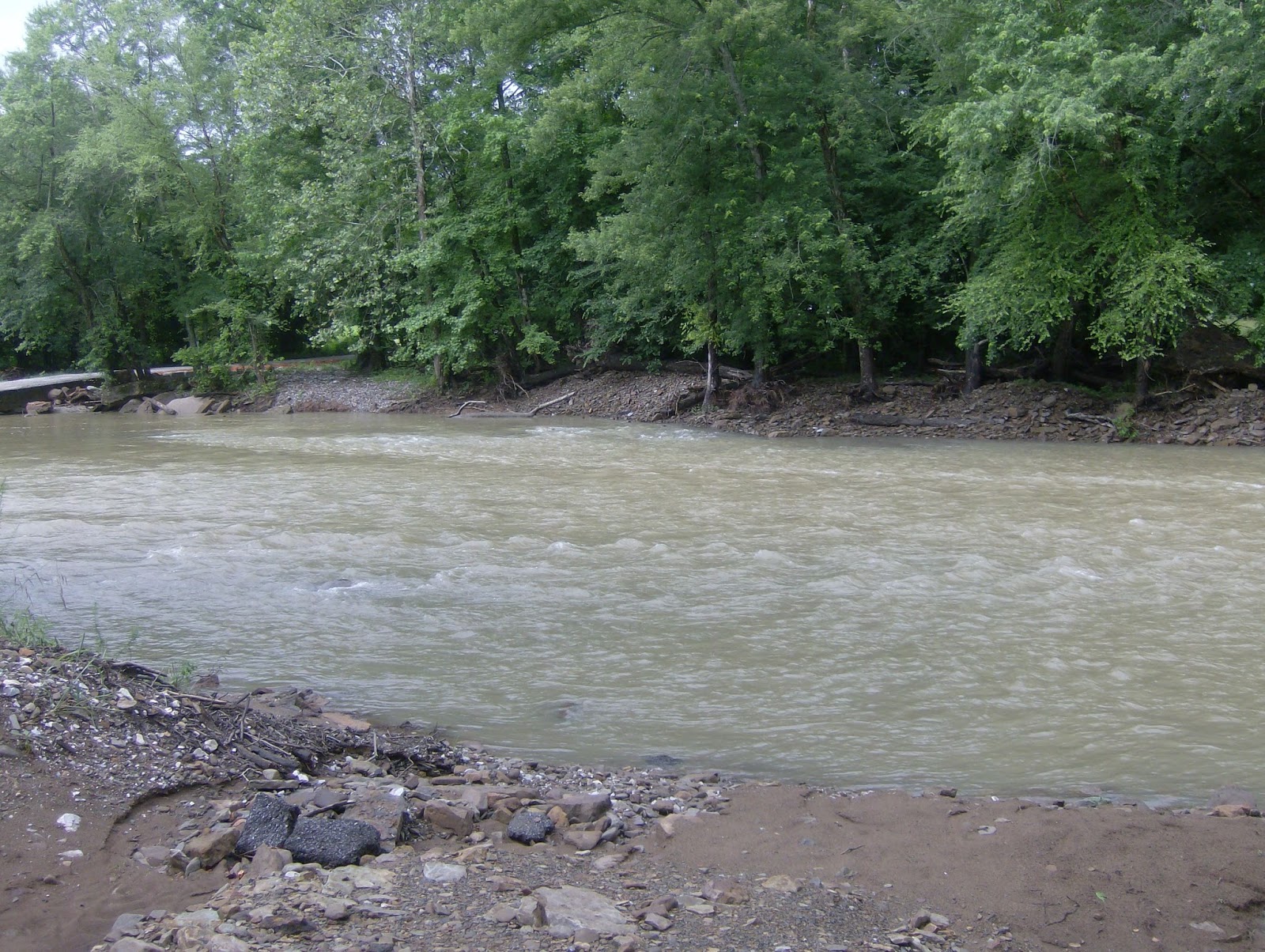
On this side it looks like a river

My brother is never afraid to ask for directions. We saw a man in a county truck who affirmed we were on the right road for the Patrick Cemetery. We stopped again to ask two men working in a garage who directed us to the edge of a fence just visible down the road. This was the Patrick Cemetery, and soon we saw a stone etched with the name of the cemetery and an arrow directing us to the road on the left. After driving a road beside the fence, we were soon turning into the entrance.

It's a pretty big cemetery. There were lots of Patricks, but we could see that there were a few other surnames that also had a large representation in the cemetery. I was looking for the older part of the cemetery. I had seen a picture of Robert Patrick's brass grave marker, and I knew there were larger stone markers around him. I was really not prepared for two large sarcophagi(?) next to Robert Patrick's grave. (I'm not sure that's what you call monuments of this sort in America, but that's what they looked like.) If you are a descendant also looking for these graves, they are just about in the center of the cemetery.
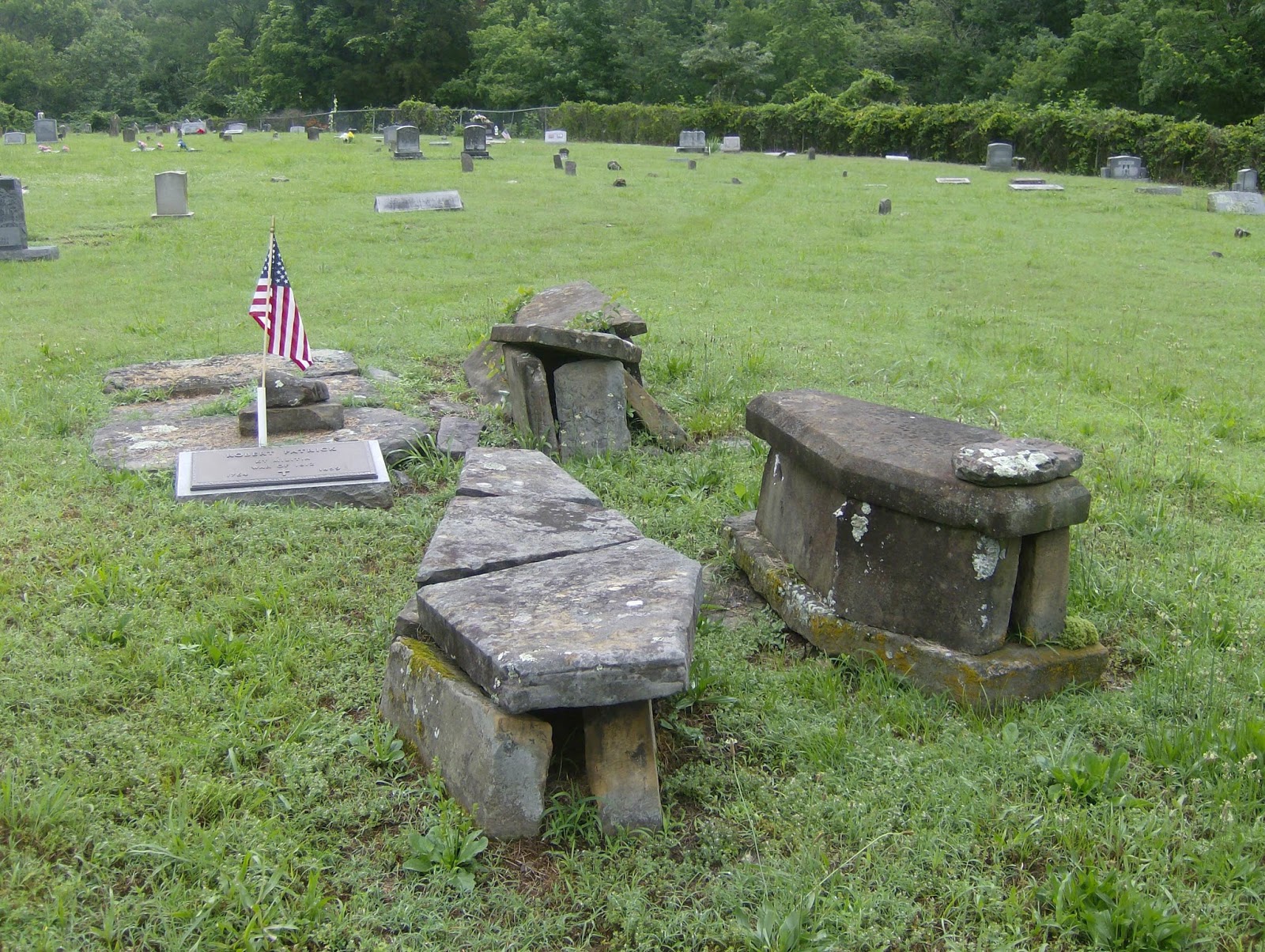
Robert Patrick grave and sarcophagi

Robert's grave shows his birth and death years (1764-1859) and proclaims him as a veteran of the War of 1812. Both sarcophagi bear the faint trace of the name "Nancy." (One almost looks like it says "Nancy Tackett.") There may have been other information there at one time, but I couldn't see it.

(Note 6/26/15: Nancy Tackett appears to be the daughter of Mary Ann Patrick and her husband, William Mason Tackett. William and Mary Ann had 10 children. A photo on Ancestry.com, taken about 1885, shows 8 of the children. It was noted that one of the sons had died in war and Nancy had also died.)


Robert Patrick
KY Militia
War of 1812
1764-1859

Nancy Tackett?

Nancy Prater Patrick?

So there lie my 4th great-grandfather and my maybe 4th great-grandmother in a quiet cemetery on the edge of a forest in Arkansas. I'm pretty sure my grandmother didn't know they were there. Robert Patrick was dead long before his granddaughter, Nancy Emily Reed Day, came to Oklahoma. Grandma Day was born in 1853, so she was only 6 and living in Kentucky when he died. She had never known him. It took well over 150 years (and the Internet, Ancestry.com, Findagrave, and Mapquest) for our branch of the family to find him again. I just wish he or Nancy could answer a couple of questions for me. Who was Sarah Patrick's mother? Why did you leave her in Kentucky when you moved to Arkansas? (See post "DNA Circles: Robert Patrick and Elizabeth McMullen.")

We left out the back entrance of the cemetery, which probably was the original front entrance.

Patrick Cemetery original entrance?

Here's the funny part of the story. The next part of our trip consisted of finding I-40 and following it into Oklahoma so we could visit our mother's grave in Dustin, OK. While I-40 crosses into Oklahoma at Ft. Smith, far south of our present location, it was easier to go north and catch it in Fayetteville. So we headed north again on Highway 16. Just outside of Elkins there was a huge traffic jam due to road work, so we stopped for breakfast at the McDonald's in Elkins and waited for the traffic to clear. Back on the now-clear Highway 16, we came to the outskirts of Fayetteville and a sign that said to turn left for 16 West. According to our map, this would take us to I-49 South and eventually to I-40.

Let's just say it was a scenic road. We drove and drove and drove through green, few houses in sight. Siri wouldn't help us. She thought we were in Iceland. We saw few road signs, which was very frustrating to my brother, but eventually we saw a sign down the road. It said Durham. Then we saw the sign for Crosses, then the one that said we were passing into Madison County. Again. Somehow we had gone north, turned west, and ended up south of Elkins. Again. When my brother finished fuming, we both began to laugh. Was it a vortex? Our own personal Groundhog Day? A bad map, bad navigator (me)? We'll never know.


Monday, July 1, 2013

Genealogy on the Road: West Liberty, Kentucky

Three years ago my brother and I visited West Liberty, Kentucky.  I wrote about that trip in the blog post, “My Old Kentucky Home.”  One of the objectives of that trip was to find the graves of our great-great-grandparents, Goldman D. and Rachel (Sargent) Castle.  Unfortunately, after visiting at least a dozen cemeteries, we failed to find them; we finally gave up and went home.

Within a couple of weeks of returning home, I corresponded with a Castle cousin who told me that the graves we were seeking were in a part of Morgan County near West Liberty that had been called Panama.  When my brother and I started planning a trip for this summer, I used Google Maps to locate Panama.  The location was on Centerville Road before it intersects with Homer Gevedon Road.  I was pretty sure this was an area we had searched before, but we were going to give it another try.

As soon as we turned off Highway 460, I knew this was the same road we had traveled three years ago.  In fact, soon we passed Day Branch Road where we had stopped to take photographs in 2010.  We had been following another Castle cousin’s instructions when we passed a barn close to the road and looked to the right to see a cemetery on a hill.  My brother had charmed a pack of dogs and climbed the steep hill to find that this was not the Castle cemetery. 

This time someone was home at the house next door, and my brother went up to talk to the homeowner.  He told Tim that he knew the cemetery we were looking for; it was further down the road near an old barn.  He had recently remarked to a young neighbor that the cemetery was really overgrown; the neighbor had replied that since it was the Castle cemetery, there was no one left to take care of it.  Who would have thought there would be another cemetery on a point near a barn on the same road? 

So—we drove down the road, found another old barn, and my brother climbed the hill to look for the cemetery.  No luck.  This was getting old.  Driving farther down the road, we found another man working in his garden.  Tim got out and walked down to talk to him; pretty soon my brother started back to the car, followed by the man, who turned out to be Mr. Gevedon.  Mr. Gevedon stopped at his barn to get a 4-wheeler, I hopped on the back, and Tim followed in the car.  We went a short way down the road and then up a very steep gravel track.  Tim followed as far as he could in the car—which wasn’t very far—and walked the rest of the way up.

Graves were under the pine trees to the right

Tim had walked the right hill.  It’s no wonder he couldn’t find the graves.  They had fallen down and couldn’t be seen from the road.  They were covered in leaves, thorny vines, and a small pine forest.  We would never have found them without the help of someone who knew exactly where they were.  But we were in the right place—because there was a headstone there, still standing, that made this cemetery unique.  It said DONIA’S FOOT.


Caladonia was my grandmother’s cousin, the daughter of James H. and Elizabeth (Nickell) Castle.  According to my grandmother, when she was a young girl, she fell off the porch and hurt her leg.  Eventually, her foot had to be amputated, and it was buried in the Castle cemetery.  I’m not sure if that’s the whole story, as Caladonia didn’t live long.  She died when she was 16.


The cemetery also holds the graves of Caladonia’s father, James, and her mother, Elizabeth.  (James was the brother of my great-grandfather, George Turner Castle.  His wife Elizabeth was the sister of George’s first wife, Frances.)  We also found a headstone for Caladonia’s brother, Goldman, named for his grandfather.  We found the headstone of our great-great-grandmother Rachel, and finally, fallen from its base, the headstone of our great-great grandfather, Goldman Davidson Castle.  Tears came to my eyes as I remembered my grandmother talking about brushing her grandfather’s silver hair.

G. D. Castle

Rachel Castle


We wished we had known in what bad shape the cemetery was.  We could have brought tools to clean it up.  Honestly, though, it would have taken a chain saw at the very least.  What do you do in that situation?  We are probably the only descendants that have visited the graves in years, and no telling when we will be back.  It’s sad to leave them in such a condition, but having to work so hard to find them at all gave us a sense of accomplishment that we had shown them what honor we could.   

Tuesday, April 2, 2013

Grandparent #3: John William Wheat


John William Wheat is the only one of my grandparents that I didn’t know and the one I know the least about.  Practically everything I know about him has been pieced together from documents.  The only person I ever talked to that did know him was my mother’s sister, Iona “Marie” Wheat Kerensky, and the main thing she remembered about him was his body arriving at the train station in Dustin, Oklahoma for burial.  He died when my mother was only 2.

According to his 1906 Army enlistment papers, John William Wheat was born on 24 January 1880 in Grayson County, Texas.  He was 5 months old on the 1880 census, living with his parents J. and Sinthe Wheat, and his brother A.B., age 2, in Precinct 3, Collin County, Texas.  They are family #478 living in residence #444 with family #477, Cynthia’s parents and siblings.  Cynthia Ming was the daughter of William Frederick Ming and his wife and first cousin, Susanna Wheat.  I believe J. Wheat was Joseph Wheat, son of Caroline (Farris) and Henry Clay Wheat.  I have not been able to find John William on the 1900 census.

J.W. Wheat, age 5 months, on 1880 Collin County census 
On 5 March 1906, at age 26, John W. Wheat enlisted in the U.S. Army at Guthrie, Oklahoma Territory.  He listed his place of residence as Blackburn, Oklahoma Territory.  He stated that his brother, T.J. Wheat, was his next of kin.  T.J.’s place of residence was Mill Creek, Indian Territory.  John W., 5’7” in height, was described as having blue eyes, dark brown hair, and a fair complexion.  His marital status was Single.  John was trained at Jefferson Barracks, Missouri; assigned to the 11th Company Coast Artillery at Key West Barracks, Florida; and was discharged from the Army at Ft. Schuyler, New York, in April 1909.

John W. Wheat, enlistment ledger, 1906
Since I don’t know much about John William’s life, it’s tempting to try to put together a story based on the details in his enlistment papers.  Blackburn is not a locale associated with any other family members and is much farther north in Oklahoma than any other place that John ever lived--about 175 miles north of where his brother was living in Mill Creek.  It was a farm community with a nearby oil camp, so my guess is that John was there for a job as a farm hand or oil worker. The town experienced a drought in the early 1900s, and many farms were abandoned, so perhaps the loss of a farm job or the closing of the oil camp caused him to join the Army. 

John listed his brother as his next-of-kin, confirming my supposition that their father was dead by this time and that their mother had also died or had lost contact with her sons because of her remarriage in 1890.  It’s also possible that John ended up in Blackburn because of a woman, because on the 1910 census he stated that he was widowed.  I’ve never been able to find any record of John William’s first wife, but she could have died before 1906, when he listed his brother as next-of-kin.  (He also could have married her in another state while in the Army, that being the reason that I’ve never been able to find a record of the marriage.)  In 1910 John was living with Thomas in Cottle County, Texas.  Both brothers had moved to Oklahoma and back to Texas.  Thomas was married in Oklahoma and in 1910 had two daughters, both born in Oklahoma.

1910 Cottle County, Texas, census
John W. living with his brother Thomas's family
John W. Wheat, age 37, was living in Pauls Valley, Garvin County, Oklahoma, when he applied for a license to marry Cora Lee Bell, age 20, of Dustin, Hughes County.  They were married on 28 January, 1917, at Carson, Hughes County.  In September 1918 John William Wheat registered for the World War I draft at age 37 while living at 327 W. Washington, Oklahoma City.  He listed his occupation as Deliveryman and his wife as Cora Lee Wheat of the same address.

John William Wheat WWI draft registration 
On the 1920 census John W. Wheat and his family--wife Cora L., age 24, and daughter Leona, age 2--are living in Dustin, Hughes County.  John and Cora had son William Powell in 1921, daughter Iona Marie in 1923, and daughter Ida Belle in 1925.  John was working in the oil fields in Seminole, Oklahoma, when he died of heart failure induced by pneumonia on 9 November, 1927, at age 47.  John’s body was shipped home by train to be buried at Carson Cemetery.

John W. Wheat at Seminole Oil Camp, about 1927
My grandfather is in this picture somewhere
According to my cousin, whose grandmother was my grandmother’s sister, she was once told that John’s death was the result of a beating by a group of men led by my grandmother’s brother Jim Bell, because John Wheat was not taking care of his family.  I guess this is completely plausible, as my grandmother and the four Wheat children were living with her father, T.J. Bell, in Dustin, 40 miles away from Seminole where her husband was living.  Who knows if any of his paycheck was making it home to her?  I have looked for newspaper articles and will continue to look, hoping that I will find some proof of this incident.  No matter what I find, I think it’s sad that he died so young and my mother grew up without her father.

John W. Wheat's headstone
Carson Cemetery, Hughes County, Oklahoma
    

Thursday, March 28, 2013

The Ming Dynasty

Okay, I couldn’t resist the title of this post.  And no, my Ming ancestors were not Chinese, but I can’t really tell you what they were.  The tradition is that the family came from Wales, but Ming is not a known Welsh surname.  As far as I can tell, even the die-hard Ming researchers are stumped as to the origin of our Mings, although DNA results point generally to the British Isles.  All I know is that it’s the one surname in my family tree that has been pretty easy to search—at least within the United States--because it’s so unusual.

The Mings came into my family tree with Cynthia Ming, daughter of William Frederick Ming and Susanna Wheat, who married Joseph Wheat in 1877.  According to The Peters Colony of Texas by Seymour V. Connor, William F. Ming came from Alabama to Texas as a 24-year-old single man before 1848. The Peters Colony was a business venture in which a group of men, headed by William S. Peters, contracted with the Republic of Texas to bring 600 families to inhabit land in north Texas. In 1850 William was living in Dallas County with his wife Frances J.  In 1855 he sold his land in Johnson County to Elisha Rhodes, his neighbor.  In 1890 after the death of Joseph Wheat, his daughter Cynthia married Thomas L. Rhodes, son of Elisha, in Weatherford, Parker County.


Extent of Peters Colony

By 1860 William’s wife Frances had apparently died, and he had remarried to his first cousin, Susanna Wheat, 11 years his junior.  On that census they had three children: Helen, 6; Thomas, 3; and (Cynthia) Francis, 1.   It has always been my opinion (or maybe just a hunch) that the oldest child on the 1860 census, Helen, was the daughter of Frances, and not of Susanna.  I mostly based this on the fact that on the 1900 census, Helen said her mother was born in Tennessee, and Susanna was born in Arkansas.  However, Helen was remarkably inconsistent in naming the birthplaces of both of her parents.  In any case, I have this instinctive dislike of William F. Ming—maybe deserved, maybe not—and one of the reasons is that he named his second daughter Cynthia Frances, in honor of his first wife.  If I had been Susanna, I would not have been pleased, although she went on to have several more children with William: George A., Jefferson Davis, William Alfred, John, James N., Martha Emily, and Josephine.  In 1880 they were living in Collin County and shared their home with daughter Cynthia, her husband Joseph Wheat, and their two children, one of whom was my grandfather.

Mings and Wheats on 1880 census in Collin County, Texas
Another thing that makes me think that Helen was the daughter of William’s first wife is that William was living with Helen and her husband Isaac Tompkins in Greer County, Oklahoma, from at least 1900 until he died in 1911.  You may ask, “What is wrong with that?”  Nothing, except that William was claiming to be a widower, and his wife Susanna was living with another daughter, Martha (Mattie) and husband Benjamin Bell, on the other side of the state.  Susanna is buried in Carson, Oklahoma, while William rests 200 miles away in Granite. 

William F. Ming with Tompkins family in Greer County, OK--1900
I’ve been to William’s grave.  It’s kindof a funny story.  I visited Granite with a friend whose mother had recently remarried to a man from there.  He happened to know the cemetery where William was buried and offered to take me there.  I never would have found it myself.  After we walked out in a pasture and through knee-high grass to find the graves of William and members of the Tompkins family, Teresa’s stepdad said, in a slow and rather understated way, I thought, “You know, I probably should have warned you about the snakes.”  After all that, I had forgotten to bring my camera, and I thought I would never have another opportunity to photograph William's grave.  I'm very appreciative of Desiree Strong, who posted this picture of his headstone on findagrave.com.

William F. Ming headstone
Quartz Cemetery, Granite, Greer Co., OK 
On the 1860 census William is living next door to his father, Thomas N., and mother, Susanna (Stephenson) Ming, for whom his wife was namesake and niece.  Thomas, born in 1796 in Chowan County, North Carolina, listed his occupation as carpenter.  William was listed as a cooper.  Pictures I have seen of Thomas N. Ming on ancestry.com show him holding his carpenter's square.  Thomas died in 1887 and is buried in Burnet County, Texas.

William F. and Thomas N. Ming families
1860 Grayson County census


Thomas N. Ming

I hesitate to trace the Mings back any further, as I have not done the research myself, but most researchers on ancestry.com seem to agree on the following.  Thomas’s father, James Ming, was born in Chowan, N.C. in 1868 and died in Limestone County, Alabama.  His wife was Ann Beasley.  James’s father was Thomas and his wife was named Delilah.  Thomas’s father was Joseph Ming(e) who was married to Rachel Ward.  Joseph’s father, Joseph, died in 1707, and was married to Sarah.  Some researchers list his father as David Ming and his mother as Elizabeth Carter.  Most of these ancestors lived and/or died in Chowan County, N.C. 

Tuesday, March 19, 2013

The Wheats in Texas


You know that Jeff Foxworthy joke: “You know you’re a redneck if…your family tree doesn’t branch”?  That would be me, at least on the Wheat side of the family.

My first clue was a headstone at the Carson Cemetery in Hughes County, Oklahoma.  It read “Susanna Wheat Ming – 1836-1916.”  My grandparents, John William Wheat and Cora Bell, are buried beside this woman.  She is not John William’s mother, Cynthia Ming--nobody knows where she is buried.  She is John’s grandmother, but on the Ming side not the Wheat side. 

Susanna Wheat Ming headstone
Carson Cemetery, Hughes County, OK
As I began to research the Mings and the Wheats, I found out that Cynthia’s parents, William Frederick Ming and Susanna Wheat, were first cousins.  Their mothers were sisters.  Then, as if that wasn’t bad enough, W.F. and Susanna’s daughter Cynthia turned around and married J. Wheat.  (Who his parents and grandparents were has been a mystery only recently solved--I think--and a post for another day.)  Susanna Wheat Ming’s parents were Samuel Wheat and Cynthia Stephenson.  W.F. Ming’s parents were Thomas N. Ming and Susannah Stephenson.

Thomas N. Ming headstone
Marble Falls, Burnet County, TX
www.findagrave.com
Cynthia and Susannah Stephenson were daughters of Robert Stephenson (sometimes spelled Stinson) and his wife Elizabeth Whitley.  Elizabeth was the daughter of William and Esther Whitley.  I remember how excited I was when I googled “William Whitley” for the first time and found out that he was a famous Kentucky pioneer and that his home still stood as a state park site in Kentucky. (More about that later, too.)

Susannah Stephenson Ming's portrait at
William Whitley House in Kentucky

Samuel Wheat was born in Virginia in 1787; married Cynthia Stephenson in Madison County, Mississippi Territory in 1814; was enumerated on the 1830 and 1840 censuses in Arkansas; and then helped organize the Pilot Grove Church in Grayson County, Texas, in 1847.  His now-broken tombstone in the Hall Cemetery near Howe, Grayson County, Texas, once read:  “In memory of Elder Samuel Wheat, who departed this life 23 Nov 1866, aged 79 years and 1 day. Elder Wheat had been an old-school Baptist from his youth and a Minister of the Cross for 50 years. Standing firm amidst the siftings and schisms among the Churches, the fearless advocate of Virginia immigrated to Alabama, then to Tennessee, then to Arkansas, then to Texas in 1847, making his first discourse to Pilot Grove Church in Grayson County to which he made his last a few days before his death.” 


Samuel Wheat headstone
Hall Cemetery, Grayson County, TX
www.findagrave.com

Samuel’s wife Cynthia is presumably buried in Milam County, Texas, where she was last found on a census in 1850.  Thomas N. Ming is buried in Fairland Cemetery near Marble Falls, Texas.  Susannah Stephenson Ming died in Grayson County, Texas.
Obviously, it was a time of great migration within the young United States. Grayson County, Texas was the final destination for a number of Wheats, although mine traveled on to nearby Collin County, and then eventually to Oklahoma.


Tuesday, March 5, 2013

Castle In-Laws and Their In-Laws


Before I leave the Castles, I would like to summarize what I know about their in-laws, the Days, and their in-laws, the Reeds, Oneys, Patricks, Lewises, etc. 

My great-grandmother, Sarah Florida Day, was the daughter of James Thomas Day and his wife, Nancy Emily Reed.  She was born in White Oak, Magoffin County, Kentucky, and a couple of generations of family members are buried there. The counties of Morgan and Magoffin border each other, and in fact, if you just keep driving out of West Liberty on Hwy. 460, you will reach White Oak in about 10 minutes.

The parents of James Thomas Day were Andrew Jackson Day (1836-1921) and Sarah Oney (1840-1862).  They were married on 25 September 1855 in Morgan County. The marriage registration shows that “Jackson” Day, age 19, lived in Caney, Morgan County, and was born there. Sarah “Owney” was born in Tazewell County, Virginia, and was living in White Oak at the time of her marriage at age 15.  Sarah died in 1862, and Andrew J. Day remarried to Catherine (Jane) Reed. 

Marriage record of Jackson Day & Sarah Oney

Andrew Jackson Day & 2nd wife

Sarah Oney’s parents were William Oney and Susanna Coburn who were both born about 1807 in Kentucky. (Correction: Not true. Sarah's parents were Rhoda Day and James Oney, who were first cousins. James Oney's father was probably William Oney from Tazewell, Virginia. See post "The Oneys and a Couple of Great Stories") They were still living and listed on the 1870 census in Floyd County. Most researchers on ancestry.com list William’s father as Benjamin Oney with a trail leading back to Tazewell County, Virginia. William’s death record on 9 Mar 1878 lists his father as Samuel Oney from Pike County. That’s a question to be answered on another day.

William Oney, died 9 March 1878, father Samuel Oney 


Andrew Jackson Day’s father was Thomas P. Day. He was born in 1804 in Virginia and died before 1880 in Kentucky. On the 1840 census he is in Tazewell County, Virginia; on the 1850 and 1860 he is in Morgan County; and on the 1870 he is in Magoffin County.  His wife was Margaret “Nancy” McGrady, who was born in 1812 in Grayson County, Virginia.

Thomas’s father was Joseph Day who married Rhoda Cock, daughter of Andrew Cock, on 10 August 1796.  Rhoda died 16 August 1827 at age 49, after having given birth to at least 10 children.  Joseph remarried to Rebecca Dunn in 1830, and his second wife had 7 children!  At the age of 80, just a few months before his death, he wrote his will and listed his youngest son as age 8.  Joseph lived in Grayson and Carroll counties in Virginia.  Joseph and Rhoda are both buried in Carroll County, VA.


Nancy Emily Reed’s parents were Lewis Reed and Sarah Patrick. They married 3 May 1849 and were living in Morgan County at the time of the 1850 census. On the 1860, 1870, and 1880 censuses they are living in Magoffin County in Salyersville and Johnsons Fork. Lewis died on 9 December 1895 in Elsie, Magoffin County.  Sarah Patrick, daughter of Robert Patrick and Elizabeth McMullen, was born 5 January 1830 and died 15 March 1892 in Elsie. Robert Patrick was from Staunton, Augusta County, Virginia.  He was born in 1779 and died in 1859 in Madison County, Arkansas.  His headstone reads “KY Militia, War of 1812.”  His parents were Hugh Patrick and Susanna Harris.

Patrick Cemetery, Madison County, Arkansas
The parents of Lewis Reed were Daniel Reed and Martha “Patsy” Lewis.  Daniel was born 3 April 1806 in Virginia.  Daniel and Patsy were enumerated on the 1830-1870 censuses in either Morgan or Magoffin counties. They were living near the mouth of Cow Creek when Daniel died on 8 February 1878. Patsy died on 18 April 1880 in Magoffin County of pneumonia.   

Patsy’s father was John Lewis. He was born in North Carolina in 1782 but was living in Kentucky by 1820 and in Morgan County by 1830. His parents were James Lewis and Winnie Henson.  According to Lewis family researchers, James came from Wales to America with his father Nathaniel in 1740. They settled first in Virginia. James died in 1825 at Cutshin Creek, Perry County, Kentucky, and is buried in the J.C. Lewis Cemetery in Wooton.  He served in the North Carolina Militia during the Revolutionary War. There is a sign in the cemetery listing his children and commemorating his service. 


Friday, March 1, 2013

Grandparent #2: Frances (Fannie) Lou Castle


On this date in 1897 my grandmother was born to George T. and Florida (Day) Castle in Morgan County, Kentucky.  She was named for her father’s first wife, Frances Nickell, who had died in childbirth in 1893.  George married Florida, 15 years his junior, in 1896.  Fannie was the oldest of their 8 children.

When she was just a toddler, an incident happened that affected my grandmother all of her life.  Her young mother needed to leave their cabin and go to the spring for fresh water. She tied my grandmother into her high chair, but on her way back to the cabin she saw an awful sight:  Fannie standing on the front porch of the cabin with burning embers in her hair.  She had managed to get free from the chair and fall headfirst into the fireplace.  The burning left scars that she would hide for the rest of her life with bangs and hairpieces.  This disfigurement was much more obvious to Fannie than it was to anyone else, and she hid it well.  I never even realized she had scars until she was in her 90s.

Stacy Fork School--about 1902
Fannie is in the front row, 7th from left
Her brother Forrest is next to her, 4th from right
Half-sister Cora is standing next to the teacher on the left
She clearly remembered her early school days in Kentucky.  The one-room schoolhouse had two exit doors in the back, one for the boys and one for the girls.  If a book was placed in the door on the girls’ side, it meant that a girl was occupying the outhouse; if the book was in the boys’ side, it meant a boy was in the privy.  
This photo of the old schoolhouse taken
by Aunt Georgia Beebe on a trip back to Kentucky
After the family moved to Oklahoma in 1907, Fannie continued her education and graduated from Chandler High School.  After taking the teacher’s exam at age 17, she began teaching in a one-room schoolhouse near Collinsville.  She later completed college at Northeastern State Teachers’ College (now Northeastern State University) in Tahlequah.


She married in 1919 and gave birth to twin boys in 1928.  She taught at Park Elementary and for 30 years at Pleasant Porter Elementary, both in Red Fork.  At age 62 she wasn’t ready to retire, but she did so that she could stay home with me and my brother after our mother died. 


Until I got close to age 60 myself, I hadn’t quite imagined what it would have been like to take on a 3-year-old and a 4-month old at that stage of my life.  It would have been easy for me to miss having a mother, but she filled that role so well that I never really did. She supported everything I wanted to do—including hemming up my miniskirts and attending all my school events.  She was a Cub Scout den mother and climbed up in the bleachers in her 70s to watch my brother play basketball. I remember a couple of summers when she decided I needed to learn how things were done in the old days, so we strung peppers and made grape jam and soap from scratch.     

She wasn’t through raising children.  When I went to work as a teacher in 1977, she took care of my son.  Later, she sent him across the street to school at Park Elementary and took care of him after school until I got home.

She wasn’t always easy because she had high standards and would criticize me if I couldn’t do something with the “Castle lick,” the perfect way in which something should be done—from sweeping the floor to ironing a shirt.  When I rolled out of bed in the morning, she had a list ready of all the things she had done while I was sleeping: breakfast dishes, two loads of laundry, ironing ten of Daddy’s shirts, etc.  She often criticized what I wanted to wear, which she called my “garb.”  She was terribly hard of hearing and drove us all crazy trying to make her understand what we were saying. Once she misunderstood something one of us had said and questioned, “Snow’s on the roof?” (It was summer.)  After that, it was our favorite saying when she didn’t understand something.  After several attempts at making her understand, we’d all yell, “Snow’s on the roof!”  She had absolutely no sense of humor, so we all thought it was pretty funny when she bought a plaque that said “I’m not deaf; I’m just ignoring you” and hung it on the living room wall.

She was still going strong when she turned 90, and we had a big surprise birthday party for her.  As the oldest of George and Florida’s children, she was everybody’s Aunt Fannie, and I even called her Aunty for years before I finally figured out she was the only mother I was ever going to have and started calling her Mom.  I always knew she was a big influence on me, but I don’t think I had realized that so much of what I’m interested in is because of her. Being a teacher, of course. But I also share her love of poetry* (in her 80s she could recite long narrative poems she had learned in 4th grade!), genealogy (she’s the one who wrote down all the brothers and sisters of my ex-husband’s great-grandmother), history and culture (my fascination with Indian mounds, cemeteries, pioneer times, and the settling of Oklahoma.)  Family was always the most important thing in the world to her, and she would love knowing that I’m making connections with the descendants of her kinfolks in Kentucky.


My grandmother holding a sign painted for her by
John Castle, signed by all the Castles, and
presented at a Castle family reunion at John's

*On any occasion when we were all together (birthdays, Christmas), we would beg her to recite her poems.  I have searched in vain to find copies of them.  My favorite was about a father chopping wood when his little boy falls underneath the axe.  (It begins, “What are ye askin’, stranger, about a lock of hair?” and ends with an affirmation of the Biblical saying, “’the hairs of your head are numbered,’ and sir, I believe it’s so.”) Another was about a little girl and her mother traveling on an immigrant train at Christmas time. The little girl worries that Santa won’t be able to find them, and a man (was he Santa?) gets off the train at one of the stops and buys her presents. Another was about a little boy who steals a watermelon and gets in trouble from his mother because the one he stole wasn’t ripe! I also liked the one about an older sister who "is flustered the whole of the day/And gives the silliest answers to what we may say" because "her beau is coming to see her on Saturday night." All of these poems gave us a glimpse into what life was like when my grandmother was growing up.

Fannie Castle Smith (or Fannie C. Smith, as she signed herself) was a beloved teacher, mother, aunt, and grandmother.  She died on 12 December 1992 and is buried at Rose Hill Cemetery in Tulsa, Oklahoma.  

Monday, February 25, 2013

My Old Kentucky Home


When my grandmother left Kentucky in 1907, she never went back.  Morgan County was never far from her heart, though.  All of her siblings, except for the youngest two, had been born there.  Her mother and the other Day sisters who had lived in Morgan County all lived in Oklahoma. Even an old friend from home, Geneva Haney, lived in Tulsa.  When they got together, they reminisced about the old days back home.  

My grandmother subscribed to the Licking Valley Courier and even contributed articles when a newsworthy event happened in Oklahoma.  In later years she corresponded with her cousins, Effie Castle Walters, Hattie Day Egelston, and Mearil McGuire.  The names of families like the Elams, the Lykins, and the Haneys, and towns with names of Caney, Cannel City, Malone, Stacy Fork, and West Liberty, were as familiar to me as Davenport, Red Fork, and Tulsa.

Surprisingly, it was my brother who got the idea for us to take a trip back to Kentucky, just the two of us.  I guess not so surprising, because he was raised by my grandmother from the age of 4 months and just as steeped in the lore of her old Kentucky home.  We set off from Tulsa in July 2010, one OCD woman and one ADD man.  It’s a wonder we didn’t kill each other, but we didn’t even have an argument. 

Of course, the OCD woman had made an itinerary that included the St. Louis Arch and our ancestor (on the other side of the family) William Whitley’s house in Crab Orchard, Kentucky, but I wasn’t so OCD that I minded stopping in the historical utopian town of New Harmony, Indiana, or at Fort Boonesboro or at Ashland, Henry Clay’s house in Lexington, all on the spur of the moment.


William Whitley House
Ashland, Home of Henry Clay


The centerpiece of the trip, though, was a couple of days in West Liberty, from whence we set out to explore the courthouse, the historical society, and three million cemeteries.  (Of course, this was before the tornado that hit the town in 2012.)  We stayed in West Liberty and drove the winding State Highway 460 through all the little towns that my grandmother had told us about. 

We were looking for the cemetery where my great-great-grandparents, Goldman Davidson and Rachel Castle, are buried.  What we found is that there is a cemetery on the top of every hill in that part of Kentucky.  We got so we looked up every time we saw a hill, and sure enough, there was a cemetery there, many of which we duly explored.  We found some Castles and other related families, but not the ones we were looking for.


We had passed the same spot on the highway several times because there was a cemetery entrance across the road.  This time we read the street sign that said “Castle Branch.”  A family was working in their yard when we stopped to ask if they knew anything about the Castles.  All they knew was that the sign had always been there, but there had been no Castles there in their generation nor in the man’s father’s generation.  They did admit to knowing Virgil Castle—a prominent relative in the area, now deceased, that everyone had seemed to know.


We decided to call Virgil’s son and ask for directions to the cemetery.  We reached him by phone from the motel that night, and in his laconic Kentucky accent, he said, “Drive down the highway, turn at this road, look for a barn right beside the road.  When you see the barn, look back to your right up on the ‘purnt’ (point), and you’ll see the cemetery.”  The next day we drove there, and his directions were perfect, but I was A)unable to climb the incredibly steep hill up to the cemetery,  and B)scared of the pack of dogs roaming the neighbor’s yard. My brother, the intrepid former postman, made friends with the dogs, climbed the hill, but didn’t recognize any of the names in the cemetery.

We didn’t find the cemetery, but we did find another street sign.  This one said “Day Branch Road.”  Our family names are all over an area where no Days and few Castles have lived for 100 years.


We have not given up the quest to find the Castle cemetery.  We are going back this summer with directions from a Castle cousin.  If it turns out that we go back to the same cemetery that we visited before, I’m climbing the hill this time.