Documenting my family's past for future generations. My family tree includes the Smith/Mansell families of Alabama and Oklahoma, the Castle/Day families of Kentucky and Oklahoma, the Wheat/Ming families of Texas and Oklahoma, and the Bell/Roberts families of Mississippi, Tennessee, and Oklahoma.

Showing posts with label Patrick. Show all posts

Wednesday, September 4, 2019

Cousin Communication

Well, summer is officially over. One thing you can say about summer is that people seem to slow down a bit. Maybe they have time to check their Ancestry account, or to answer an old email, or to read a blog. In any case, over the last couple of months I have heard from more cousins--from all branches of my family--than I have in the whole rest of the year. Here are some of the things I learned:

From the Pharris/Farris family: 
I'm still trying to figure out how I am related to the Pharrises. My 2nd great-grandmother, Elzina Huff, was born on the Dry Fork of Martin's Creek in Jackson County, Tennessee, in 1826. I have never been able to document the names of her parents, although a lot of trees say they were William Huff and Susannah Toney. The Pharrises were close neighbors, so I have long suspected that Elzina (or her husband, Stephen Roberts, also of undocumented parentage) were somehow connected to this family of Pharrises. Since I also have lots of Embry DNA cousins, I had considered that Elzina might be the daughter of James Pharris, whose mother was an Embry.

To make things even more complicated, I may also have a Farris ancestor. I say "may," because this is another relationship I can't document. However, much research into the puzzle of my great-grandfather, J. A. (Joseph) Wheat, has convinced me that he was the son of Henry Clay Wheat and Caroline Farris. Caroline was the granddaughter of Champion Farris, an early resident of Russell County, Virginia, and Tennessee. Since I had never been able to discover if these Farrises were related to the Jackson County Pharrises, I had decided it was much more likely that my ancestry went back somehow to the Pharrises that were neighbors to my Elzina.

Then I got a message on Ancestry this summer from a DNA match who is a Pharris descendant. We had corresponded years ago when we were both new to DNA. She wondered if I had considered the possibility that my DNA connection to her was through Champion Farris. She had found a reference to Champion Farris that indicated he was in Smith County, Tennessee, the parent county of Jackson County, in 1800-1805; she had some y-DNA results for a Pharris descendant that indicated he also matched some Farrises; and she drew my attention to one of my Ancestry Thru-Lines that indicated that the mother of William Huff was a Pharris. 

This cousin communication definitely gave me several lines of inquiry to consider.

From the Simmons family:
I regularly hear from my Simmons cousin, Sam Casey. This time he shared a newspaper article from the Troy (AL) Messenger, dated July 6, 1921, that he had found on Ancestry. It  read, in part, "T.B. Floyd, 67, youngest son of George Floyd, was in Troy...[and] gave the following sketch. His grandfathers, Luke Simmonds and William Floyd, came to Pike in the Pioneer days, when Indians were still in this section. They had been neighbors in the Carolinas, the state line coming between their residences. Simmons lived in North Carolina and Floyd in South Carolina. Their residences were almost on the line. When they moved to Pike [Co.] some of the children intermarried."


T.B. Floyd article in Troy Messenger
Originally shared to Ancestry by W. Tucker

Sam added, "For this to be accurate, one of Luke Simmons' daughters would have to have married a son of William Floyd. I don't have the Floyds in my data and don't know which daughter this would have been."

So, again, I did a little research. I found Thomas B. Floyd, born 1855, with his father George and mother Patience on the 1860 census in Pike County. I concluded that Patience must have been a child of Luke Simmons (and therefore a sister of my 2nd great-grandmother, Elizabeth Simmons) that I didn't have in my tree. The 1860 census stated that she was 35 so must have been born in 1825, although with her first daughter born in 1838, that didn't seem reasonable. In my list of Luke's children I had a big gap between Jemima, born 1816, and Eliza, born 1827, so there was plenty of room in there for Patience, even if her birth date was earlier than 1825. It turns out I had room for several children in that gap!


Floyd family on 1860 census, Pike Co. AL

When I emailed Sam with the info, he sent back the transcription of the family page from Luke Simmons' Bible with children: Elizabeth, born 1812; Jemima, born 1815; Susannah, born 1817; Patience and Nancy (twins), born 1821; Leonard M., born 1823; Rebekah, born 1825, and Elizur, born 1827. Apparently, when Sam had shared the Bible entries (years ago!), I had never entered the names in my tree. [Maybe because I wasn't sure of the dates? The copyright on the Bible is 1827, so all these birth dates, except maybe for Eliza's, were entered after the fact.]

Because of Sam's email, I was able to add four siblings of my 2nd great-grandmother to my tree.

From the Wheat family:
Actually, this information did not come from a cousin. I got an email from Lee F. who wanted to share information he had received as a result of a purchase of Confederate documents. I am not even certain how he got my email address, but the information he shared helped me add a previously unknown spouse  and children to a 3rd great-uncle on my family tree.

His email read, in part, "A few years ago I bought off ebay some Confederate notes from an old gentleman named John Wheat. He told me the notes came from Robert Wheat and his 2nd wife of Wheatland, Titus County, TX...He said Samuel Wheat was Robert's father and Samuel Wheat founded Wheatland, TX. Samuel was ex-military before coming to TX. Robert was in charge of the home guard during the war. Robert's wife had died. His new wife was the widow of the officer in charge of the regular military in Titus County. Anyway after the war the family moved to Sherman, TX..."

I set about trying to corroborate the information that came from this unexpected source. First, I do have a 3rd great-uncle named Robert Wheat (1819-1901) that served with the Confederacy in the Civil War. I have been to his grave in Grayson County, TX. As a matter of fact, he is the brother of the above-mentioned Henry Clay Wheat. Their father was not Samuel Wheat, but Samuel's brother William.

Next, I tried to find out what I could about Wheatland, TX. I remembered that years ago I read about a community in Texas that had been named for my Wheat family, but I didn't remember where I had read that information. Google to the rescue--although I didn't have much luck at first. There were two communities named Wheatland--one in Dallas County and one in Tarrant County. So I tried Titus County--but neither the Wikipedia entry nor the Handbook of Texas Online mentioned a town named Wheatland in the county. Then I tried "Wheat family Titus County TX," and I found this article about Wheatville, a community founded by William Wheat, that previously existed in the area now occupied by Naples, TX. (The creation of Morris County in 1875 meant that by the time Wheatville ceased to exist in the late 1870's, it was in Morris, not Titus, County.)

The article, prepared by Glenda Brown Scarborough, corroborated many of the statements made by John Wheat. Others, such as the name of the community and its founder, were almost right but not completely accurate. From that article: "Wheatville was indeed the true beginning of present-day Naples, Texas. It received its name from the William Wheat family sometime before 1852." On September 12, 1860, R.S. (Robert) Wheat was living in Mount Pleasant, the county seat of Titus County, with his first wife, Elizabeth (Finn), and their children. Elizabeth must have died not long after. Robert fought as a Confederate in the Civil War with the 33rd Cavalry, Duff's Partisan Rangers.

Sometime after the war Robert married Mary E. (Corprew) Sheppard, the widow of W.B. Sheppard. According to the Wheatville article, "W.B. Sheppard was Captain of the Titus Rangers, a unit organized in Wheatville during the Civil War...W.B. Sheppard died or was perhaps killed in the war and his widow later married R.S. Wheat. R.S. Wheat was a widower and a member of the family from which the town received its name. The couple and their families later moved to Grayson County, Texas." The 1870 and 1880 censuses show Robert and Mary and various children living in Grayson County. The 1870 census included a daughter named Mary Sheppard and the first of Robert and Mary's children, James, who was 3. Two more of their children were listed on the 1880 census, ages 8 and 6.


Robert S. Wheat family on 1870 census, Grayson Co. TX
with step-daughter Mary Sheppard


Before receiving this summer's surprising email from Lee F., I was not aware that Robert S. Wheat had a second wife and a second set of children. Using the information I learned in the Wheatville article, I found the marriage of Mary E. Corprew to Williamson B. Sheppard on January 15, 1885, in Chambers County, Alabama. I had always wondered who Mary Sheppard was and how she was connected to Robert Wheat's family.

Robert's end was rather sad. The 1900 census shows Robert, age 81, living at the North Texas Hospital for the Insane in Kaufman, Texas. His "insanity" may have been no more than senile dementia, but I can't help wondering how he was treated at the hospital. He died in 1901 and is buried in the Hall Cemetery in Howe, Grayson County, Texas, along with his wife Mary, who had died in 1897, and many other Wheats.


Robert S. Wheat grave in Hall Cemetery, Howe, TX
Originally shared on Ancestry by Jan Elaine Biard Thomas


From the Walker family:
Not exactly my family, although my last name was Walker for over 30 years. No, this is my son's ancestry. Several years ago I bought him a DNA test, and this summer he got an email from a Walker cousin, Jimmy. He has a very ambitious goal--to document all the branches of Walkers that descend from Thomas Walker and Marian Sara Jeffries of Fairfield County, South Carolina, and he wanted to know on what branch my son fit.

I had taken my son's Walker ancestry back several generations, and I was able to add a couple more. With the information Jimmy had already collected, he was able to take my son's ancestry back to Thomas and Marian.

In the process of searching for Jimmy's tree on Ancestry, I also discovered that he and I share a little DNA, as well! We think the connection might be with our Reynolds ancestors. On my side my Reynolds ancestor was Priscilla, who was married to Zachariah Wheat. They were the parents of William and Samuel, mentioned above.

This summer I also got emails or Ancestry messages from:
A professional genealogist helping a descendant of my 4th great-grandfather, Benjamin Bell and his wife, Elizabeth Ledbetter. I referred her to my blog post, "Laying Out the Facts." She promised to share anything they discover.

A cousin from my Day/Reed/Patrick side, asking about the Scots heritage of our Patrick ancestors. She still lives in the Chandler/Davenport area, where my grandmother grew up. Contact with her may lead to meeting some of our other remaining cousins who live there.

A first cousin of my dad's on the Smith side, who offered to share some old photos. He shared a story that I also researched. My grandfather grew up in Oologah, Oklahoma, the birthplace of Will Rogers. When I was a kid, I remember being told that the older Smith boys ran around with him. As I grew older and did more genealogy and read more history, I tended to doubt the story. Will Rogers grew up on a big ranch, attended school in Missouri and then a military academy, and quit school in 10th grade. I just wondered where he would have met any of the Smith boys. 

However, my cousin had a variation on that story that I'm sure is true and maybe the origin of the Will Rogers story that my family told. He shared that "Johnny Yokim, a cousin to Will Rogers, was a buddy of Dad's [his father was Albert Smith, my grandfather's brother] and both attended a one-room Indian school. There is a good story here about riding horses to school and they both had six-shooters in their holsters."

Albert was born in 1889, so I tried looking for a John Yokim born about the same time. There are so many ways to spell that name that I didn't have much luck narrowing it down. So I thought of a different way to go about it. I searched Ancestry for Will Rogers' family tree, then searched for John Yokim. Sure enough, Will Rogers' sister May (Mary), was married to Matthew John Yocum, and they had a son named John, born 1893.

So we do have a connection to Will Rogers' family, if not the man himself! And the Smith boys were in Wild West shows too.


Albert and one of the other Smith boys (?)
in Wild West show
Shared by John Smith

The moral of this story: It pays to put your name out there in the genealogy community. Sometimes you reap some unexpected rewards. Check your Ancestry account, answer an email, check out a blog you've been meaning to read (or catch up on.)

Just a couple more summer things before I wind this post up.

I've always been interested in diseases and their prevention since my dad introduced me to a book called Microbe Hunters by Paul DeKruif when I was a teenager. So this summer I have been listening to a podcast called "This Podcast Will Kill You." In each episode the two female podcasters describe a disease, its history, how it operates, and how it's treated. It's been fascinating. In the episode on hookworms, poison dew was mentioned, and I remembered that my grandmother would never let me walk barefoot in dew because I might get some unspecified disease. I still feel guilty when I walk on wet grass barefoot.

Well, guess what? The unspecified disease is hookworm infection, because hookworms are right there on the ground/in the grass (but only where infected animals or people have pooped) and they can burrow through any bare feet that get close enough. Hookworms were especially prevalent in the South for many reasons and while not fatal, the anemia that resulted from hookworm infection was debilitating. John D. Rockefeller started an education and sanitation campaign in the early 1900's to reduce the incidence of the disease, and it must have made quite an impression on my grandmother. Now that I know why, it's made a big impression on me. I'm going to wear my shoes outside from now on.

The other thing that happened this summer is that this blog passed 100,000 page views. Thanks for reading!

Tuesday, August 7, 2018

Reed Family Riddles

The inspiration for this post was a photograph. Luckily, I didn't have to try to figure out whose family was in the photograph, because someone had written the family name on the back. The caption on the back of the photo says: "Uncle Boone and Aunt Mary / Mother's brother and family -- Elsie, Kentucky, at their home on the banks of Licking River, Elsie, Ky." Great description--if you know who the writer was, and I do. It was Aunt Emma Day, sister of my great-grandmother, Sarah Florida Day. Probably 40 years ago she sent my grandmother several family photos, most of them with identified people and places. Just a little sleuthing required--the man in the photo is her uncle, her mother's brother, and her mother was Nancy Emily Reed. So my question to myself was: What could I find out about Uncle Boone Reed?


Along with the facts of his life and the lives of his family members, I also learned that sometimes those very facts are not apparent, even on Ancestry.com, which usually makes research amazingly easy. If you're not familiar with Ancestry, you might not know that once you create a profile for a family member, Ancestry is generous with hints and suggestions. In researching Boone Reed, I had suggestions from other people's family trees and links to all kinds of documents, including census, marriage, and death records. But when I tried to verify his birth and death dates, I couldn't find a document that matched up with the dates that most Reed researchers had listed for his birth and death.

The Social Security Death Index listed his birth date as 22 September 1867, but it didn't show a death date--just a "claim date," 12 June 1957. There was no link to a death certificate, but when I did a search for one, I found out the reason why. First, the name on the certificate was D. B. Reed, and he died in Holton, Indiana! How did I even know this was the same person? Because at the very bottom of the certificate, under burial information, the cemetery was listed as "Reed Cemetery, Elsie, Ky." The death date was 21 December 1957, and the birth date was given as 10 September 1967 (he was 90!) And honestly, I don't even know if the birth date is correct, because the informant listed on the death certificate is Henry W. Reynolds, who says that D.B. Reed is his "step-father-in-law." More about that later.


D. B. Reed Death Certificate


Even though Holton, Indiana, was a surprise, the name D. B. Reed was not. Uncle Boone was really Daniel Boone Reed, and throughout his life he used the names Boone, Daniel Boone, Daniel B., and D. B. interchangeably. He and his sister, Nancy Emily Reed, my 2nd great-grandmother, were the children of Lewis Reed and Sarah Patrick. The first census on which Daniel Boone Reed appears is the 1870, where the family is listed as: Lewis Reed, age 40; Sarah, age 40; Martha J., age 19; Nancy E., age 17; Mary, age 10; Eli, age 9; Sarah A., age 8; Daniel B., age 2; and (Catlet) Lee, age 3 months. The 1880 census lists Lewis, Sariah, Ely, daughter Sariah, Daniel B. and Catlet. (By 1880 Martha Jane had married Harrison Patrick, Nancy Emily had married James Thomas Day, and Mary had married Mason Gullett.) 


1870 Magoffin County census


By 1900 both Lewis and Sarah had passed away, and all their children had married. Further research into the siblings of Nancy Emily and Daniel Boone Reed solved a little mystery I have wondered about for years. In addition to family photos, Aunt Emma also gave my grandmother the Day family Bible. Under the Deaths was a date for a Sarah May. I never could figure out who that was, since there was no Day family member by that name. It turns out that Sarah, daughter of Lewis and Sarah, sister of Nancy and Boone, listed above in the 1870 and 1880 censuses, married Abel May.

According to Kentucky marriage records, D. B. Reid married Mary Elizabeth Patrick on 5 December 1889. (Another complication is that Reed is spelled several ways in the records.) Of course, since his mother was a Patrick, I wondered if Mary Elizabeth was his cousin, and yes, she was. Her father was Brice Patrick, brother of Sarah Patrick Reed. By the 1900 census Boone and Mary had four children: Cassius, Curtis, Nora, and Fannie. By 1910 Levna and Tilden had been added to the family. (Yes, Levna is the correct spelling. It's been transcribed as Levenia and Leona, but Levna is the spelling used in her will, which she signed.)


Boone and Mary's marriage record


So, back to the photo--who, besides Uncle Boone and Aunt Mary, posed for this photograph? Assuming, of course, that the children were the children of Boone and Mary Reed, this is the conclusion I came to, although I could be wrong:  

1. Just judging generally by the clothing, I thought the picture was probably taken in the early 1900's. Mary died in 1929, so it had to be before then.

2. Unless the boy shown in the photo is a grandchild, he has to be Tilden, who was born in 1905. Cassius and Curtis are the only other boys and they were much older and close to each other in age. If the picture was taken when they were young, both of them would be in it. Tilden appears to be 8-10 in the photo, so my guess is that it was taken about 1913-1915.

3. Looking next at the girl to the far right, she is wearing shorter skirts than the other females, so she is probably still considered a child. Levna was born in 1902, so dating the picture at 1913-1915, she would be 11 to 13, which is exactly what she looks to me.

4. That leaves the other female. I can't find a marriage record for Nora Reed, but on the 1920 census, her oldest child is 6, so I'm guessing she married about 1913. Fannie married in 1916, so I think she is the one shown in this photo.

I found this photo of Nora on Ancestry, contributed by an Ancestry user with the username Airsoup. Isn't she pretty? She was 16 in this photo. Does she look like the girl in my photo? In my opinion, no. I still think the girl in my photo is probably Fannie.


Nora Reed, age 16


My only qualm is that Boone looks old to me in this picture, but he would be getting close to 50 in 1915. That's young nowadays--or at least it is to me!--but people seemed to age earlier back in the day. But wait! Boone has a lot of life left in him yet. 

As I mentioned, Mary died in 1929. On 23 September 1930 D. B. Reed married Eliza Patton (maiden name McCarty), a widow. (She is listed as a widow on the 1930 census--taken in April of 1930--with five children, Eulah, Ruth, Dillard, Mary, and J.B.) Boone was 63, and Eliza was 35. They go on to have a child together, Grover, who was born in 1931.

And that is how Boone ends up in Holton, Indiana. Henry Reynolds (Remember him? The source for Boone's death certificate?) married Ella Ruth Patton, Eliza's daughter. Apparently, at some point after the 1940 census, Boone and Eliza go to live with or near Eliza's daughter in Indiana. Boone dies there in 1957 at age 90; Eliza dies there in 1980 (after marrying again!) and is also buried in Elsie, Kentucky, according to her death certificate.

Moral of this story: Sometimes you really have to hunt, especially when there have been name and geographical changes that don't seem to make sense. Clues lead to clues, and eventually you can make sense of the timeline of a person's life.

Thursday, June 18, 2015

Lost in Arkansas

My brother and I took a little cultural/genealogical excursion this past weekend. As usual, we talked history, politics, and books; ate good food; visited some interesting places; and had a couple of frustrating experiences that we turned into a really good story. So here's the story.

My brother wanted to check out the Crystal Bridges Museum of Art in Bentonville, Arkansas, thinking it would be a fun destination for his wife and him when they become empty-nesters next month. We both love long drives and small towns, and we planned to visit the museum and maybe walk around the historic parts of Bentonville and Fayetteville. From our hotel between Springdale and Fayetteville, we planned to venture out on the second day to find the grave of our 4th great-grandfather, Robert Patrick, in Patrick, Arkansas, south of Fayetteville.

Our first stop was the town square of Bentonville. Even though the Civil War ended 150 years ago, it's not far from the mind of any small town in the South. In the center of the square is a monument erected by the United Daughters of the Confederacy in 1908, honoring James H. Berry, a Confederate soldier and the only governor of Arkansas from Benton County. The west, north, and east sides of the monument read: "They fought for home and fatherland," "Their names are borne on honors shield," and"Their record is with God."

Square in Bentonville AR with Confederate monument

***Update: On September 2, 2020, the Confederate monument was removed from the Bentonville city square. The Daughters of the Confederacy, who own the monument, announced that it will be moved to a private park.

We made our first circuit around the square, looking at the historic buildings that were constructed in the 1880's. We noticed there was a sidewalk art sale going on down one of the side streets, so we took a leisurely walk through the booths and visited with the painters, jewelry makers, and potters. We were getting hungry, and had choices of an old time soda fountain, an upscale buffet, and sandwich/salad/coffee shop (the Pressroom?) We ended up at the sandwich shop. Boy, I wish I could remember the restaurant's name because they had a great bacon and tomato sandwich they called the BLAT. I thoroughly enjoyed it and the mixed greens side salad.

Our next stop was Crystal Bridges. On the way there from downtown we saw some beautiful homes. One even had a deer grazing in the front yard. I had been to Crystal Bridges before for the Norman Rockwell exhibit, but there was no special exhibit going on at present. We toured the regular galleries and walked out to the trails. It had been really cool in the morning because of rain, but it was getting really hot and humid by the time we went outside. We didn't last long on the trails.

Crystal Bridges Museum of Art, Bentonville AR

Tim on trail bridge at Crystal Bridges

In the evening we drove down to the University of Arkansas campus in Fayetteville and walked around. I was impressed with the sidewalks etched with the names of all the U of A graduates, starting in 1904. What a cool tradition!

The next morning we left our hotel between Springdale and Fayetteville and proceeded on the genealogical portion of our trip. We drove south of Fayetteville on Highway 16. I had already Mapquested the little community of Patrick, named for our ancestor, and determined that the closest town of any size was called Elkins. Pretty soon we were driving Highway 16 through Elkins, where a large grocery store and a McDonald's probably serve the communities for miles around.

On south of Elkins we were traveling on the edge of the Ozark National Forest, and the scenery was just beautiful. With all the recent rain we were surrounded by green trees and vegetation on either side of the road, then occasionally we would pass through an open area where we could see the mountains wreathed in early morning mist. We passed through a small community in Washington Co. named Durham, then we saw just a small green highway sign for the community of Crosses. Pretty soon we saw a sign saying we were passing from Washington into Madison Co. and finally another small highway sign for Patrick.

The Ozarks 

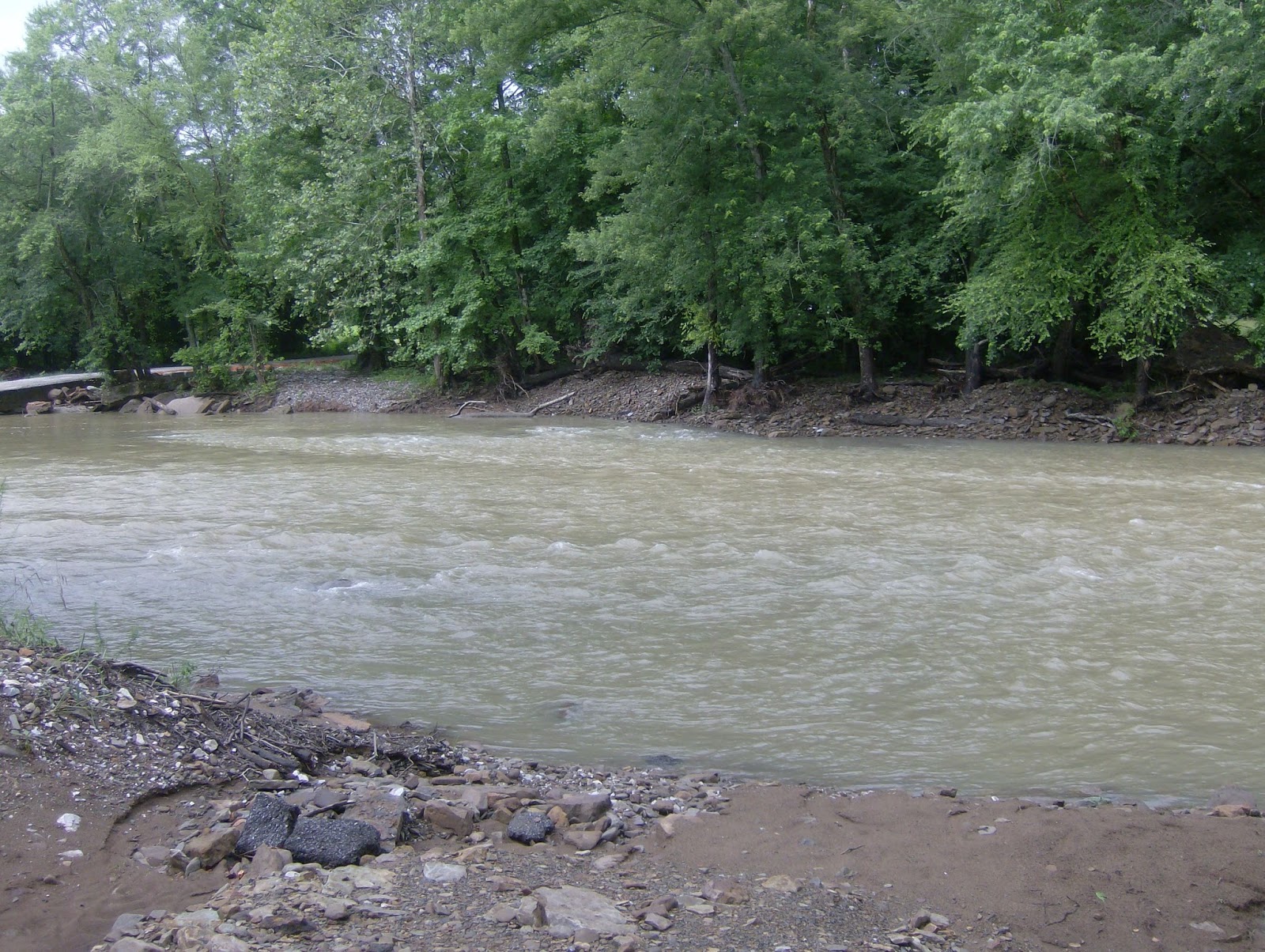
There was only one way to go. On the right side of the highway were a couple of buildings that looked abandoned. On the left was a road. Turning left off the highway, we soon came to a low bridge over a busy creek filled with all the recent rain. After just a moment of hesitation, Tim drove us over the bridge and up the road on the other side.

Scary bridge

Looks like a creek from this side

On this side it looks like a river

My brother is never afraid to ask for directions. We saw a man in a county truck who affirmed we were on the right road for the Patrick Cemetery. We stopped again to ask two men working in a garage who directed us to the edge of a fence just visible down the road. This was the Patrick Cemetery, and soon we saw a stone etched with the name of the cemetery and an arrow directing us to the road on the left. After driving a road beside the fence, we were soon turning into the entrance.

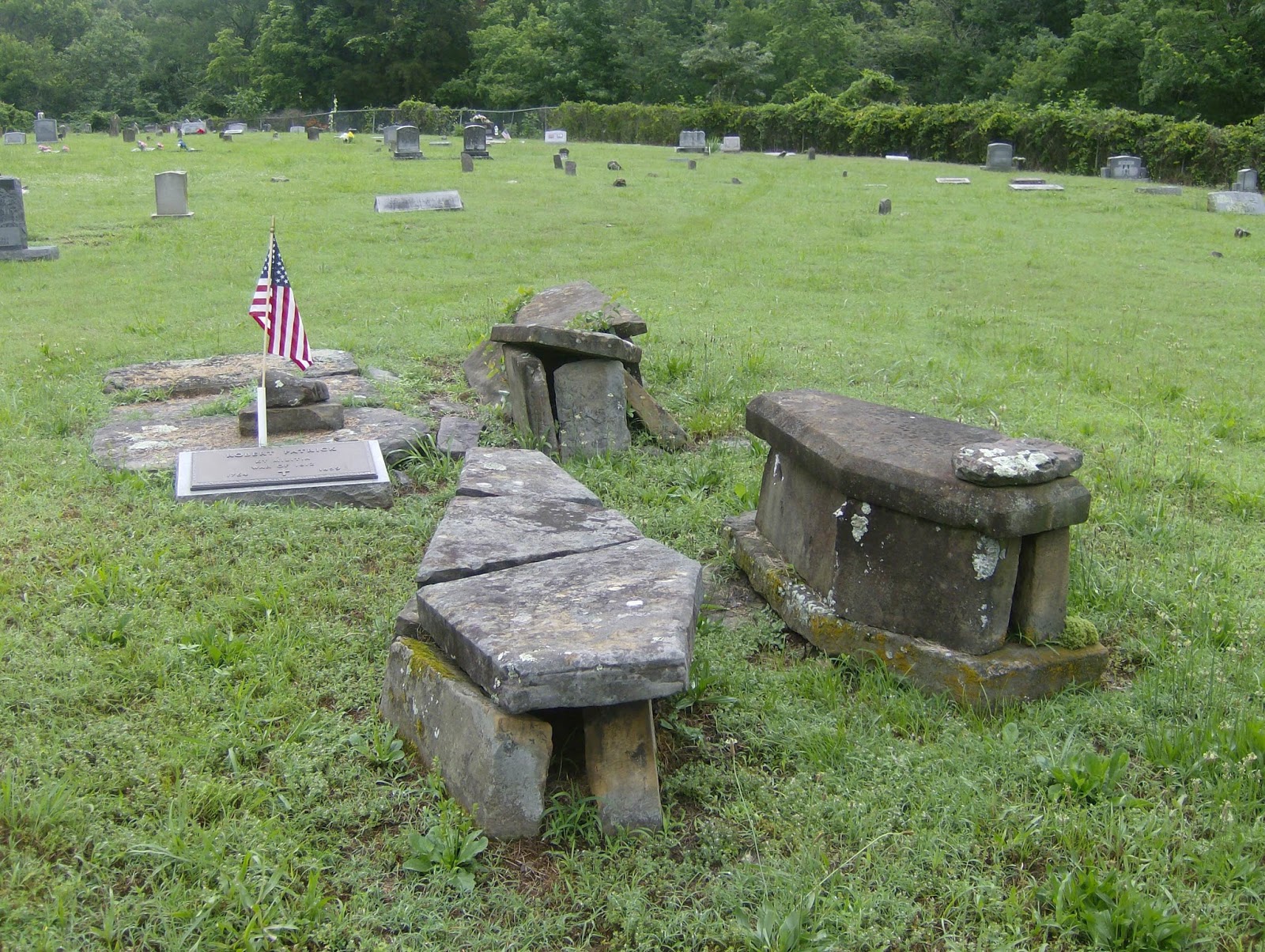
It's a pretty big cemetery. There were lots of Patricks, but we could see that there were a few other surnames that also had a large representation in the cemetery. I was looking for the older part of the cemetery. I had seen a picture of Robert Patrick's brass grave marker, and I knew there were larger stone markers around him. I was really not prepared for two large sarcophagi(?) next to Robert Patrick's grave. (I'm not sure that's what you call monuments of this sort in America, but that's what they looked like.) If you are a descendant also looking for these graves, they are just about in the center of the cemetery.

Robert Patrick grave and sarcophagi

Robert's grave shows his birth and death years (1764-1859) and proclaims him as a veteran of the War of 1812. Both sarcophagi bear the faint trace of the name "Nancy." (One almost looks like it says "Nancy Tackett.") There may have been other information there at one time, but I couldn't see it.

(Note 6/26/15: Nancy Tackett appears to be the daughter of Mary Ann Patrick and her husband, William Mason Tackett. William and Mary Ann had 10 children. A photo on Ancestry.com, taken about 1885, shows 8 of the children. It was noted that one of the sons had died in war and Nancy had also died.)


Robert Patrick
KY Militia
War of 1812
1764-1859

Nancy Tackett?

Nancy Prater Patrick?

So there lie my 4th great-grandfather and my maybe 4th great-grandmother in a quiet cemetery on the edge of a forest in Arkansas. I'm pretty sure my grandmother didn't know they were there. Robert Patrick was dead long before his granddaughter, Nancy Emily Reed Day, came to Oklahoma. Grandma Day was born in 1853, so she was only 6 and living in Kentucky when he died. She had never known him. It took well over 150 years (and the Internet, Ancestry.com, Findagrave, and Mapquest) for our branch of the family to find him again. I just wish he or Nancy could answer a couple of questions for me. Who was Sarah Patrick's mother? Why did you leave her in Kentucky when you moved to Arkansas? (See post "DNA Circles: Robert Patrick and Elizabeth McMullen.")

We left out the back entrance of the cemetery, which probably was the original front entrance.

Patrick Cemetery original entrance?

Here's the funny part of the story. The next part of our trip consisted of finding I-40 and following it into Oklahoma so we could visit our mother's grave in Dustin, OK. While I-40 crosses into Oklahoma at Ft. Smith, far south of our present location, it was easier to go north and catch it in Fayetteville. So we headed north again on Highway 16. Just outside of Elkins there was a huge traffic jam due to road work, so we stopped for breakfast at the McDonald's in Elkins and waited for the traffic to clear. Back on the now-clear Highway 16, we came to the outskirts of Fayetteville and a sign that said to turn left for 16 West. According to our map, this would take us to I-49 South and eventually to I-40.

Let's just say it was a scenic road. We drove and drove and drove through green, few houses in sight. Siri wouldn't help us. She thought we were in Iceland. We saw few road signs, which was very frustrating to my brother, but eventually we saw a sign down the road. It said Durham. Then we saw the sign for Crosses, then the one that said we were passing into Madison County. Again. Somehow we had gone north, turned west, and ended up south of Elkins. Again. When my brother finished fuming, we both began to laugh. Was it a vortex? Our own personal Groundhog Day? A bad map, bad navigator (me)? We'll never know.


Sunday, December 28, 2014

DNA Circles: Robert Patrick and Elizabeth McMullen

Two more of my DNA Circles on Ancestry.com are centered on Robert Patrick and Elizabeth McMullen. Looking at these two ancestors in more depth has led to questions I didn’t know I had.

Robert “Robin” Patrick is my 4th great-grandfather. He was born in Staunton, Virginia, in 1764, and lived in Virginia, North Carolina, and Tennessee before settling in Floyd County, Kentucky. His daughter, Sarah Patrick, born 5 January 1830, married Lewis Reed on 3 May 1849 in Morgan County, Kentucky. Their daughter, Nancy Emily Reed, married James Thomas Day in Magoffin County, Kentucky, in 1876 and moved to Oklahoma before statehood. They were the parents of my great-grandmother, Sarah Florida Day.

For years, without question, I have listed Robert’s wife and my 4th great-grandmother as Elizabeth “Betsy” McMullen. However, in doing more research for this post, I have found that there are facts about the marriage of Robert and Betsy that call into question whether she is my ancestor. In 1819 after the birth of seven children, Hugh, Henry, Hiram, Robert, Nancy, Margaret, and Brice—the latter two were twins born in 1816—Betsy filed for divorce, citing her husband’s adultery and abandonment as causes. According to Betsy, Robert was living with another woman.

Robert was ordered to come before the court but never appeared. One sheriff remarked that he “got sight of the defendant but could not arrest him.” Elizabeth was afraid that Robert would dispose of property with which he could provide her support, and Robert was “restrain(ed)…from removing or consigning his property without the jurisdiction of (the) court.” Apparently, after living with a woman named Nancy Prater Allen for several years, Robert finally married her after Elizabeth’s death in 1830. It has been assumed that all of the children born after Betsy filed for divorce in 1819 are the children of Nancy. In 1838 the couple, along with Robert’s brother James and several other families, left Kentucky for the West. They traveled over 700 miles to the new state of Arkansas, mostly by river raft. Robert was 74. If nothing else, he was a tough old man.

Most of Robert and Nancy’s children—Robert Jr., Wiley, Jemima, Mary Ann, George, and Rhoda--moved with them to Arkansas. And therein lies the problem. Sarah, my ancestor Sarah, didn’t. She married Lewis Reed in Morgan County in 1849. She is listed on the 1850 census in Morgan County with her husband; they are both 20 years of age. She died in Magoffin County in 1892. If she was born in 1830, she should be Nancy’s daughter.

But why would Nancy move to Arkansas and leave an 8-year-old behind in Kentucky? Who did she leave her with? So is Sarah really Betsy’s, as I have shown in my tree all along? Looking at just the evidence of family names, it would appear not. Sarah did not have any daughters named Elizabeth, but she named the daughter who would become my 2nd great-grandmother Nancy Emily. Surely Sarah would not name a daughter after the woman who had caused her father to abandon his family.

No doubt because Robert had so many children—most researchers claim 17 total—I have tons of matches to Patrick descendants. Not only do they show up in my DNA Circles and on the Ancestry DNA site, but also on Family Tree DNA. In all, I have at least 50 matches with Patrick descendants. I think I can confidently say that I am a descendant of Robert Patrick. But from which wife?

Again, the lack of chromosome data on Ancestry hampers my ability to answer this question. In theory I should be able to compare amounts of mutual DNA with my matches and determine if we descend from a full or half relationship. In other words, are we only connected by Robert Patrick, or do we have both of our 4th great-grandparents (Robert and Betsy, or Robert and Nancy) in common?

Putting that question aside for a minute, let’s look at my matches (35 of them!) within the Robert Patrick circle. Within the Robert Patrick circle are descendants that match at least one other person in the circle by DNA and also show Robert Patrick as a descendant in the tree they have submitted to Ancestry.

The trees don’t always match the facts. Some list all of the children with birthdates through 1830 as Elizabeth’s (since she was his known wife during that time period and no date of an actual divorce can be found), even when the submitter’s ancestor is quite probably a child of Nancy’s. Some list all the children born after 1819—the date of the divorce petition—as Nancy’s, even though in the case of Sarah, that doesn’t really make sense. Some even show Elizabeth dying in Arkansas, although that was obviously Nancy.

I have to admit that I had listed Elizabeth as the mother of all the children, because I didn’t know until recently about the existence of the divorce petition. This resulted in my being placed in the Elizabeth McMullen circle, even though she might not be the mother of my Sarah. (By the way, when I changed the mother’s name in my tree to Nancy Prater, my Elizabeth McMullen circle disappeared. Now, even though I have changed the name back to Elizabeth, her circle has not reappeared. Shoot. I wish I hadn’t been so hasty; in comparison to Robert’s circle with 36 members, my Elizabeth circle had only 15 members. I really wish I had compared the names before the circle disappeared.)

Within the Robert Patrick circle are descendants of 5 of the 7 children that Robert had with Elizabeth McMullen: 4 descended from Margaret, 3 from Hugh, 3 from Henry, 3 from Brice, and 2 from Hiram. The remaining members of the circle descend from probable children of Nancy: 8 from Mary Ann, 5 from Jemima, 4 from George, and 1 from Rhoda. I am the only descendant of Sarah in the circle.

Eight members of the circle are DNA matches to me. Three of those are descended from Robert Patrick through his daughter, Jemima, a daughter of Nancy; then I have one each from Margaret, Henry, Hugh, and Hiram (all children of Elizabeth) and one from George, a son of Nancy.

The conclusions I reached about my first two DNA circles—Samuel Wheat and Cynthia Stephenson—also apply here. 1) Exploring these ancestors in more depth is a good exercise and gives a direction to my further research. 2) Lack of tools to manipulate the DNA data and erroneous trees make the DNA Circles a dubious help.

My main question is: Where was Sarah from 1838 to 1849? She wasn’t with her father, and she couldn’t have been with either mother. Nancy was in Arkansas, and Elizabeth was dead. So where was Sarah? Maybe if I can ever determine which of Robert’s wives was her mother, I might be able to find her with relatives of that wife. And then again, maybe not. I could only theorize, since her name doesn’t show up until the 1850 census after she is already married to Lewis Reed.

The Patricks and related families ended up in Madison County, Arkansas, and a little community, still called Patrick, grew up around them. Patrick, Arkansas, where Robert and Nancy are buried, is about two hours from where I live in Oklahoma. Robert Patrick was the grandfather of Grandma Day, my grandmother’s grandmother. I never heard my grandmother mention any relatives in Arkansas, and on some of our family trips we weren’t that far from Robert’s final resting place. Still, it makes me wonder. Grandpa and Grandma Day came to Oklahoma first, and later the Castle family followed. Even if Grandma Day never had any contact again with her grandfather, aunts and uncles in Arkansas, she had to know they were there. Maybe their trek by river 60 years before gave her courage to leave all she knew in Kentucky and move to Oklahoma.

I’m not sure what I think about ol’ Robert. For sure, adultery and abandonment of first wives is nothing new, but I think he treated Elizabeth pretty badly. I guess I have to admire his tenacity—he knew what we wanted and he just hung on until he got it—and his courage in moving west. I think a trip to the cemetery in Patrick is in order.

Photo from www.findagrave.com

Tuesday, March 5, 2013

Castle In-Laws and Their In-Laws


Before I leave the Castles, I would like to summarize what I know about their in-laws, the Days, and their in-laws, the Reeds, Oneys, Patricks, Lewises, etc. 

My great-grandmother, Sarah Florida Day, was the daughter of James Thomas Day and his wife, Nancy Emily Reed.  She was born in White Oak, Magoffin County, Kentucky, and a couple of generations of family members are buried there. The counties of Morgan and Magoffin border each other, and in fact, if you just keep driving out of West Liberty on Hwy. 460, you will reach White Oak in about 10 minutes.

The parents of James Thomas Day were Andrew Jackson Day (1836-1921) and Sarah Oney (1840-1862).  They were married on 25 September 1855 in Morgan County. The marriage registration shows that “Jackson” Day, age 19, lived in Caney, Morgan County, and was born there. Sarah “Owney” was born in Tazewell County, Virginia, and was living in White Oak at the time of her marriage at age 15.  Sarah died in 1862, and Andrew J. Day remarried to Catherine (Jane) Reed. 

Marriage record of Jackson Day & Sarah Oney

Andrew Jackson Day & 2nd wife

Sarah Oney’s parents were William Oney and Susanna Coburn who were both born about 1807 in Kentucky. (Correction: Not true. Sarah's parents were Rhoda Day and James Oney, who were first cousins. James Oney's father was probably William Oney from Tazewell, Virginia. See post "The Oneys and a Couple of Great Stories") They were still living and listed on the 1870 census in Floyd County. Most researchers on ancestry.com list William’s father as Benjamin Oney with a trail leading back to Tazewell County, Virginia. William’s death record on 9 Mar 1878 lists his father as Samuel Oney from Pike County. That’s a question to be answered on another day.

William Oney, died 9 March 1878, father Samuel Oney 


Andrew Jackson Day’s father was Thomas P. Day. He was born in 1804 in Virginia and died before 1880 in Kentucky. On the 1840 census he is in Tazewell County, Virginia; on the 1850 and 1860 he is in Morgan County; and on the 1870 he is in Magoffin County.  His wife was Margaret “Nancy” McGrady, who was born in 1812 in Grayson County, Virginia.

Thomas’s father was Joseph Day who married Rhoda Cock, daughter of Andrew Cock, on 10 August 1796.  Rhoda died 16 August 1827 at age 49, after having given birth to at least 10 children.  Joseph remarried to Rebecca Dunn in 1830, and his second wife had 7 children!  At the age of 80, just a few months before his death, he wrote his will and listed his youngest son as age 8.  Joseph lived in Grayson and Carroll counties in Virginia.  Joseph and Rhoda are both buried in Carroll County, VA.


Nancy Emily Reed’s parents were Lewis Reed and Sarah Patrick. They married 3 May 1849 and were living in Morgan County at the time of the 1850 census. On the 1860, 1870, and 1880 censuses they are living in Magoffin County in Salyersville and Johnsons Fork. Lewis died on 9 December 1895 in Elsie, Magoffin County.  Sarah Patrick, daughter of Robert Patrick and Elizabeth McMullen, was born 5 January 1830 and died 15 March 1892 in Elsie. Robert Patrick was from Staunton, Augusta County, Virginia.  He was born in 1779 and died in 1859 in Madison County, Arkansas.  His headstone reads “KY Militia, War of 1812.”  His parents were Hugh Patrick and Susanna Harris.

Patrick Cemetery, Madison County, Arkansas
The parents of Lewis Reed were Daniel Reed and Martha “Patsy” Lewis.  Daniel was born 3 April 1806 in Virginia.  Daniel and Patsy were enumerated on the 1830-1870 censuses in either Morgan or Magoffin counties. They were living near the mouth of Cow Creek when Daniel died on 8 February 1878. Patsy died on 18 April 1880 in Magoffin County of pneumonia.   

Patsy’s father was John Lewis. He was born in North Carolina in 1782 but was living in Kentucky by 1820 and in Morgan County by 1830. His parents were James Lewis and Winnie Henson.  According to Lewis family researchers, James came from Wales to America with his father Nathaniel in 1740. They settled first in Virginia. James died in 1825 at Cutshin Creek, Perry County, Kentucky, and is buried in the J.C. Lewis Cemetery in Wooton.  He served in the North Carolina Militia during the Revolutionary War. There is a sign in the cemetery listing his children and commemorating his service. 


Saturday, February 23, 2013

Grandpa and Grandma Day


Now seems a good time to talk about my other set of great-great-grandparents on the Castle side of my family: Grandpa and Grandma Day.  I feel like I know them even better than my Castle great-great-grandparents--even though they were gone long before I was born--because they lived and died in Oklahoma. I have photographs of them; I’ve been to the places where they lived. 

My great-grandmother Sarah Florida Day’s parents were James Thomas--sometimes called “Jim Tom” or J.T.--Day and Nancy Emily Reed. James was born 1 December 1856 in Morgan County, Kentucky, son of Andrew Jackson Day and Sarah Jane Oney.  Nancy Emily Reed, daughter of Lewis Reed and Sarah Patrick, was born 26 September 1853 (according to her headstone.) They married on 13 April 1876 in Salyersville, Magoffin County. Their marriage license says that they were married in the home of Nancy’s father, Lewis Reed.


On the 1880 and 1900 censuses they were living in Johnson Fork, Magoffin County. The 1880 census says that Nancy Emily was born in January 1858.  (I can see fudging on the year a little since her other birth date makes her 3 years older than her husband, but changing the whole month?) By 1894 they had had all their children—seven girls! and one little boy, Cassa, who died at age 4. Kelly Day, age 3, listed as a son on the 1900 census, was really their grandson.

Sometime in early 1907 or before, they moved to Indian Territory, and settled near the town of Davenport in Lincoln County. 


They brought all the girls to live with them in Oklahoma: Ida, Zedda, Emma, Margaret, Minta, Retta Lee, and Florida who came with her husband, George Castle.  On the 1920 census James T. and Nancy were living on S. Olympia Avenue in Tulsa. In 1930 the Days were living in Claremore where they ran a boarding house for visitors who came to Claremore to take mineral water baths.


The house in Claremore in which the Days lived in the 1930s
Photo taken in the early 1980s

On their golden wedding anniversary the Days were written up in the Tulsa World.  You get the impression of a devoted couple, loving to each other and generous to others.


According to my grandmother, Grandma Day sometimes let her generosity get the better of her common sense.  “She would invite everybody at church over for Sunday dinner but she wouldn’t have wrung the chicken’s neck yet!” Grandpa Day was dearly beloved by his wife, his daughters, and his grandchildren.


Ida, Florida, Zedda, Emma, Margaret, Minta, Retta Lee
Grandma and Grandpa Castle

J.T. Day died in 1931 and Nancy in 1938.  They are buried in Davenport, Oklahoma, within sight of land that still belongs to Day descendants. Last summer I met some Day cousins at the Senior Citizen Center in Davenport, where we ate ham and beans with cornbread and homegrown sliced tomatoes, told family stories, traded photographs, then visited the cemetery together. We had never met but we came together to remember James Thomas and Nancy Emily Day.